Milken Institute Series on Financial Innovation and Economic Growth – serie
Visar alla böcker i serien Milken Institute Series on Financial Innovation and Economic Growth. Handla med fri frakt och snabb leverans.
13 produkter
13 produkter
1 637 kr
Skickas inom 10-15 vardagar
The Development of Effective Securities Markets Gary Schinasi International Monetary Fund One of the more important lessons of the crisis of the 1990s—^not just the Asian Crisis—is that the performance and structure of a country's financial system is an important fundamental factor for assessing that coimtry's overall economic performance and prospects, and as a destination for investment and asset returns. Market participants that are presently managing international portfolios now understand this very well. And as we all know, many countries are making strong efforts to reform their financial infrastructures, and move their financial systems more in the direction of a market-intermediated financial system and away from an exclusively bank-intermediated system. These reform efforts are putting in place some of the important infrastructure elements that are necessary for developing effective securities markets. However, emphasis should be placed on the word necessary: as many of these measures, and all of them taken together, are only necessary and not sufficient for estabUshing effective security markets.
1 094 kr
Skickas inom 10-15 vardagar
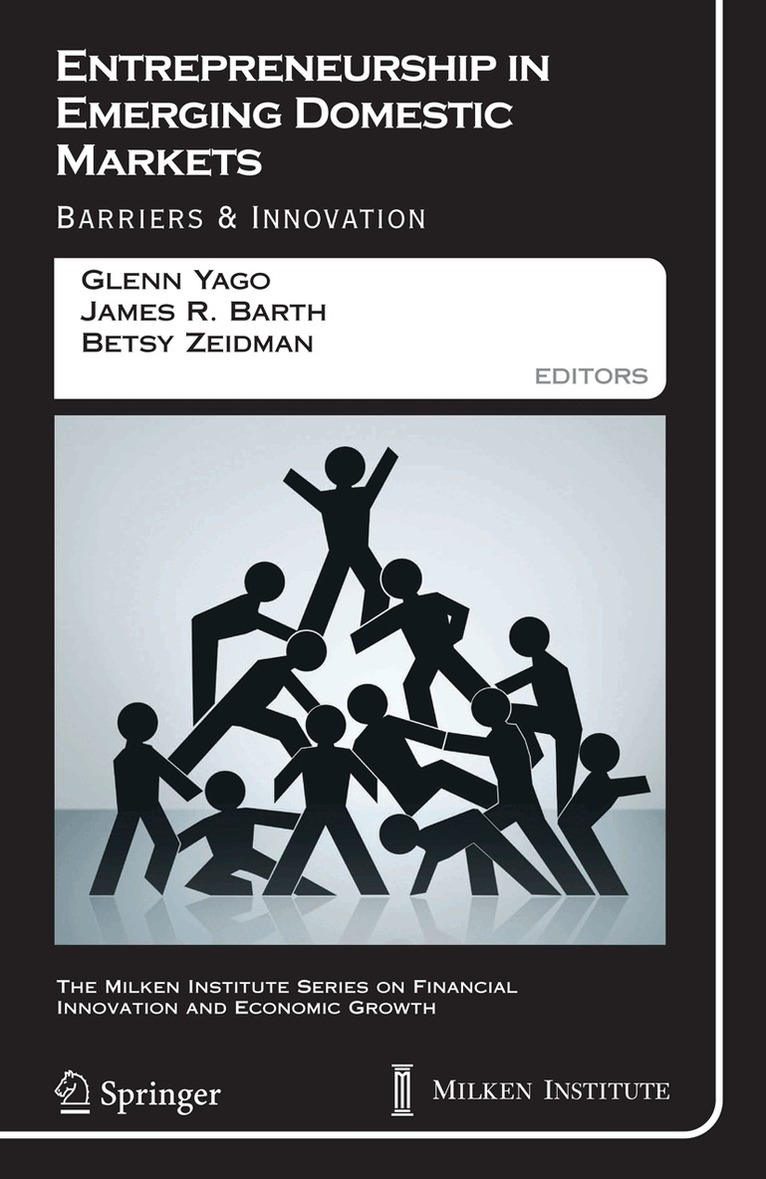
An often-overlooked aspect of entrepreneurship in American is its role in emerging domestic markets (EDM). These markets – low-to-moderate income communities, ethnic- and women-owned businesses, urban areas – are frequently ignored by mainstream markets. Yet with current demographic trends, they are an increasingly large component of the US population. Entrepreneurship can serve as a means to foster business development in these emerging communities and as a critically important way to improve the standard of living in low- and moderate-income (LMI) sectors.Increasingly, policy makers, advocates and investors understand national economic growth demands business formation among all segments of the market, and that the best attack on poverty is job and wealth creation. A robust entrepreneurial climate helps address the challenges and harness the opportunities.“Entrepreneurship in Emerging Domestic Markets: Barriers and Innovation” is a compendium of papers written by the leading researchers and practitioners from the fields of finance, public policy, entrepreneurship, and economics. With this volume, the editors aim to provide scholars, students, investors, policymakers, and the business community a resource that explores the issues surrounding entrepreneurship in EDM communities.
1 094 kr
Skickas inom 10-15 vardagar
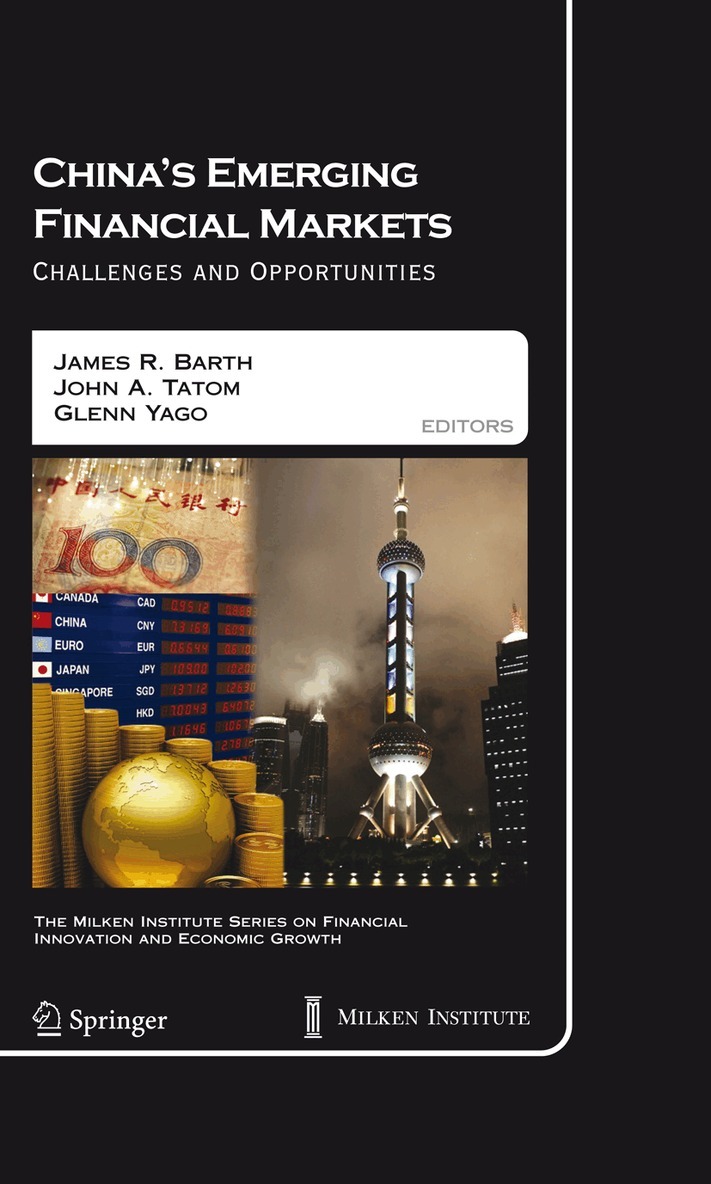
China’s emerging financial markets reflect the usual contrast between the country’s measured approach toward policy, regulatory, and market reform, and the dynamic pace of rapid economic growth and development. But they also offer unusual challenges and opportunities. In the past five years, the pace of opening and reform has accelerated sharply. Recapitalization and partial privatization of the largest banks, and the allowance of some joint venture and branch operations for foreign financial institutions, are making rapid headway in developing and expanding financial services and improving access to domestic business and households. This book provides the most extensive look available at the evolving Chinese financial system. It begins with alternative perspectives on the evolution of the financial system and the broad outlines of its prospects and potential contribution to economic growth. Three articles review broad aspects of the financial system. Franklin Allen, Jun ‘‘QJ’’ Qian, Meijun Qian, and Mengxin Zhao lead off with overviews of the banking system and performance of the equity market and other institutions.
2 180 kr
Skickas inom 10-15 vardagar
Policy makers around the globe should find that this text offers a cogent assessment of the contemporary regulatory environment in the US financial markets, and a blueprint for action in evolving global financial markets. Financial markets are among the most highly-regulated markets in the world. Nevertheless, financial crises still occur, witness the US savings-and-loan fiasco of the late 1980s and early 1990s, and the Mexican and East Asian Financial implosions of 1994 and 1997. What role does regulation play in stabilizing-or-destabilizing financial markets? "Restructuring Regulation and Financial Institutions" answers this question with incisive analysis of financial market regulation in the US. Each paper considers how regulation enhances or impedes the efficiency of a particular financial sector, and is followed by comments by two or three noted experts. The result of this approach is a wealth of useful information that may be applied by policy makers contemplating the restructuring of regulations and financial institutions.The contributors to this volume are distinguished economists, many of whom have careers not just in business, government, or academia, but have held influential positions in all three. Such varied backgrounds enable the contributors to offer remarkable insights based on the best of theory and practice. Never before has understanding the workings of U.S. financial market regulation been so important to the development of world financial markets. The ramifications of financial regulation in the United States extend far beyond the nation's borders. World financial markets are undergoing dramatic change, driven by the rapid development and deployment of new technology that enables information - and money - to travel farther, faster. However, a Byzantine array of regulatory structures in the international arena hinder the development of efficient global financial markets. Policy makers around the world are attempting to address the issues by emulating the financial markets of the US.
Del 2 - Milken Institute Series on Financial Innovation and Economic Growth
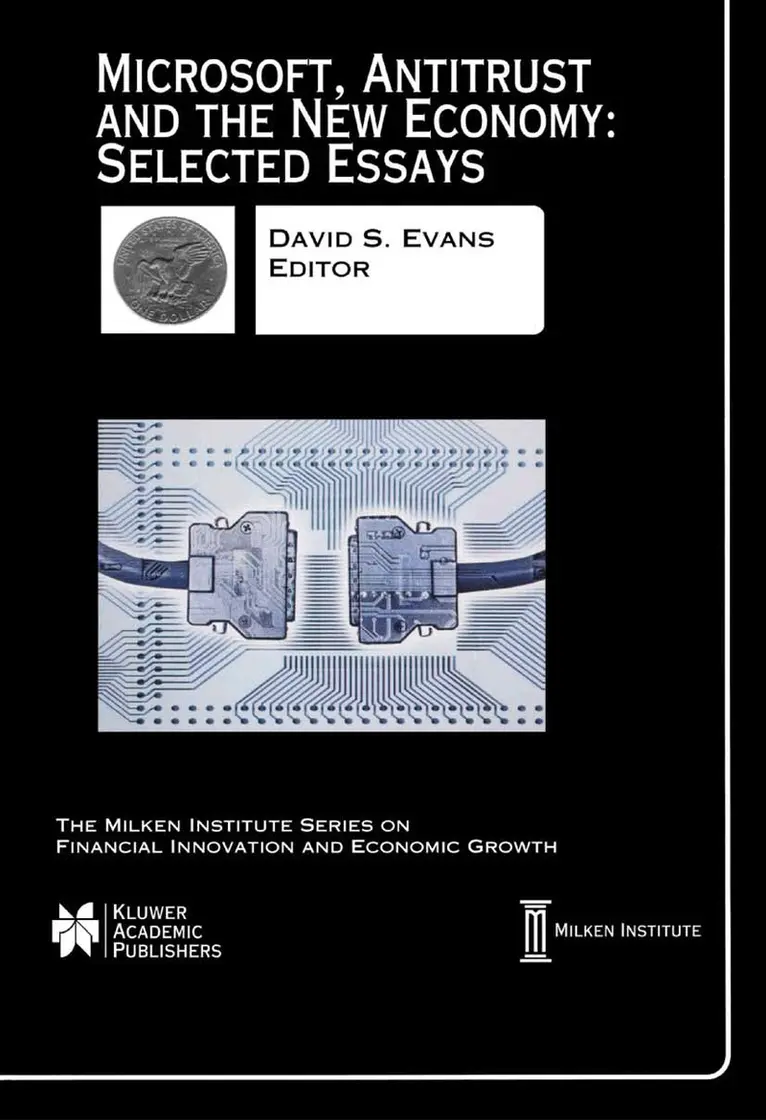
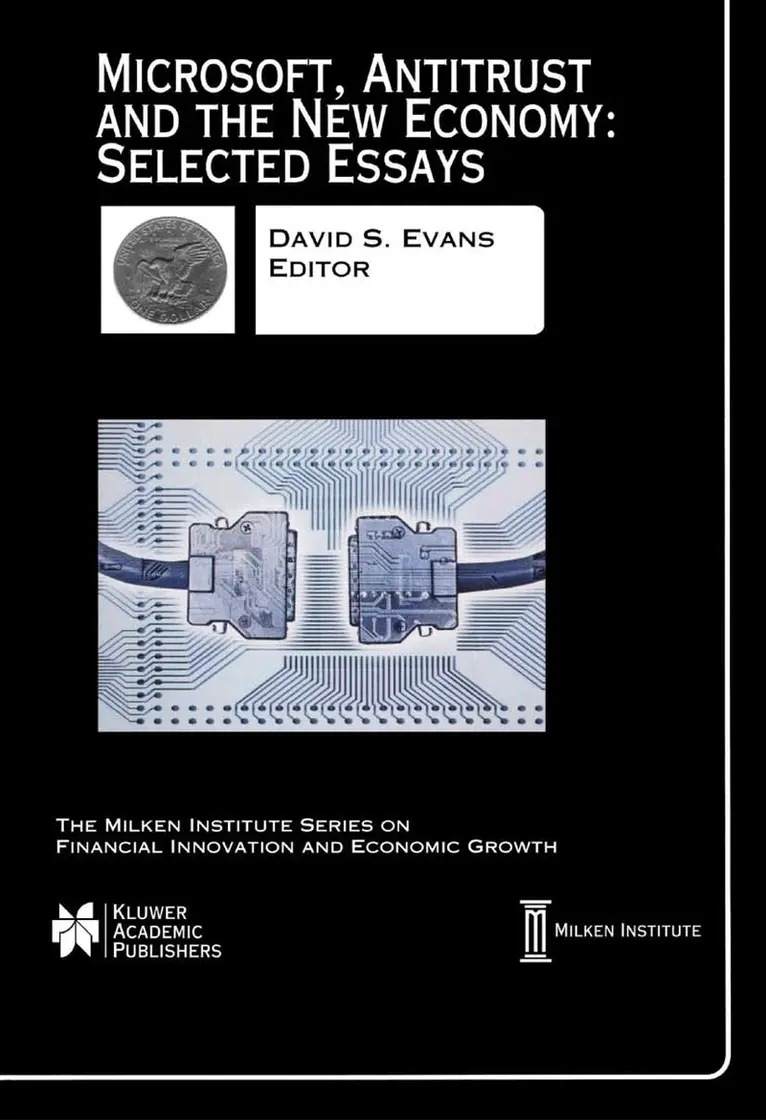
Microsoft, Antitrust and the New Economy: Selected Essays
Inbunden, Engelska, 2002
1 637 kr
Skickas inom 10-15 vardagar
No antitrust case in contemporary history has attracted as much public attention as US versus Microsoft Corporation. Nor has any antitrust case in memory raised as many complex, substantive issues of law, economics and public policy. This selection of essays constitutes an effort to analyze some of the central issues and to put the case in the context of the ongoing debate over the role of government in managing markets - especially in technology driven new economy industries. All of these essays, it should be noted, are written by critics of the government's efforts to regulate Microsoft. Indeed, many are by individuals who were closely involved in the company's legal defense and served as consultants to Microsoft. But their work should be judged on the merits rather than their provenance. For all represent serious scholarship by researchers committed to advancing the debate over government regulatory policies.
Del 3 - Milken Institute Series on Financial Innovation and Economic Growth
Mergers and Efficiency
Changes Across Time
Inbunden, Engelska, 2002
1 637 kr
Skickas inom 10-15 vardagar
This text focuses on one aspect of the corporate finance revolution that restructured corporate America and led to the longest expansion in US history - changes in rates of merger efficiency. Demystifying this most controversial and dynamic period of US economic history is key to understanding the business, financial and economic innovations that defined the last two decades of the 20th century. In addition, it is important to create a careful empirical understanding of the conditions under which merger activity increased or decreased firm efficiency, industrial productivity, and overall improvements in aggregate output and economic performance. The first chapter examines the aggregate data set by modeling the determinants of the risk of takeover. Next, the author takes a closer look at possible heterogeneity among targets in takeovers. The second chapter analyzes the categories previously discussed in the literature, such as target resistance and management dismissals. Finally, the author examines what, if any, efficiency improvements were realized after the takeover.The third and final chapter examines the ex-post performance of combined firms using fixed effects panel data models. These models have the advantage over the univariate methodologies or regressions used in earlier studies of being able to control for the prior performance of the firm.
2 180 kr
Skickas inom 10-15 vardagar
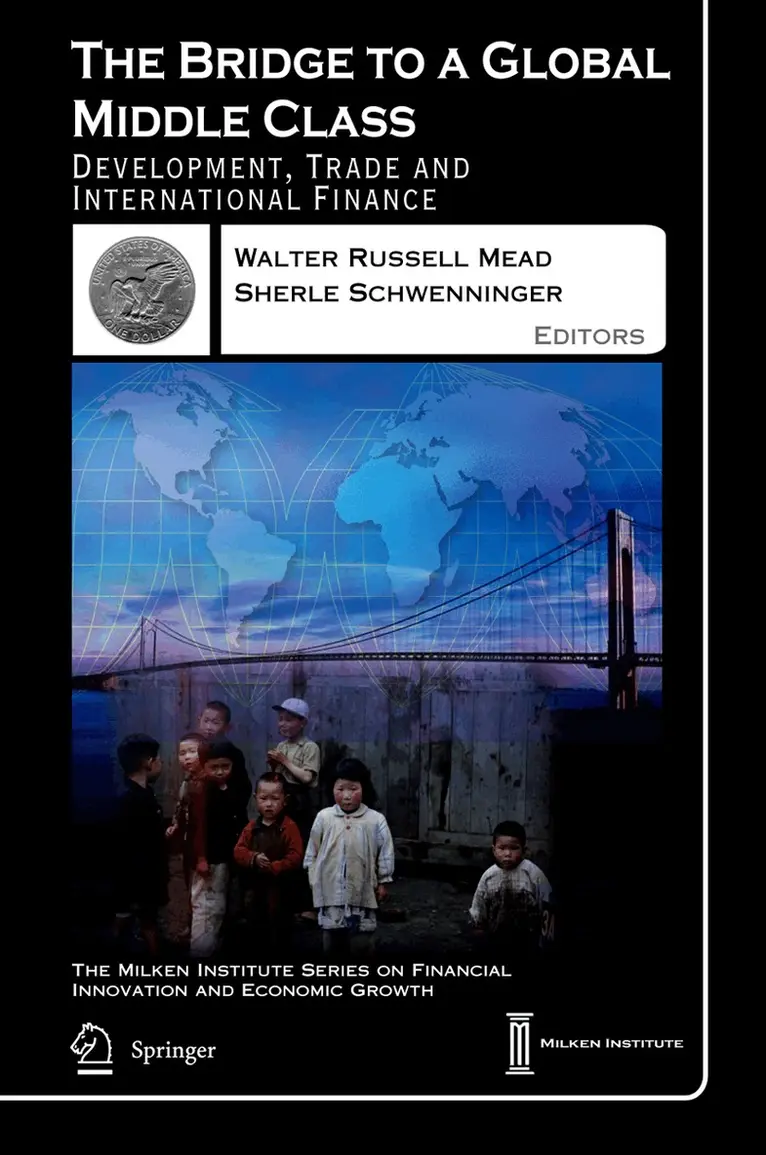
The compilation of a unique series of papers originally commissioned by the Council on Foreign Relations in the wake of the financial crises of 1997-1998. This retrospective culls the views of economists, international financial institutions, Wall Street, organized labour and varying public-interest organizations on the issue of how to fortify our global financial infrastructure. Their effort is the culmination of an 18-month study - The Project on Development, Trade, and International Finance - that seeks to encourage the evolution of middle-class oriented economic development in emerging market countries. In addressing the world economic problems that led to the crises and examining methods to improve the workings of the world's financial markets, they offer ideas and policy recommendations, and suggest the concrete forms these might take, in the drive to steer the world economy toward strategies that offer the developing world an improved standard of living. These papers make a case for middle-class-oriented economic development as the key to global prosperity and stability.US and international policy-makers should find these discussions valuable in forming new policy and providing the appropriate stimulus for economic development in emerging economies.
1 637 kr
Skickas inom 10-15 vardagar
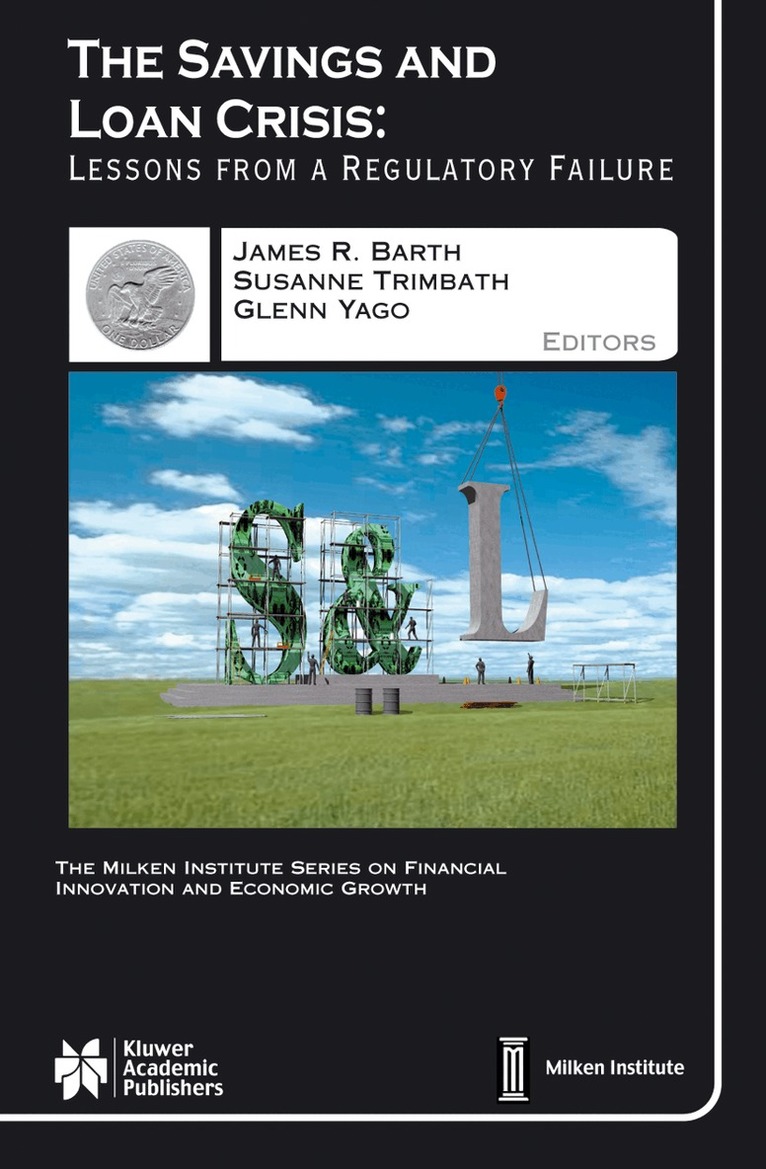
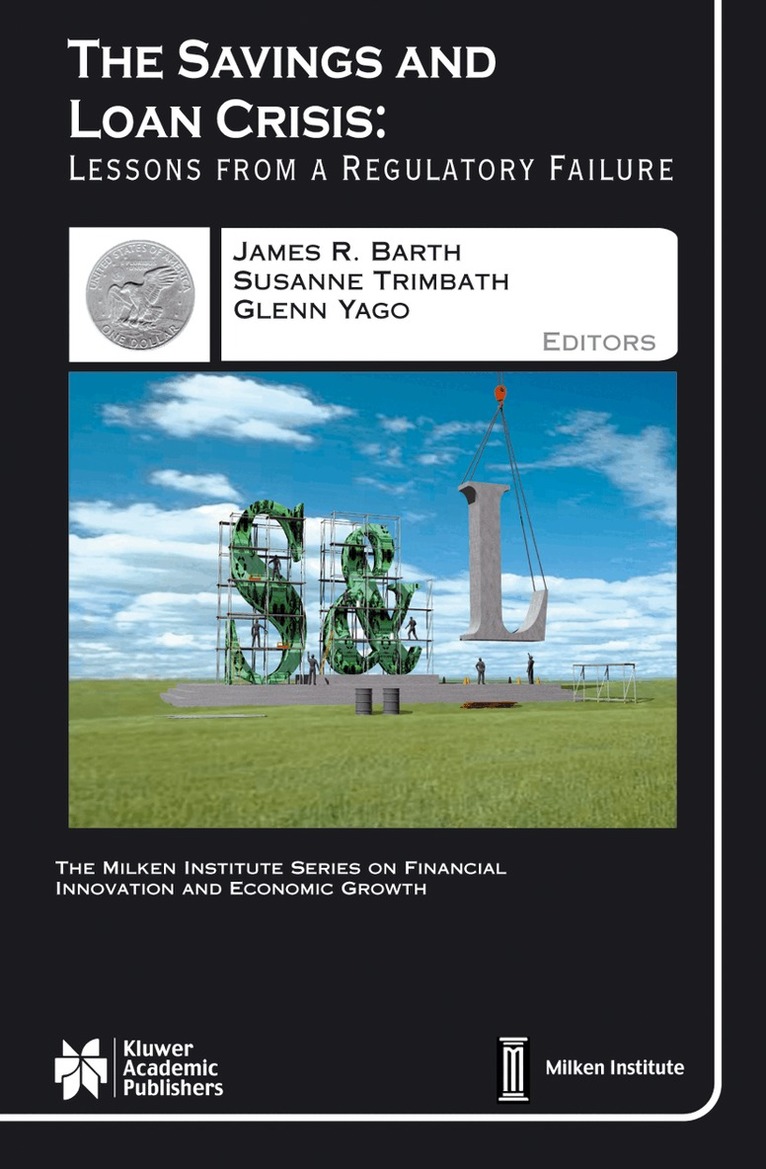
Our nation's financial institutions operated profitably over the decades despite periods of severe turmoil. Between 1980 and early 1995, however, 1,273 savings and loan associations, 1,569 commercial and savings banks and 2,330 credit unions failed in the U.S. The cost of resolving this crisis in the banking sector exceeded USD 190 billion. The Savings And Loan Crisis: Lessons from a Regulatory Failure sets the record straight about what actually happened to our banking institutions in the 1980s. As is documented by the highly respected and diverse group of former regulators, scholars and practitioners contributing to this book, the collapse of this industry was caused by a confluence of adverse economic conditions and misguided regulatory decisions. Poorly designed deposit insurance, faulty supervision, and restrictions on investments prevented savings and loans from adapting to a changing financial marketplace. Unable to use financial innovations, savings and loans could not hedge interest rate and credit risks. These factors blocked portfolio diversification and lay at the root of the crisis.The savings and loan crisis was an accident, but it was an avoidable one. Most of the factors responsible for causing and exacerbating the industry's problems were preventable, as is made clear in this volume. This book also provides an insider's view of the transformation of the financial services industry in the United States since the 1980s: how the managers and owners make decisions about product offerings and investments; how the regulators monitor performance and enforce the rules; and how Congress and the Administration influence and are influenced by the financial services industry. Lastly, it focuses attention on the lessons that should have been learned from this difficult period in the history of U.S. banking, and that should help prevent future banking crises everywhere.
1 637 kr
Skickas inom 10-15 vardagar
The Development of Effective Securities Markets Gary Schinasi International Monetary Fund One of the more important lessons of the crisis of the 1990s—^not just the Asian Crisis—is that the performance and structure of a country's financial system is an important fundamental factor for assessing that coimtry's overall economic performance and prospects, and as a destination for investment and asset returns. Market participants that are presently managing international portfolios now understand this very well. And as we all know, many countries are making strong efforts to reform their financial infrastructures, and move their financial systems more in the direction of a market-intermediated financial system and away from an exclusively bank-intermediated system. These reform efforts are putting in place some of the important infrastructure elements that are necessary for developing effective securities markets. However, emphasis should be placed on the word necessary: as many of these measures, and all of them taken together, are only necessary and not sufficient for estabUshing effective security markets.
Del 7 - Milken Institute Series on Financial Innovation and Economic Growth
Entrepreneurship in Emerging Domestic Markets
Barriers and Innovation
Häftad, Engelska, 2010
1 167 kr
Skickas inom 10-15 vardagar
This book will be the most up-to-date compilation of different perspectives on entrepreneurship. The authors are highly respected in the field, either as scholars or practitioners and have interacted before on this topic either as co-authors on papers or as conference discussants The research provides historical information as well as the latest data on entrepreneurship The book focuses on "emerging domestic markets" which encompasses minorities, women, and low-income communities
1 528 kr
Skickas inom 10-15 vardagar
China’s emerging financial markets reflect the usual contrast between the country’s measured approach toward policy, regulatory, and market reform, and the dynamic pace of rapid economic growth and development. But they also offer unusual challenges and opportunities. In the past five years, the pace of opening and reform has accelerated sharply. Recapitalization and partial privatization of the largest banks, and the allowance of some joint venture and branch operations for foreign financial institutions, are making rapid headway in developing and expanding financial services and improving access to domestic business and households. This book provides the most extensive look available at the evolving Chinese financial system. It begins with alternative perspectives on the evolution of the financial system and the broad outlines of its prospects and potential contribution to economic growth. Three articles review broad aspects of the financial system. Franklin Allen, Jun ‘‘QJ’’ Qian, Meijun Qian, and Mengxin Zhao lead off with overviews of the banking system and performance of the equity market and other institutions.
1 637 kr
Skickas inom 10-15 vardagar
No antitrust case in recent history has attracted as much public attention as U.S v. Microsoft Corp. Nor has any antitrust case in memory raised as many complex, substantive issues of law, economics and public policy. Microsoft, Antitrust and the New Economy: Selected Essays constitutes an early effort to analyze some of the central issues and to put the case in the context of the ongoing debate over the role of government in managing markets - especially in technology driven New Economy industries. All of these essays, it should be noted, are written by critics of the government's efforts to regulate Microsoft. Indeed, many are by individuals who were closely involved in the company's legal defense and served as consultants to Microsoft. But their work should be judged on the merits rather than their provenance. For all represent serious scholarship by researchers committed to advancing the debate over government regulatory policies.
1 637 kr
Skickas inom 10-15 vardagar
Robert L. Bartley Editor Emeritus, The Wall Street Journal As this collection of essays is published, markets, regulators and society generally are sorting through the wreckage of the collapse in tech stocks at the turn of the millennium. All the more reason for an exhaustive look at our last “bubble,” if that is what we choose to call them. We haven’t had time to digest the lesson of the tech stocks and the recession that started in March 2001. After a decade, though, we’re ready to understand the savings and loan “bubble” that popped in 1989, preceding the recession that started in July 1990. For more than a half-century, we can now see clearly enough, the savings and loans were an accident waiting to happen. The best insurance for financial institutions is diversification, but the savings and loans were concentrated solely in residential financing. What’s more, they were in the business of borrowing short and lending long, accepting deposits that could be withdrawn quickly and making 20-year loans. They were further protected by Regulation Q, allowing them to pay a bit more for savings deposits than commercial banks were allowed to. In normal times, they could ride the yield curve, booking profits because long-term interest rates are generally higher than short-term ones. This world was recorded in Jimmy Stewart’s 1946 film, It’s a Wonderful Life.