Perspectives on Justice and Morality - Böcker
Visar alla böcker i serien Perspectives on Justice and Morality. Handla med fri frakt och snabb leverans.
5 produkter
5 produkter
872 kr
Skickas inom 5-8 vardagar
Unequal Foundations offers readers a novel theory and a unique use of cross-cultural data to assert that the level of economic inequality in a society is reflected in the emotional experience of its members. People living in societies with more equality (countries such as Japan, Germany, and Canada) generally experience more positive, binding emotions on a regular basis. On the other hand, those living in unequal societies (the United States and China, for example) are significantly more likely to regularly experience negative, sanctioning moral emotions. In this book, authors Steven Hitlin and Sarah K. Harkness explore the idea that morality operates at both the societal and individual levels, and contend that individual moral emotions represent the distal structure of society.In addition to developing this broad theory ranging from society to the individual, Hitlin and Harkness offer their readers a novel use of data from a tool drawn from the affect control theory tradition in order to demonstrate empirical support for this theory. As such, the authors delve deeper than previous literature by presenting data that supports their general approach using a method designed for cross-cultural comparative research.
872 kr
Skickas inom 5-8 vardagar
Punishment of offenders is one of the most universal features of human behavior. Throughout history, ranging across a multitude of cultures including the ancient hunter-gatherers to our contemporary courts of law, it is extraordinarily common for people to punish offenders within their groups. By the same token, it's important to understand that punishment is not only restricted to criminal offenders, but actually emerges within all spheres of our social life, including: corporations, our public institutions, in traffic, during sports matches, in our schools, and more. Punishment strongly influences what we think, how we feel, and what we do.The Moral Punishment Instinct asserts that people possess this exact instinct within themselves: a hard-wired tendency to aggress against those who violate the norms of their group. We have evolved this instinct because of its power to control our behavior by curbing selfishness and free-riding, thereby providing incentives to stimulate the mutual cooperation that our ancient ancestors needed in order to survive the challenging natural environments.In this book, Jan-Willem van Prooijen methodically describes how punishment originates from moral emotions, stimulates cooperation, and shapes the social life of human beings. Guided by a host of recognizable and relatable examples, this book illuminates how the moral punishment instinct manifests itself among a variety of modern human cultures, children, the hunter-gatherer tribes, and even non-human animals--all while accounting for the role of this instinct in religion, war, racial bias, restorative justice, gossip, torture, and radical terrorism.
Why People Radicalize
How Unfairness Judgments are Used to Fuel Radical Beliefs, Extremist Behaviors, and Terrorism
Inbunden, Engelska, 2018
869 kr
Skickas inom 5-8 vardagar
In Why People Radicalize, Kees van den Bos argues that if we want to truly understand radicalization and prevent, attenuate, and fight violent extremism and terrorism, we must pay attention to what is driving the radicalization process. This implies that we should systematically analyze how radicalizing persons interpret the world. For example, perceptions that certain situations are fundamentally unfair and hence need to be changed are among the core issues that drive Muslim, right-wing, and left-wing radicalization. Furthermore, experiences and perceptions of unfairness and injustice can tempt those who struggle with self-control to break the law and engage in violent extremist and terrorist behavior. Why People Radicalize is among the first attempts to provide a systematic, integrative, and in-depth analysis of the psychology of unfairness judgments and the ways these judgments impact on various radicalization processes. Discussing several conceptual and practical implications that follow from this line of reasoning, the book emphasizes the role of careful scientific thought and the notion of taking individuals seriously, as judgments of unfairness are not merely perceptions. They feel genuine to the persons forming the judgments. This volume discusses in detail how these radicalization processes can develop and what components are of pivotal relevance in these processes. Accessible for scientists, professionals, and practitioners, the book explains how uncertainty and insufficient self-corrections influence this process. Finally, the book delineates future research issues on radicalization, extremism, and terrorism and applies the analysis to appropriate legal contexts, making the book relevant for policy and decision makers, among others.
Socializing Justice
The Role of Formal, Non-Formal, and Family Education Spheres
Inbunden, Engelska, 2022
845 kr
Skickas inom 5-8 vardagar
This book offers a comprehensive view of the numerous roles of justice in three education spheres--public and globalized schools, nonformal education, and the family. It develops a heuristic framework for taking account of issues related to distributive justice in the everyday lives of children and young people and to the pillars of justice in various socialization settings, also examining justice research as it intersects with sociology of education, social psychology, and political philosophy. It relies on the quantitative and ethnographic methodological traditions in these fields to identify controversies and illustrate how the forms of justice underlying educational spheres are universal yet sensitive to sociocultural variation.Socializing Justice is a thoughtful investigation into justice theory and research in schools, nonformal education systems, family units and the roles each play in developing social ideals in democratic societies.
824 kr
Skickas inom 5-8 vardagar
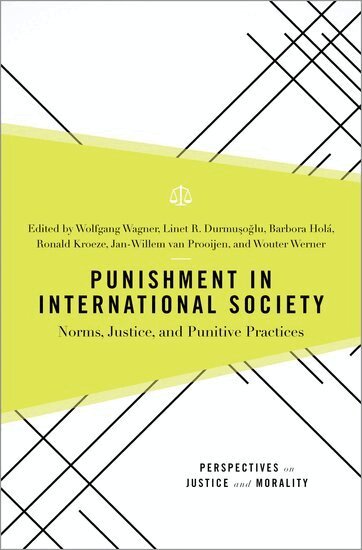
Punitive practices are highly revealing of a society's social fabric, its normative order, and power structure. Punishment in International Society examines the penal philosophies and practices in international society. The contributions to this book show the added value of a punitive lens to international politics in two major ways: First, punitive practices reveal the contours of the international normative order, its structures, and hierarchies. Such a perspective highlights the prominent position of individuals in the current normative order, but it also reveals a major divergence in the international normative order between a global North that emphasizes individualized, retributive punishment for atrocity crimes and a global South that puts reparations for past colonial wrongs on the agenda. Second, in contrast to a nation-state, the authority to sanction and act in defense of the normative order is far more dispersed and contested in international society. Although there is a demand to embed punitive practices in procedures and institutions, the most legitimate site of such authority remains contested as regional organizations such as the African Union compete with the United Nations for the authority to defend the normative order. This book brings together an international roster of scholars from the social sciences, law, and humanities. The contributions demonstrate that punitive practices have been more prevalent than commonly acknowledged as they have often been masked as (self-)defence, reparations, or coercive diplomacy. By approaching international punishment from various disciplines, this volume sheds new light on different dimensions of the punitive practices across the globe.