Plant Systematics and Evolution - Supplementa - Böcker
Visar alla böcker i serien Plant Systematics and Evolution - Supplementa. Handla med fri frakt och snabb leverans.
12 produkter
12 produkter
Del 1 - Plant Systematics and Evolution - Supplementa
Flowering Plants
Evolution and Classification of Higher Categories Symposium, Hamburg, September 8–12, 1976
Häftad, Engelska, 1977
536 kr
Skickas inom 10-15 vardagar
The original suggestion to organize a symposium about the classi fication and evolution of the Flowering Plants was made at, the International Botanical Congress at Leningrad in 1975, and the idea was so well accepted by several colleagues that plans for such a symposium quickly took shape. An organizing committee consisting of Professor H. MERXMULLER, Miinchen, Professor V. H. HEYWOOD, Reading, and Professor K. KUBITZKI, Hamburg, was set up. The conference took place on 7-12 September 197tl in the Institut fiir Allgemeine Botanik of the University of Hamburg under the auspices of the International Association for Plant Taxonomy and was at tended by 80 participants from 14 countries. There have been several meetings in recent years which have dealt with the origin and evolution of the Flowering Plants so that it might be questioned whether yet another symposium dealing with more or less the same subject were really "justified. As the reader will see from the contents of the book, this symposium differed from similar ones held recently in two respects: 1. Emphasis was given to methodological aspects of the classification of higher taxa, and 2. much classificatory and evolutionary evidence relating to the higher taxa of Flowering Plants was presented.
Del 6 - Plant Systematics and Evolution - Supplementa
Secondary Pollen Presentation
Form, Function and Evolution
Inbunden, Engelska, 1993
1 578 kr
Skickas inom 10-15 vardagar
Secondary pollen presentation is presentation of pollen to vectors by structures other than anthers, either passively or via a specialized protection and delivery system. The main part of the book describes secondary pollen presentation genus-by-genus in 25 families. The subject has never been extensively reviewed, although secondary pollen presentation occurs in the largest family of flowering plants, the Asteraceae (Compositae), and a large family of great economic importance, the Leguminosae. Now material from the scattered literature is brought together and supplemented with original observations. Many species are illustrated and each family is individually discussed. The last two chapters provide an overview of the whole topic. All the main functions that secondary pollen presentation may perform can be carried out in other plants without it. It is concluded from this that the evolution of secondary pollen presentation has been subject to constraint and canalization. The floral biology of most plants with secondary pollen presentation has not been adequately studied. Appendix 1 points to a wide range of topics on which research at various technical and academic levels is needed. The book should also become a reference work for morphologists, systematists, and floral ecologists.
852 kr
Skickas inom 10-15 vardagar
The anther tapetum, present in all land plants, is a highly specialized, transient tissue surrounding the (micro-)spores and/or pollen grains during their development. Any tapetum malfunction causes male sterility. The exact knowledge of tapetum form and function therefore is indispensable not only for basic research, but also and especially in plant breeding and plant genetics. In fourteen contributions by reknown experts, a comprehensive account of the various characters and functions of the tapetum is provided, covering the areas of cytology, cytophysiology, biochemistry, tapetum development and function.
1 130 kr
Skickas inom 10-15 vardagar
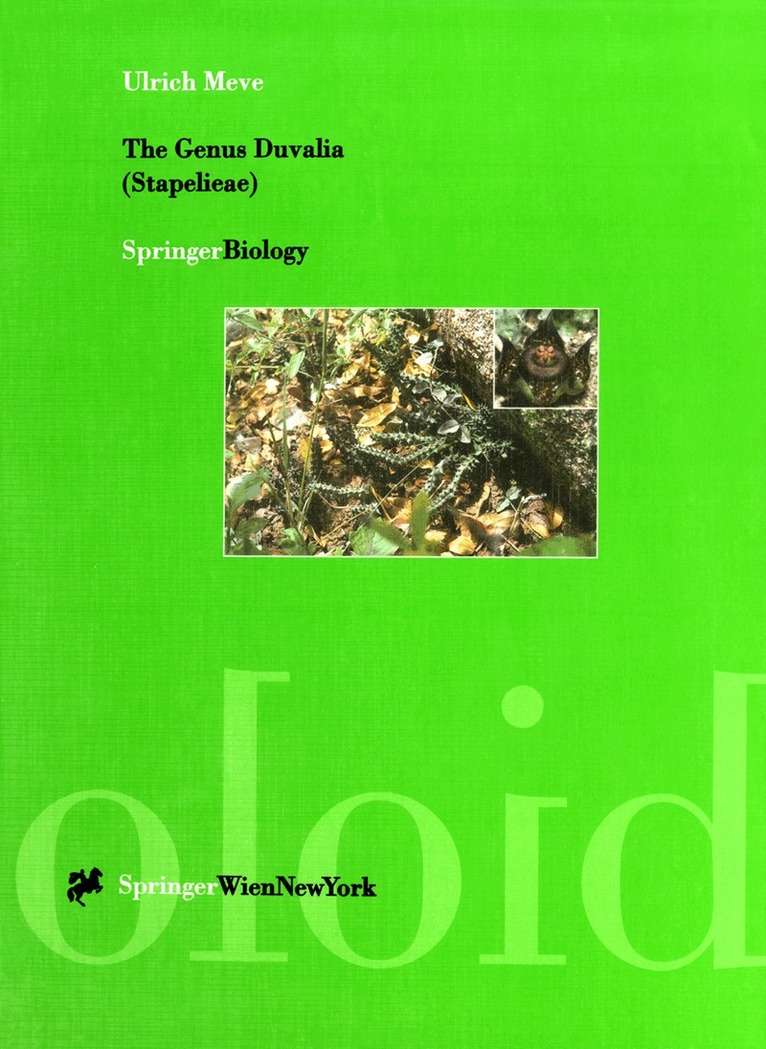
Dr ULRICH MEVE'S book on Duvalia, one of the 30 genera comprising the group of stem-succulent Asclepiadaceae, is a piece of well-done research. The text is supported by excellent illustrations comprising full-page drawings and photo graphs making this monograph a very practicable contribution for both profes sional and amateur botanists. Dr MEVE'S species delimitations are mainly based on morphological, karyological and biogeographical studies, and therefore easy to follow. His taxonomic and well-established biogeographic conclusions have been supported by field observations in southern and eastern Africa. Without doubt, this book represents one of the best and most intensive monographs ever published for the Asclepiadaceae. The studies of Dr MEVE were initiated at my former chair of systematic botany in Kiel, the former work place of the renowned succulent plants specialist Dr H. JACOBSEN and the karyologist Prof. G. REEsE. Dr MEVE has been involved with Asclepiadaceae research for more than ten years, and his work is characterized by a meticulousness typical of him. He has made himself a name amongst colleagues as well as plant lovers by his remarkable number of scientific and popular publications, which are not restricted to succulent Asclepiadaceae.
536 kr
Skickas inom 10-15 vardagar
This volume contains the papers and posters contributed to the International Conference "Systematics and Evolution of the Ranunculiflorae" held on 10/11 September 1994 at Bayreuth/Germany. These contributions deal, on different systematic level s and in different contexts, with virtually all taxa contained in the group, explore a wide array of characters employed for the classification of higher plants, and also discuss aspects of the biology of the plants in question. After the consideration of the entire Ranunculiflorae, emphasis is place d on the Papaveraceae s. l. , Lardizabalaceae, Ranunculaceae and Berberidaceae including various segregate genera. Unfortunately little new information was presented for the M enispermaceae apart from their possible phylogenetic position within the group. This certainly illustrates our unbalanced knowledge of reasonably small temperate versus large tropical flowering plant families, and emphasizes the need for intensified research in the latter. The particular strength of this volume is the combination ofmorphological and molecular evidence used for the understanding of the phylogeny of the Ranunculi- fiorae and its constituent famihes.On a theoretieal basis the issue of data combina- tion is addressed by BANDELT. Following an introduction into the history of the concept of the Ranunculiflorae (Ranunculidae, Ranunculanae) and its problems by KUBITZKI, comparative interpre- tations of wood anatomy (CARLQUIST), sieve-element plastids and phloem proteins (BEHNKE), epicuticular wax structure (BARTHLOTT & THEISEN), floral structure and floral biology (ENDRESS), structure of the androecium (RONSE DECRAENE & SMETS), palynology (BLACKMORE & al.
536 kr
Skickas inom 10-15 vardagar
The anther tapetum, present in all land plants, is a highly specialized, transient tissue surrounding the (micro-)spores and/or pollen grains during their development.Any tapetum malfunction causes male sterility. The exact knowledge of tapetum form and function therefore is indispensable not only for basic research, but also and especially in plant breeding and plant genetics.In fourteen contributions by reknown experts, a comprehensive account of the various characters and functions of the tapetum is provided, covering the areas of cytology, cytophysiology, biochemistry, tapetum development and function.
1 578 kr
Skickas inom 10-15 vardagar
Secondary pollen presentation is presentation of pollen to vectors by structures other than anthers, either passively or via a specialized protection and delivery system. The main part of the book describes secondary pollen presentation genus-by-genus in 25 families. The subject has never been extensively reviewed, although secondary pollen presentation occurs in the largest family of flowering plants, the Asteraceae (Compositae), and a large family of great economic importance, the Leguminosae. Now material from the scattered literature is brought together and supplemented with original observations. Many species are illustrated and each family is individually discussed. The last two chapters provide an overview of the whole topic. All the main functions that secondary pollen presentation may perform can be carried out in other plants without it. It is concluded from this that the evolution of secondary pollen presentation has been subject to constraint and canalization. The floral biology of most plants with secondary pollen presentation has not been adequately studied. Appendix 1 points to a wide range of topics on which research at various technical and academic levels is needed. The book should also become a reference work for morphologists, systematists, and floral ecologists.
1 064 kr
Skickas inom 10-15 vardagar
LES, D. H., GAVIN, D. K., WIMPEE, C. F., 1991: Molecular evolutionary history of ancient aquatic angiosperms. - Proc .. Natl. Acad. Sci. USA 88: 10119-10123. LLOYD, D. G., WELLS, M. S., 1992: Reproductive biology of a primitive angiosperm. Pseudowintera colorata (Winteraceae), and the evolution of pollination systems in the Anthophyta. - PI. Syst. Evol. 181: 77-95. PELLMYR, 0.,1992: Evolution of insect pollination and angiosperm diversification. - Trends Ecol. Evol. 7: 46-49. QIU, Y.-L., CHASE, M. W., LES, D. H., PARKS, C. R., 1993: Molecular phylogenetics of the M agnoliidae: cladistic analyses of nucleotide sequences of the plastid gene rbcL. - Ann. Missouri Bot. Gard. 80: 587-606. TAYLOR, D. W., HICKEY, L. J., 1990: An Aptian plant with attached leaves and flowers: implications for angiosperm origin. - Science 247: 702-704. - - 1992: Phylogenetic evidence for the herbaceous origin of angiosperms. - PI. Syst. Evol. 180: 137-156. THIEN, L. B., BERNHARDT, P., GIBBS, G. W., PELLMYR, 0., BERGSTROM, G., GROTH, I., MCPHERSON, G., 1985: The pollination of Zygogynum (Winteraceae) by a moth, Sabatinca (Micropterigidae): an ancient association? - Science 227: 540-543. TOMLINSON, P. B.,1991: Pollen scavenging. - Natl. Geogr. Res. Explor. 7: 188-195. TUCKER, S. c., 1984: Origin of symmetry in flowers. - In WHITE, R. A., DICKISON, W. c., (Eds): Contemporary problems in plant anatomy, pp. 351-395. - Orlando: Academic Press.
Del 4 - Plant Systematics and Evolution - Supplementa
Research Advances in the Compositae
Häftad, Engelska, 2011
536 kr
Skickas inom 10-15 vardagar
T. J. MABRY and G. W AGENITZ The half-day symposium on "Multidisciplinary approaches to the systematics of Compositae", held as part of the XIV International Botanical Congress in Berlin, on July 26, 1987, was designed to complement the University of Reading Compositae Conference (1975). The latter had yielded two impressive and thorough volumes on "The biology and chemistry of the Compositae", which were edited by HEYWOOD, HARBORNE & TURNER (1977). The 1987 Berlin Symposium did not attempt to update the information from the earlier conference but instead focussed on selected new methods for investigating the systematics of the family as well as a few examples of new systematic approaches with classical methods. From mapping chloroplast DNA restriction sites JANSEN, PALMER, and MI CHAELS reported the astonishing fact that, with the exception of one group (the subtribe Barnadesiinae of the tribe Mutisieae), all investigated other members of Compositae exhibit a characteristic inversion in their chloroplast DNA, suggesting that the inversion occurred early in the evolution of the family and that at least its major part is monophyletic. Within those groups with the inverted segment, chloroplast DNA also suggests that most of the conventionally recognized tribes are also monophyletic. This lends high credit to our predecessors who laid the foundations for the taxonomic system of the Compositae. These chloroplast DNA studies have already been published and are not included here (JANSEN & PALMER 1987, 1988).
Del 2 - Plant Systematics and Evolution - Supplementa
Genome and Chromatin: Organization, Evolution, Function
Symposium, Kaiserslautern, October 13–15, 1978
Häftad, Engelska, 2012
536 kr
Skickas inom 10-15 vardagar
At a round table discussion on the eukaryotic chromosome sponsor ed by the Deutsche Forschungsgemeinschaft in Diisseldorf, February 1978, the botanists among the participants felt that plant systems were under-represented. In this unsatisfactory situation, Professor V. HEMLEBEN, Tiibingen, suggested another meeting to discuss actual problems and results concerning botanical chromosome research. Professor W. NAGL was willing to organize a symposium at the University of Kaiserslautern, and Professor F. EHRENDoRFER, Wien, contacted the Rpringer-Verlag, Vienna-New York, to explore the possibility of publishing the results of this symposium in the form of a supplement volume to the journal Plant Systematics and Evol7ttion. The conference took place on 13-15 October 1978 in the Department of Biology of the University of Kaiserslautern and was attended by 40 participants from 11 universities between Hamburg and Vienna. Emphasis of this Chromosome Symposium was given to three aspects, which do not attract major interest at large international congresses: 1. Discussion and Demonstration of technical details which cannot be found in published papers (so-called tricks). 2. Orientation about actual trends and results in our understanding of the organization, evolution, and function of the plant genome at the level of the DNA (gene), the level of chromatin, and the level of the karyotype. 3. Presentation of hypotheses and models which may be stimulating for further research. Moreover, younger students should have the possibility to present their results and to discuss them with more experienced scientists.
536 kr
Skickas inom 10-15 vardagar
Biosystematic studies on the Rubiaceae have a long tradition at the Institute of Botany in Vienna. Within this family the Anthospermeae, and especially its African and Madagascan members, are of particular interest because of several aspects in their evolution: I) Perfection of anemophily within an otherwise nearly exclusively zoophilous family; 2) transitions from hermaphrodity to polygamy and finally dioecy; 3) differentiation from large and long-lived shrubs to short-lived herbs; 4) adaptive radiation from humid to seasonally dry, fire-exposed and xeric habitats. However, morphological diversity linked to sexual differentia tion, modificatory plasticity, and eco-geographical polymorphism have for a long time hampered our understanding of the relationships among these African Anthospermeae. Thus, it was imperative to put special emphasis on field observations and to carry out a variety of experiments with cultivated plants in addition to the analysis of an enormous herbarium material. The author, for this reason, carried out extensive field work, often under very adverse conditions, and covered most African countries from Ethiopia to Southern Africa and twice visited Madagascar. In this way a multitude of data was accumulated on the group in respect to germination and growth form, vegetative and reproductive morphology, anatomy and biology, embryology, karyology, crossing relationships, phytochemistry, distribu tion and ecology, etc.
536 kr
Skickas inom 10-15 vardagar
Palynology, the science of fossil and recent spores/pollen grains, is of high importance, both in many pure and applied fields of the natural sciences (e.g. in botany, geology, climatology, archeology and medicine). It is not only an auxiliary science, but can certainly stand for itself. The "classical" palynology subjects, pollen morphology and systematics, are at present influenced by many modern approaches, e.g. from cell biology, analytical electron microscopy, morphometry, up to com- puter-aided-design of threedimensional reconstruction. In recent years fascinating informations have come to light, and new insights have given rise to changing scientific concepts. During the XIV International Botanical Congress, held in Berlin in 1987, a symposium was devoted to important topics of (actuo)palynology. Nine of its innovative, major contributions are presented in this volume.They cover the comparative morphology and the systematic/evolutionary significance of pollen/spores in critical taxa, aspects of pollen development (cytoskeleton), the substructure of sporopollenin, homologies between wall strata of ferns, gymnosperms and angiosperms, and important (but so far underrated) physical aspects of harmomegathy and pollen transport (fluid versus solid mechanics).