Michael Hesse - Böcker
Visar alla böcker från författaren Michael Hesse. Handla med fri frakt och snabb leverans.
10 produkter
10 produkter
554 kr
Skickas inom 10-15 vardagar
This open access book offers a fully illustrated compendium of glossary terms and basic principles in the field of palynology, making it an indispensable tool for all palynologists. It is a revised and extended edition of “Pollen Terminology. An illustrated handbook,” published in 2009. This second edition, titled “Illustrated Pollen Terminology” shares additional insights into new and stunning aspects of palynology. In this context, the general chapters have been critically revised, expanded and restructured. The chapter “Misinterpretations in Palynology” has been extended with new research data and additional ambiguous terms, e.g., polyads vs. massulae; the chapter “Methods in Palynology” has been extensively enhanced with illustrated protocols showing the majority of the methods and techniques used when studying recent and fossil pollen with LM, SEM and TEM. Moreover, additional information about the description and publication of pollen data is provided in the chapter “How to Describe and Illustrate Pollen Grains.” Various other parts of the general chapters have now been updated and/or extended with more comprehensive textual passages and new illustrations. The chapter “Illustrated Pollen Terms” now features new and more appropriate examples of each term, including additional LM micrographs. Where necessary, the entries for selected pollen terms have been refined by rewording or adding definitions, illustrations, and new micrographs. Lastly, new terms are included, such as “suprasculpture” and the prefix “nano-“ for ornamentation features.The chapter “Illustrated Pollen Terms” is the main part of this book and comprises more than 300 widely used terms illustrated with over 1,000 high-quality images. It provides a detailed survey of the manifold ornamentation and structures of pollen, and offers essential insights into their stunning beauty.
856 kr
Skickas inom 10-15 vardagar
The anther tapetum, present in all land plants, is a highly specialized, transient tissue surrounding the (micro-)spores and/or pollen grains during their development. Any tapetum malfunction causes male sterility. The exact knowledge of tapetum form and function therefore is indispensable not only for basic research, but also and especially in plant breeding and plant genetics. In fourteen contributions by reknown experts, a comprehensive account of the various characters and functions of the tapetum is provided, covering the areas of cytology, cytophysiology, biochemistry, tapetum development and function.
2 426 kr
Skickas inom 10-15 vardagar
The identification of pollen is widely used in the reconstruction of vegetation, the climate of the past, and plant biodiversity. Studies concerning pollen structure, size, and form are key issues in basic sciences as plant taxonomy and evolution. But they also play an important role in applied fields as plant breeding. In pollination studies pollen is generally used to identify food sources of visitors and to reconstruct their foraging routes. The 16 papers in this volume consider the functional ecology of pollen in relation to its structure and constituents as a framework towards a better understanding of evolutionary processes that mold pollination biology. They can be roughly classified into three main topics: pollen structure and constituents, pollen evolutionary ecology, and the pollen-pollinator interface. Floral reward, such as pollen and nectar, are only one aspect of the multidimensional pollination caleidoscope. Other aspects include the various mechanisms in distributing or collecting pollen, the question of pollen longevity, or the convergence of evolution in angiosperm pollination.
1 900 kr
Skickas inom 10-15 vardagar
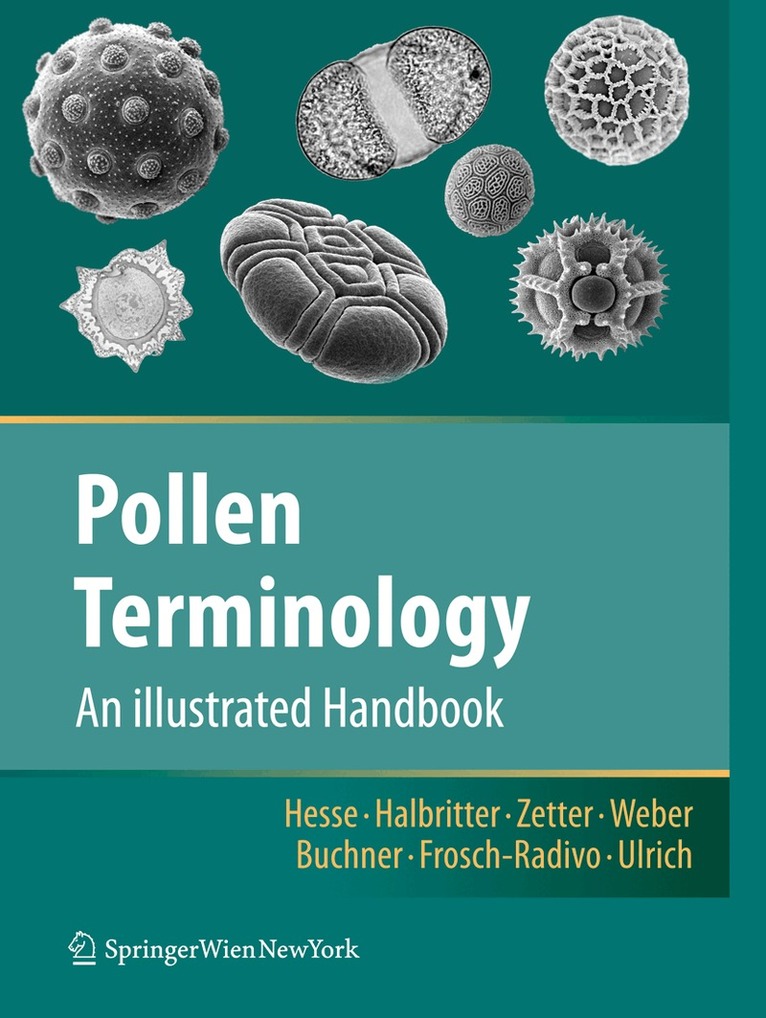
Palynology is important in basic as well as in manifold applied sciences, as e.g. biology, medicine, forensics, earth history, climatology and food production. This volume is the first fully illustrated handbook of palynological principles and glossary terms, exclusively using LM and EM micrographs of superior quality. A comprehensive General Chapter on pollen morphology, anatomy, pollen development etc. based on the present knowledge in palynology introduces the reader in the world of pollen. The glossary part comprises more than 300 widely used terms illustrated with over 1.000 high quality light and/or electron microscopic pictures to show the character range of a term. Terms are grouped by feature, e.g. ornamentation, where each term is illustrated on a separate page, definition and original citation included and where necessary, provided with a comprehensive explanatory comment. The term's use in LM, SEM or TEM and its assignment to anatomical, morphological and/or functional pollen features is indicated by icons and colour coding, respectively. This handbook is not only a valuable source for students and researchers but also for all persons interested in pollen and its aesthetic beauty.
554 kr
Skickas inom 10-15 vardagar
This open access book offers a fully illustrated compendium of glossary terms and basic principles in the field of palynology, making it an indispensable tool for all palynologists. It is a revised and extended edition of “Pollen Terminology. An illustrated handbook,” published in 2009. This second edition, titled “Illustrated Pollen Terminology” shares additional insights into new and stunning aspects of palynology. In this context, the general chapters have been critically revised, expanded and restructured. The chapter “Misinterpretations in Palynology” has been extended with new research data and additional ambiguous terms, e.g., polyads vs. massulae; the chapter “Methods in Palynology” has been extensively enhanced with illustrated protocols showing the majority of the methods and techniques used when studying recent and fossil pollen with LM, SEM and TEM. Moreover, additional information about the description and publication of pollen data is provided in the chapter “How to Describe and Illustrate Pollen Grains.” Various other parts of the general chapters have now been updated and/or extended with more comprehensive textual passages and new illustrations. The chapter “Illustrated Pollen Terms” now features new and more appropriate examples of each term, including additional LM micrographs. Where necessary, the entries for selected pollen terms have been refined by rewording or adding definitions, illustrations, and new micrographs. Lastly, new terms are included, such as “suprasculpture” and the prefix “nano-“ for ornamentation features.The chapter “Illustrated Pollen Terms” is the main part of this book and comprises more than 300 widely used terms illustrated with over 1,000 high-quality images. It provides a detailed survey of the manifold ornamentation and structures of pollen, and offers essential insights into their stunning beauty.
Del 54 - Studien Zur Deutschen Und Europaeischen Literatur Des 19. Un
Kunst ALS Fraktales Spiel
Potentiale Der Kommunikation in Den Romanen Alfred Anderschs
Häftad, Tyska, 2004
613 kr
Tillfälligt slut
2 426 kr
Skickas inom 10-15 vardagar
Pollen studies make important contributions nature, into three main themes: pollen struc to our knowledge in many interdisciplinary ture and constituents, pollen evolutionary arenas. Pollen identification is widely used in ecology and the pollen-pollinator interface. reconstruction of, e.g., vegetation, the climate Several papers overlap somewhat or are of the past, and plant biodiversity. Studies perhaps even somewhat contradictory and concerning pollen structure, size and form are reflect the author's own ideas and experience. key issues in basic sciences, as, e.g., plant Some could be understood more deeply by taxonomy and evolution, but are also of consulting other closely related articles. The importance in applied fields as, e.g., plant reader is strongly referred to the respective breeding. In pollination studies pollen is literature list of each article. generally used specifically to identify food ofanther ripening and pollen The last steps development (Pacini) and the mature pollen sources of visitors and to reconstruct their foraging routes. Fewer have been devoted to wall structure (Hesse) are key factors to pollen collection mechanisms and to the struc understand pollen dispersal mechanisms in ture and content of pollen in relation to its biotic pollination (Stroo) as well as abiotic pollination (Ackerman). Pollen size, shape, function.
538 kr
Skickas inom 10-15 vardagar
The anther tapetum, present in all land plants, is a highly specialized, transient tissue surrounding the (micro-)spores and/or pollen grains during their development.Any tapetum malfunction causes male sterility. The exact knowledge of tapetum form and function therefore is indispensable not only for basic research, but also and especially in plant breeding and plant genetics.In fourteen contributions by reknown experts, a comprehensive account of the various characters and functions of the tapetum is provided, covering the areas of cytology, cytophysiology, biochemistry, tapetum development and function.
538 kr
Skickas inom 10-15 vardagar
Palynology, the science of fossil and recent spores/pollen grains, is of high importance, both in many pure and applied fields of the natural sciences (e.g. in botany, geology, climatology, archeology and medicine). It is not only an auxiliary science, but can certainly stand for itself. The "classical" palynology subjects, pollen morphology and systematics, are at present influenced by many modern approaches, e.g. from cell biology, analytical electron microscopy, morphometry, up to com- puter-aided-design of threedimensional reconstruction. In recent years fascinating informations have come to light, and new insights have given rise to changing scientific concepts. During the XIV International Botanical Congress, held in Berlin in 1987, a symposium was devoted to important topics of (actuo)palynology. Nine of its innovative, major contributions are presented in this volume.They cover the comparative morphology and the systematic/evolutionary significance of pollen/spores in critical taxa, aspects of pollen development (cytoskeleton), the substructure of sporopollenin, homologies between wall strata of ferns, gymnosperms and angiosperms, and important (but so far underrated) physical aspects of harmomegathy and pollen transport (fluid versus solid mechanics).
1 315 kr
Skickas inom 5-8 vardagar