Roundtable Series in Behavioral Economics - Böcker
Visar alla böcker i serien Roundtable Series in Behavioral Economics. Handla med fri frakt och snabb leverans.
4 produkter
4 produkter
1 026 kr
Skickas inom 7-10 vardagar
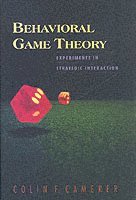
Game theory, the formalized study of strategy, began in the 1940s by asking how emotionless geniuses should play games, but ignored until recently how average people with emotions and limited foresight actually play games. This book marks the first substantial and authoritative effort to close this gap. Colin Camerer, one of the field's leading figures, uses psychological principles and hundreds of experiments to develop mathematical theories of reciprocity, limited strategizing, and learning, which help predict what real people and companies do in strategic situations. Unifying a wealth of information from ongoing studies in strategic behavior, he takes the experimental science of behavioral economics a major step forward. He does so in lucid, friendly prose. Behavioral game theory has three ingredients that come clearly into focus in this book: mathematical theories of how moral obligation and vengeance affect the way people bargain and trust each other; a theory of how limits in the brain constrain the number of steps of "I think he thinks ..." reasoning people naturally do; and a theory of how people learn from experience to make better strategic decisions.Strategic interactions that can be explained by behavioral game theory include bargaining, games of bluffing as in sports and poker, strikes, how conventions help coordinate a joint activity, price competition and patent races, and building up reputations for trustworthiness or ruthlessness in business or life. While there are many books on standard game theory that address the way ideally rational actors operate, Behavioral Game Theory stands alone in blending experimental evidence and psychology in a mathematical theory of normal strategic behavior. It is must reading for anyone who seeks a more complete understanding of strategic thinking, from professional economists to scholars and students of economics, management studies, psychology, political science, anthropology, and biology.
1 413 kr
Skickas inom 3-6 vardagar
Twenty years ago, behavioral economics did not exist as a field. Most economists were deeply skeptical--even antagonistic--toward the idea of importing insights from psychology into their field. Today, behavioral economics has become virtually mainstream. It is well represented in prominent journals and top economics departments, and behavioral economists, including several contributors to this volume, have garnered some of the most prestigious awards in the profession. This book assembles the most important papers on behavioral economics published since around 1990. Among the 25 articles are many that update and extend earlier foundational contributions, as well as cutting-edge papers that break new theoretical and empirical ground. Advances in Behavioral Economics will serve as the definitive one-volume resource for those who want to familiarize themselves with the new field or keep up-to-date with the latest developments. It will not only be a core text for students, but will be consulted widely by professional economists, as well as psychologists and social scientists with an interest in how behavioral insights are being applied in economics.The articles, which follow Colin Camerer and George Loewenstein's introduction, are by the editors, George A. Akerlof, Linda Babcock, Shlomo Benartzi, Vincent P. Crawford, Peter Diamond, Ernst Fehr, Robert H. Frank, Shane Frederick, Simon Gachter, David Genesove, Itzhak Gilboa, Uri Gneezy, Robert M. Hutchens, Daniel Kahneman, Jack L. Knetsch, David Laibson, Christopher Mayer, Terrance Odean, Ted O'Donoghue, Aldo Rustichini, David Schmeidler, Klaus M. Schmidt, Eldar Shafir, Hersh M. Shefrin, Chris Starmer, Richard H. Thaler, Amos Tversky, and Janet L. Yellen.
847 kr
Skickas inom 7-10 vardagar
This book offers a definitive and wide-ranging overview of developments in behavioral finance over the past ten years. In 1993, the first volume provided the standard reference to this new approach in finance--an approach that, as editor Richard Thaler put it, "entertains the possibility that some of the agents in the economy behave less than fully rationally some of the time." Much has changed since then. Not least, the bursting of the Internet bubble and the subsequent market decline further demonstrated that financial markets often fail to behave as they would if trading were truly dominated by the fully rational investors who populate financial theories. Behavioral finance has made an indelible mark on areas from asset pricing to individual investor behavior to corporate finance, and continues to see exciting empirical and theoretical advances. Advances in Behavioral Finance, Volume II constitutes the essential new resource in the field.It presents twenty recent papers by leading specialists that illustrate the abiding power of behavioral finance--of how specific departures from fully rational decision making by individual market agents can provide explanations of otherwise puzzling market phenomena. As with the first volume, it reaches beyond the world of finance to suggest, powerfully, the importance of pursuing behavioral approaches to other areas of economic life. The contributors are Brad M. Barber, Nicholas Barberis, Shlomo Benartzi, John Y. Campbell, Emil M. Dabora, Daniel Kent, Francois Degeorge, Kenneth A. Froot, J. B. Heaton, David Hirshleifer, Harrison Hong, Ming Huang, Narasimhan Jegadeesh, Josef Lakonishok, Owen A. Lamont, Roni Michaely, Terrance Odean, Jayendu Patel, Tano Santos, Andrei Shleifer, Robert J. Shiller, Jeremy C. Stein, Avanidhar Subrahmanyam, Richard H. Thaler, Sheridan Titman, Robert W. Vishny, Kent L. Womack, and Richard Zeckhauser.
734 kr
Skickas inom 7-10 vardagar
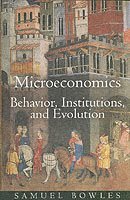
In this novel introduction to modern microeconomic theory, Samuel Bowles returns to the classical economists' interest in the wealth and poverty of nations and people, the workings of the institutions of capitalist economies, and the coevolution of individual preferences and the structures of markets, firms, and other institutions. Using recent advances in evolutionary game theory, contract theory, behavioral experiments, and the modeling of dynamic processes, he develops a theory of how economic institutions shape individual behavior, and how institutions evolve due to individual actions, technological change, and chance events. Topics addressed include institutional innovation, social preferences, nonmarket social interactions, social capital, equilibrium unemployment, credit constraints, economic power, generalized increasing returns, disequilibrium outcomes, and path dependency. Each chapter is introduced by empirical puzzles or historical episodes illuminated by the modeling that follows, and the book closes with sets of problems to be solved by readers seeking to improve their mathematical modeling skills.Complementing standard mathematical analysis are agent-based computer simulations of complex evolving systems that are available online so that readers can experiment with the models. Bowles concludes with the time-honored challenge of "getting the rules right," providing an evaluation of markets, states, and communities as contrasting and yet sometimes synergistic structures of governance. Must reading for students and scholars not only in economics but across the behavioral sciences, this engagingly written and compelling exposition of the new microeconomics moves the field beyond the conventional models of prices and markets toward a more accurate and policy-relevant portrayal of human social behavior.