Routledge Library Editions: Homer - Böcker
Visar alla böcker i serien Routledge Library Editions: Homer. Handla med fri frakt och snabb leverans.
11 produkter
11 produkter
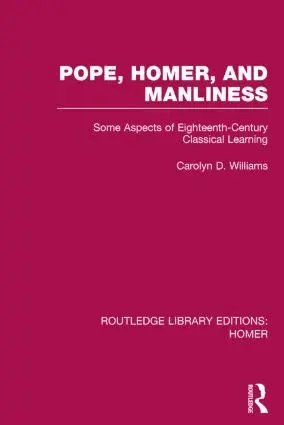
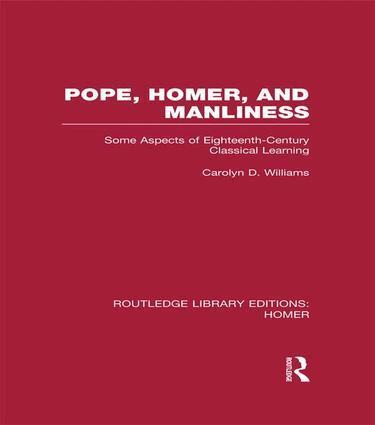
Pope, Homer, and Manliness
Some Aspects of Eighteenth Century Classical Learning
Inbunden, Engelska, 2014
2 420 kr
Skickas inom 10-15 vardagar
The author here reassesses the concept of ‘masculinity’, and argues that it cannot be seen as an absolute standard, but only as the product of perpetual conflict between competing and unstable models. The argument is sustained by a close reading of the problematic conflict between gendered values in eighteenth-century classical learning. Pope’s Homer ensured the continuation of the tradition of using the Iliad and Odyssey to teach privileged boys how to become more ‘manly’. This book examines this pedagogy in its socio-literary context, and concludes that Pope’s Homer emerges as a relic of the struggle to preserve masculine dignity from the encroachments of feminine values in the text. This knowledge of classical and early modern literature has rarely been brought to bear on gender studies. First published in 1993, it remains a valuable contribution to debates concerning the reception of the Classical tradition.
2 420 kr
Skickas inom 10-15 vardagar
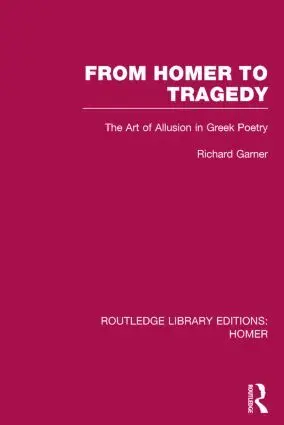
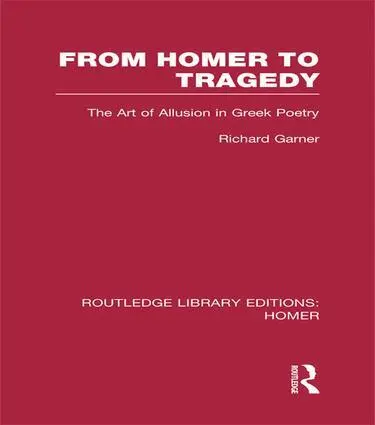
The role of poetic allusion in classical Greek poetry, to Homer especially, has often largely been neglected or even almost totally ignored. This book, first published in 1990, clarifies the place of Homer in Greek education, as well as adding to the interpretation of many important tragedies.Focussing on the dramatic masterpieces of Aeschylus, Sophocles, and Euripides, and how these writers imitated and alluded to other poetry, the author reveals the immense dependence on Homer which can be seen throughout the corpus of Attic tragedy. It is argued that the practice of the art of allusion indicates certain conventions in fifth-century Athenian education, and perhaps also suggests something in the way of public, political, and historical self-awareness. Invaluable to anyone interested in the reception of Homer in the classical age, and to students of comparative literature and linguistic theory.
2 498 kr
Skickas inom 10-15 vardagar
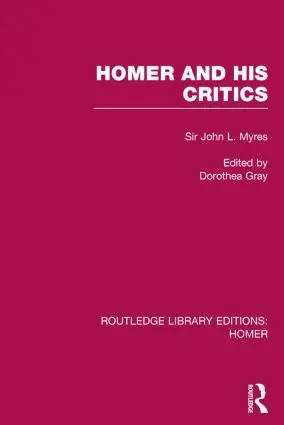
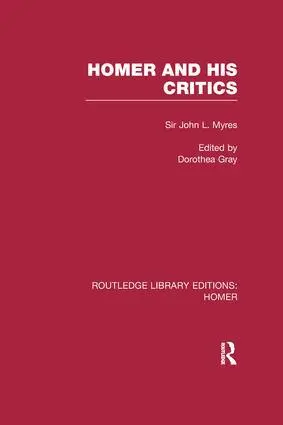
Here is presented a succinct and insightful account of the reception of the Iliad and Odyssey from antiquity to the mid-twentieth century. The overall result is less a systematic history than a series of independent studies differing in scale and focus, the chapter on Gladstone being the most comprehensive and detailed. First published in 1958.The author gives greatest attention to those who made active use of Homer rather than passive, even if admiring, readers: Virgil because he wrote the Aeneid, Gladstone because he brought him to prominence in Oxford education, Wood because he sought out the geography and Schliemann because he dug for the kings. The emphasis is thus placed less on the purely academic critic than on the traveller and the innovative amateur. A valuable contribution to a subject of perennial fascination, this will be of interest to all students and teachers of the classics.
1 953 kr
Skickas inom 10-15 vardagar
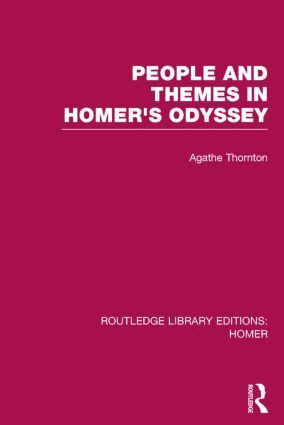
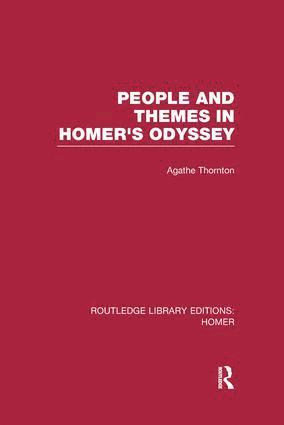
Published in 1970, this important work interprets the poem with a focus on the idiosyncrasies of its originally oral composition. In part I, the main themes of the Odyssey such as ‘guest-friendship’ and ‘testing’ are investigated. The incorporation of these and other themes, such as ‘omens’ and the ‘homecomings of the Achaeans’, into the dramatic construction of the whole epic is also examined. In Part II, the main characters of the Odyssey are described: the Suitors, Telemachus, Odysseus and Penelope. So too are Theoclymenus and Laertes, whom traditional criticism has maligned or disregarded. The analysis of the characters tries to illumine features which are challenging for the contemporary reader. In the conclusion, the ‘plan’ of the Odyssey is reconstructed. The author argues that it would probably have been performed over the course of three days: two sessions each day, with each recitation maintaining its own artistic unity.
2 576 kr
Skickas inom 10-15 vardagar
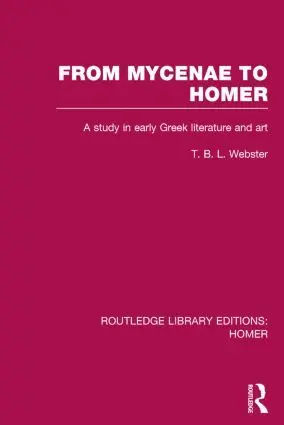
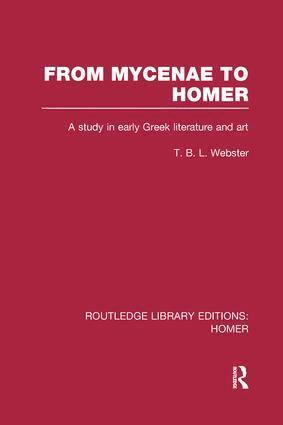
This book, first published in 1958, aims to describe Greek art and poetry within this ambiguous period of ancient history (often referred to as the Greek ‘Dark Ages’), and to explore the possibilities of learning about Mycenaean civilisation from its own documents and not only from archaeology.Specifically, Webster utilises Michael Ventris’ decipherment of Linear B in 1952 – which proved that Greek was spoken in the Mycenaean world – to determine the general contours of aesthetic development from Mycenae to the time of the written composition of the Homeric epics. Because they record Mycenaean civilisation in Mycenaean terminology, while Homer was writing in Ionian Greek at the beginning of the polis civilisation, they show how much in Homer is in fact Mycenaean. Further, where it is clear that these Mycenaean elements cannot have survived until Homer’s time, they tell us something about the poetry which connected the two.
13 955 kr
Skickas inom 10-15 vardagar
Reissuing works originally published between 1958 and 1993, this five-volume set offers a selection of scholarship on the greatest classical poet, whose two monumental epics, the Iliad and the Odyssey, remain foundational to the Western cultural tradition. Routledge Library Editions: Homer helps to situate this immense artistic achievement in its historical and cultural context, considering issues such as the relationship between the Homeric epics and the Mycenaean civilisation which preceded them, the importance of Homer for the flowering of Greek tragedy, and the reception of Homer during and after the Enlightenment.
770 kr
Skickas inom 10-15 vardagar
Here is presented a succinct and insightful account of the reception of the Iliad and Odyssey from antiquity to the mid-twentieth century. The overall result is less a systematic history than a series of independent studies differing in scale and focus, the chapter on Gladstone being the most comprehensive and detailed. First published in 1958.The author gives greatest attention to those who made active use of Homer rather than passive, even if admiring, readers: Virgil because he wrote the Aeneid, Gladstone because he brought him to prominence in Oxford education, Wood because he sought out the geography and Schliemann because he dug for the kings. The emphasis is thus placed less on the purely academic critic than on the traveller and the innovative amateur. A valuable contribution to a subject of perennial fascination, this will be of interest to all students and teachers of the classics.
770 kr
Skickas inom 10-15 vardagar
The role of poetic allusion in classical Greek poetry, to Homer especially, has often largely been neglected or even almost totally ignored. This book, first published in 1990, clarifies the place of Homer in Greek education, as well as adding to the interpretation of many important tragedies.Focussing on the dramatic masterpieces of Aeschylus, Sophocles, and Euripides, and how these writers imitated and alluded to other poetry, the author reveals the immense dependence on Homer which can be seen throughout the corpus of Attic tragedy. It is argued that the practice of the art of allusion indicates certain conventions in fifth-century Athenian education, and perhaps also suggests something in the way of public, political, and historical self-awareness. Invaluable to anyone interested in the reception of Homer in the classical age, and to students of comparative literature and linguistic theory.
770 kr
Skickas inom 10-15 vardagar
Published in 1970, this important work interprets the poem with a focus on the idiosyncrasies of its originally oral composition. In part I, the main themes of the Odyssey such as ‘guest-friendship’ and ‘testing’ are investigated. The incorporation of these and other themes, such as ‘omens’ and the ‘homecomings of the Achaeans’, into the dramatic construction of the whole epic is also examined. In Part II, the main characters of the Odyssey are described: the Suitors, Telemachus, Odysseus and Penelope. So too are Theoclymenus and Laertes, whom traditional criticism has maligned or disregarded. The analysis of the characters tries to illumine features which are challenging for the contemporary reader. In the conclusion, the ‘plan’ of the Odyssey is reconstructed. The author argues that it would probably have been performed over the course of three days: two sessions each day, with each recitation maintaining its own artistic unity.
Pope, Homer, and Manliness
Some Aspects of Eighteenth Century Classical Learning
Häftad, Engelska, 2016
770 kr
Skickas inom 10-15 vardagar
The author here reassesses the concept of ‘masculinity’, and argues that it cannot be seen as an absolute standard, but only as the product of perpetual conflict between competing and unstable models. The argument is sustained by a close reading of the problematic conflict between gendered values in eighteenth-century classical learning. Pope’s Homer ensured the continuation of the tradition of using the Iliad and Odyssey to teach privileged boys how to become more ‘manly’. This book examines this pedagogy in its socio-literary context, and concludes that Pope’s Homer emerges as a relic of the struggle to preserve masculine dignity from the encroachments of feminine values in the text. This knowledge of classical and early modern literature has rarely been brought to bear on gender studies. First published in 1993, it remains a valuable contribution to debates concerning the reception of the Classical tradition.
802 kr
Skickas inom 10-15 vardagar
This book, first published in 1958, aims to describe Greek art and poetry within this ambiguous period of ancient history (often referred to as the Greek ‘Dark Ages’), and to explore the possibilities of learning about Mycenaean civilisation from its own documents and not only from archaeology.Specifically, Webster utilises Michael Ventris’ decipherment of Linear B in 1952 – which proved that Greek was spoken in the Mycenaean world – to determine the general contours of aesthetic development from Mycenae to the time of the written composition of the Homeric epics. Because they record Mycenaean civilisation in Mycenaean terminology, while Homer was writing in Ionian Greek at the beginning of the polis civilisation, they show how much in Homer is in fact Mycenaean. Further, where it is clear that these Mycenaean elements cannot have survived until Homer’s time, they tell us something about the poetry which connected the two.