Routledge Library Editions: Modern East and South East Asia – serie
Visar alla böcker i serien Routledge Library Editions: Modern East and South East Asia. Handla med fri frakt och snabb leverans.
13 produkter
13 produkter
8 426 kr
Tillfälligt slut
This 7-volume set reissues a range of classic out-of-print texts that cover a host of issues that have contributed to the development of modern East and South East Asia. With titles covering economics, politics, history, anthropology and security, this set provides the researcher with an essential resource on the region.
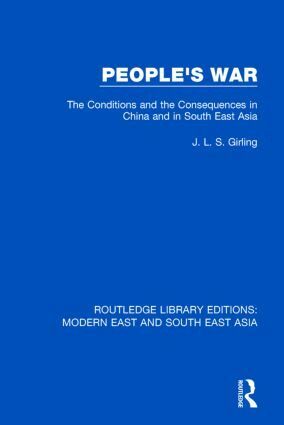
People's War (RLE Modern East and South East Asia)
The Conditions and the Consequences in China and in South East Asia
Inbunden, Engelska, 2015
2 176 kr
Skickas inom 10-15 vardagar
This book, first published in 1969, casts a critical eye over the problem of insurgency. The author sees insurgency not just as a matter of technique – military tactics or organizational skill – nor as the result of ‘force and fraud’, but as ‘people’s war’: the conditions in which the mass of the people become involved, voluntarily or otherwise, on either side. He quotes Nasution’s statement, ‘The guerrilla movement is only the result, not the cause of the problem’. People’s war brings the peasantry, hitherto ignorant, apathetic or rejected, into the political process. For ‘war is … the continuation of politics by other means’. In Asia this was essentially a peasant’s war, arising when peasant grievances, interests or demands cannot be met under the existing ‘legitimate’ but urban or landowner-orientated system of rule. It shows little understanding to blame outside intervention when peasant – and nationalist – unrest leads to revolt. The Chinese Communists did not owe success to Soviet aid, the Vietminh to Chinese assistance or the Vietcong to North Vietnamese intervention. The conclusion applies to governments as to insurgents: no amount of outside aid can win the war for them if they themselves are incapable and the people – on whom they depend for support – have no will to fight. This book, based on first-hand experience of the area and on study of original sources, offers (1) an analysis of ‘people’s war’ in China, Indochina and Vietnam, (2) a critique of US policy in Laos and Vietnam and (3) a comparison with counter-measures in Malaya, the Philippines and Indonesia. It is both original and constructive.
People's War (RLE Modern East and South East Asia)
The Conditions and the Consequences in China and in South East Asia
Häftad, Engelska, 2016
550 kr
Skickas inom 10-15 vardagar
This book, first published in 1969, casts a critical eye over the problem of insurgency. The author sees insurgency not just as a matter of technique – military tactics or organizational skill – nor as the result of ‘force and fraud’, but as ‘people’s war’: the conditions in which the mass of the people become involved, voluntarily or otherwise, on either side. He quotes Nasution’s statement, ‘The guerrilla movement is only the result, not the cause of the problem’. People’s war brings the peasantry, hitherto ignorant, apathetic or rejected, into the political process. For ‘war is … the continuation of politics by other means’. In Asia this was essentially a peasant’s war, arising when peasant grievances, interests or demands cannot be met under the existing ‘legitimate’ but urban or landowner-orientated system of rule. It shows little understanding to blame outside intervention when peasant – and nationalist – unrest leads to revolt. The Chinese Communists did not owe success to Soviet aid, the Vietminh to Chinese assistance or the Vietcong to North Vietnamese intervention. The conclusion applies to governments as to insurgents: no amount of outside aid can win the war for them if they themselves are incapable and the people – on whom they depend for support – have no will to fight. This book, based on first-hand experience of the area and on study of original sources, offers (1) an analysis of ‘people’s war’ in China, Indochina and Vietnam, (2) a critique of US policy in Laos and Vietnam and (3) a comparison with counter-measures in Malaya, the Philippines and Indonesia. It is both original and constructive.
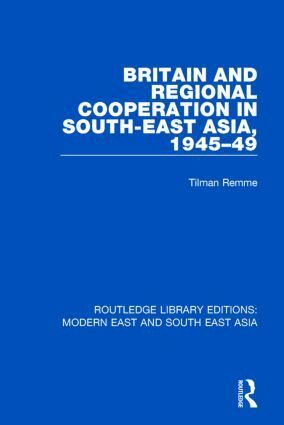
Britain and Regional Cooperation in South-East Asia, 1945-49 (RLE Modern East and South East Asia)
Inbunden, Engelska, 2015
2 176 kr
Skickas inom 10-15 vardagar
This book, first published in 1995, traces the attempt by the British Foreign Office to establish an international regional organisation in South-East Asia which would allow Britain to dominate the region politically, economically and militarily. The author explores the changing emphasis of Britain's regional policies and puts the issues affecting South-East Asia in the post-War period into a wide context. He explores events in the light of the Japanese defeat in the Second World War, the Communist struggle for supremacy of China, the development of Anglo-American relations in Asia and the beginnings of the Cold War.
Britain and Regional Cooperation in South-East Asia, 1945-49 (RLE Modern East and South East Asia)
Häftad, Engelska, 2016
567 kr
Skickas inom 10-15 vardagar
This book, first published in 1995, traces the attempt by the British Foreign Office to establish an international regional organisation in South-East Asia which would allow Britain to dominate the region politically, economically and militarily. The author explores the changing emphasis of Britain's regional policies and puts the issues affecting South-East Asia in the post-War period into a wide context. He explores events in the light of the Japanese defeat in the Second World War, the Communist struggle for supremacy of China, the development of Anglo-American relations in Asia and the beginnings of the Cold War.
1 966 kr
Skickas inom 10-15 vardagar
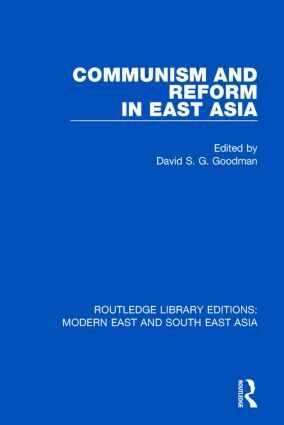
The West no longer regards communism in East Asia as a threat. On the contrary, because the communist party states of East Asia appear to be undergoing a process of reform directed primarily at economic modernization, it is now regarded as a potential market. The West’s attitude is reinforced by the recognition of East Asia’s economic importance more generally – a perception which in itself undoubtedly stimulated reform in the region’s communist party states. The causes, extent and consequences of reform in the East Asian communist party states are the concerns of the contributions to this volume, first published in 1988. It includes chapters on the reform process in China, North Korea, Vietnam and Mongolia; as well as examinations of the roles played by both China and the Soviet Union in the Asia-Pacific region. They demonstrate that a belief in a simple, single process of economic and political liberalization – brought about by the drive for economic modernization, the production imperative – is a misleading argument. Although the production imperative might act as a stimulus to reform, it is neither a sufficient nor even a necessary condition. In individual countries the communist party’s search for legitimacy, a change of leadership, or the relationship with the USSR have equally been the spur to reform. The drive for economic modernization may even be a consequence of the communist party’s desire to reform rather than a cause. The absence of a uniform pattern does not detract from the potential consequences of economic and political change. These challenge socialist thinking on the nature of collective life, ownership and rural society.
567 kr
Skickas inom 10-15 vardagar
The West no longer regards communism in East Asia as a threat. On the contrary, because the communist party states of East Asia appear to be undergoing a process of reform directed primarily at economic modernization, it is now regarded as a potential market. The West’s attitude is reinforced by the recognition of East Asia’s economic importance more generally – a perception which in itself undoubtedly stimulated reform in the region’s communist party states. The causes, extent and consequences of reform in the East Asian communist party states are the concerns of the contributions to this volume, first published in 1988. It includes chapters on the reform process in China, North Korea, Vietnam and Mongolia; as well as examinations of the roles played by both China and the Soviet Union in the Asia-Pacific region. They demonstrate that a belief in a simple, single process of economic and political liberalization – brought about by the drive for economic modernization, the production imperative – is a misleading argument. Although the production imperative might act as a stimulus to reform, it is neither a sufficient nor even a necessary condition. In individual countries the communist party’s search for legitimacy, a change of leadership, or the relationship with the USSR have equally been the spur to reform. The drive for economic modernization may even be a consequence of the communist party’s desire to reform rather than a cause. The absence of a uniform pattern does not detract from the potential consequences of economic and political change. These challenge socialist thinking on the nature of collective life, ownership and rural society.
2 176 kr
Skickas inom 10-15 vardagar
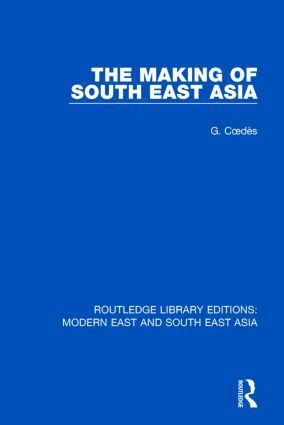
From the time of its original publication in France, this cultural history (first published in English in 1966) by an international authority has stood apart from other histories of South East Asia. Most such accounts describe events before 1500 in summary fashion, and concentrate on later developments. This book, on the contrary, deals mainly with the earlier, formative epochs that marked the flowering in the region of the Great Traditions of Hinduism and of Buddhism. Following a succinct sketch of the prehistoric period, the book moves on to a chronological account of the developments from the Chinese conquest of Annam in the third century to the period of European conquest in the nineteenth. It reflects the author’s thoughtful views concerning the evolution of political institutions, religions, literatures, and arts that distinguished the region. In geographical scope it embraces Thailand, Burma, and the area formerly known as French Indochina, and is an indispensable guide to the making of the region.
567 kr
Skickas inom 10-15 vardagar
From the time of its original publication in France, this cultural history (first published in English in 1966) by an international authority has stood apart from other histories of South East Asia. Most such accounts describe events before 1500 in summary fashion, and concentrate on later developments. This book, on the contrary, deals mainly with the earlier, formative epochs that marked the flowering in the region of the Great Traditions of Hinduism and of Buddhism. Following a succinct sketch of the prehistoric period, the book moves on to a chronological account of the developments from the Chinese conquest of Annam in the third century to the period of European conquest in the nineteenth. It reflects the author’s thoughtful views concerning the evolution of political institutions, religions, literatures, and arts that distinguished the region. In geographical scope it embraces Thailand, Burma, and the area formerly known as French Indochina, and is an indispensable guide to the making of the region.
Prospects for a Regional Human Rights Mechanism in East Asia (RLE Modern East and South East Asia)
Inbunden, Engelska, 2015
525 kr
Skickas inom 10-15 vardagar
Regional inter-governmental human rights organizations have been in operation for sometime in Europe, the Americas and Africa. These regional human rights mechanisms have proven to be useful and effective in comparison to the global human rights mechanisms available at the United Nations. The purpose of this study, first published in 2004, is to investigate the possibility of establishing a regional inter-governmental human rights mechanism in East Asia, with a focus on the contributions of nongovernmental organizations' (NGOs) to such a development.
Prospects for a Regional Human Rights Mechanism in East Asia (RLE Modern East and South East Asia)
Häftad, Engelska, 2016
343 kr
Skickas inom 10-15 vardagar
Regional inter-governmental human rights organizations have been in operation for sometime in Europe, the Americas and Africa. These regional human rights mechanisms have proven to be useful and effective in comparison to the global human rights mechanisms available at the United Nations. The purpose of this study, first published in 2004, is to investigate the possibility of establishing a regional inter-governmental human rights mechanism in East Asia, with a focus on the contributions of nongovernmental organizations' (NGOs) to such a development.
Stakes of Democracy in South-East Asia (RLE Modern East and South East Asia)
Inbunden, Engelska, 2015
2 246 kr
Skickas inom 10-15 vardagar
Will national independence bring to the peoples of South East Asia liberty and democracy? Or will it mean corrupt government, factional strife and insolvency? Or will it mean eventual absorption by totalitarian communism? In this book, first published in 1950, the author analyses these questions, using the case history of Indonesia since 1940, in which he played a leading role, to illustrate his points. He gives an outline of the history of South East Asia, its domination by the West and its convulsion by war and nationalism. The seven nations of South East Asia – Ceylon, Burma, Siam, Indo-China, Malaya, Indonesia and the Philippines – have a great deal in common: except for Siam, they are all struggling through the formative years of nationhood; except for Ceylon, they were all occupied and pillaged by Japan during the War. They are of great value to other nations as a source of raw materials and foodstuffs. Their political and economic structure is of vital importance, both to themselves and to us and unless their new nationalism can be strengthened, the free world may lose a valuable asset to its economy and an ally against totalitarianism in Asia.
567 kr
Skickas inom 10-15 vardagar
Will national independence bring to the peoples of South East Asia liberty and democracy? Or will it mean corrupt government, factional strife and insolvency? Or will it mean eventual absorption by totalitarian communism? In this book, first published in 1950, the author analyses these questions, using the case history of Indonesia since 1940, in which he played a leading role, to illustrate his points. He gives an outline of the history of South East Asia, its domination by the West and its convulsion by war and nationalism. The seven nations of South East Asia – Ceylon, Burma, Siam, Indo-China, Malaya, Indonesia and the Philippines – have a great deal in common: except for Siam, they are all struggling through the formative years of nationhood; except for Ceylon, they were all occupied and pillaged by Japan during the War. They are of great value to other nations as a source of raw materials and foodstuffs. Their political and economic structure is of vital importance, both to themselves and to us and unless their new nationalism can be strengthened, the free world may lose a valuable asset to its economy and an ally against totalitarianism in Asia.