Rutgers Series on Human Evolution - Böcker
Visar alla böcker i serien Rutgers Series on Human Evolution. Handla med fri frakt och snabb leverans.
3 produkter
3 produkter
509 kr
Skickas inom 5-8 vardagar
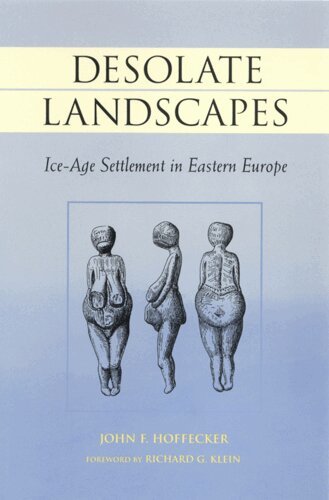
Ice-Age Eastern Europe was an inhospitable place, isolated from the moderating influence of oceans. Unlike Western Europe, which was settled over half a million years ago, Eastern Europe remained largely unoccupied until the appearance of the cold-adapted Neanderthals. When modern humans arrived from southern latitudes, they were anatomically less suited to colder climates, but successfully colonized Eastern Europe with the aid of innovative technologies that their Neanderthal predecessors lacked. John F. Hoffecker provides an overview of Pleistocene or Ice-Age settlement in Eastern Europe with a heavy focus on the adaptations of Neanderthals and modern humans to this harsh environmental setting. Hoffecker argues that the Eastern European record reveals a stark contrast between Neanderthals and modern humans with respect to technology and social organization, both of which are tied to the development of language and the use of symbols. Desolate Landscapes will bring readers up to date with the rich archaeological record in this significant region and its contribution to our understanding of one of our most important events in human evolution - the rise of modern humans and the extinction of the Neanderthals. The book is divided into seven chapters. The first discusses general anthropological principles and theories pertaining to human adaptation and development in cold environments. The second outlines the environmental conditions of the specific area under study in the book. The next two chapters focus on Neanderthal finds in the area. The following two chapters discuss the replacement of the local Neanderthal population by the Cro-magnons, and the development of their way of life in the cold Loess Steppe environment. The final chapter summarizes the discussion and is followed by an extremely valuable and extensive bibliography, more than half of which consists of non-English (primarily Russian) sources.
425 kr
Skickas inom 5-8 vardagar
Until twenty years ago we had no idea which of our genes came from our father and which came from our mother. We took it for granted that our genes expressed themselves identically and that there was a 50/50 chance that they came from either parent. We also assumed that they worked in cooperation with each other. The biggest breakthrough in genetics in the past two decades has been the discovery of genomic imprinting, which allows us to trace genes to the parent of origin. David Haig has been at the forefront of theorizing these developments. He argues that these "paternally and maternally active genes" comprise less than one percent of our total gene count and are far from being cooperative. In fact, they have been shown to be in competition with one another. If Haig's theory holds true, imprinted genes exemplify an extraordinary within-individual conflict, while shaking up our fundamental ideas of what it means to be an individual. This collection of Haig's papers represents a unique comprehensive overview of the state of evolutionary biology. The pages are linked by a commentary that provides background, and brings readers up-to-date on developments that occurred after the paper's original publication. Since genomic imprinting touches on many areas in the life sciences, including evolutionary biology and developmental genetics, Haig's work is scattered through the literature. This volume brings his work together for the first time. A volume in the Rutgers Series in Human Evolution, edited by Robert Trivers. David Haig is an associate professor of organismic and evolutionary biology at Harvard University.
375 kr
Skickas inom 5-8 vardagar
Darwinian Politics is the first book to examine political behavior from a modern evolutionary perspective. Here, Paul H. Rubin discusses group or social behavior, including ethnic and racial conflict; altruism and cooperation; envy; political power; and the role of religion in politics ¾ issues that have formed the hallmark of human social behavior.Adopting a Darwinian perspective, Rubin demonstrates why certain political-moral philosophies succeed or fail in modern Western culture. He begins by showing relationships between biology and natural selection and the history of political philosophy and explains why desirable policies must treat each person as an individual. He considers the notion of group identity and conflict, observing a human propensity to form in-groups, a behavior that does not necessitate but often leads to deviancies such as racism. In discussing altruism, Rubin shows that people are willing to aid the poor if they are convinced that the recipients are not shirkers or free loaders. This explains why recent welfare reforms are widely viewed as successful. Envy, a trait that is often counterproductive in today’s world, is also addressed. In comparing major moral philosophical systems, Rubin contends that utilitarianism is broadly consistent with our evolved preferences. He illustrates evolutionary premises for religious belief and for desires to regulate the behavior of others, and how in today’s world such regulation may not serve any useful purpose.Ultimately, Rubin argues that humans naturally seek political freedom, and modern Western society provides more freedom than any previous one. In light of his analysis, the author extrapolates that, while there are still areas for improvements, humans have done a remarkably good job of satisfying their evolved political preferences.