Schnitzer Studies in Israel Society Series – Serie
Visar alla böcker i serien Schnitzer Studies in Israel Society Series. Handla med fri frakt och snabb leverans.
13 produkter
13 produkter
2 113 kr
Skickas inom 10-15 vardagar
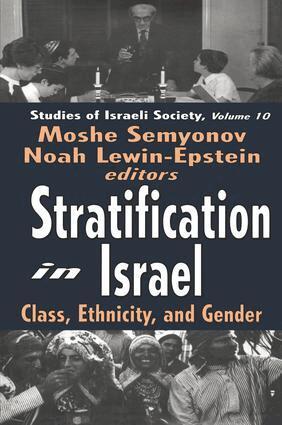
Until recently, issues surrounding ethnic-linked inequality, whether between Jews and Arabs or between Jewish ethnic groups, have dominated research on stratification in Israel to the exclusion of other dimensions. Rapidly growing inequality in Israeli society, and its intergenerational persistence, however, have generated several new trends in research. The chapters included in this volume represent the range and depth of recent developments in the study of social stratification, mobility, and inequality. Although they address a variety of issues, they have in common a focus on the institutional mechanisms that govern the allocation of rewards.The volume is divided into five parts: Part 1, "The Role of Education in the Stratification Process"; Part 2, "Class and Intergenerational Process"; Part 3, "The Ethnic Organization of the Labor Market"; Part 4, "Gender in the Stratification Process"; Part 5, "The State and the Stratification Process." Some chapters apply to Israel classical status attainment models and labor market research, developed primarily in American sociology, highlighting the peculiarities of Israeli society. Others start out with particular characteristics of Israeli society, most notably the centrality of the state apparatus, and explore their consequences for social stratification. Gender inequality inside and outside the military is examined as well as the issue of gender-related labor market inequality. Together these chapters provide a comprehensive picture of the structure of domination and subordination in various spheres of Israeli society, ranging from educational institutions to the labor market, housing, standard of living, and the cultural arena.This volume portrays the multiple dimensions of stratification and inequality in Israel by bringing together some of the most informative sociological research conducted during the past decade. It will be of particular interest to sociologists, social scientists, and students of Judaica.
1 115 kr
Tillfälligt slut
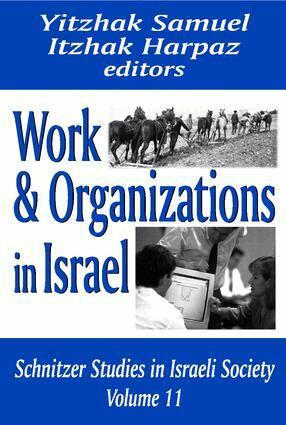
Since the State of Israel was established, its labor force has grown rapidly and has become increasingly diverse in terms of its demographic, cultural, ethnic, and socioeconomic characteristics. Israeli work values have shifted towards greater individualism, materialism, careerism, and preference for white-collar and knowledge-based occupations is evident. A major structural change is underway, as indicated by the decline of agriculture as a component in the Israeli economy and the growth of the industrial sector--mostly towards high technology and innovative enterprises.This volume sheds light on trends and developments that have been taking place in the realm of work in Israel in recent years. It contains a unique selection of articles presenting empirical evidence of the major features and important changes characterizing work organizations and the regime of work in Israeli society: labor relations, work values, power and management in organizations, work in the Kibbutz, inter-organizational relations, women and work, migrants and minorities in the Israeli labor force. Studies show that another two major trends characterize the contemporary economy and the labor market: the trend toward privatization and globalization, the results of which are a continuous decrease of job security and an increasing level of unemployed Israeli men and women that are replaced by the low-cost labor of foreign workers emigrating from third world countries.This timely volume is valuable for its contribution to illuminating the recent changes taking place in the realm of work in Israel, and will be of interest to sociologists, social scientists, and students of Judaica.
2 113 kr
Skickas inom 10-15 vardagar
For over a hundred years, demography has been at the heart of the Zionist project, reflected in the goal of creating and maintaining a Jewish majority in Israel and in ensuring the physical continuation of the Jewish people. Demography continues to be an essential issue in the current struggle between Israel and Palestine. Yet in academic discourse, demography is treated as a minor, largely technical side-issue in the social sciences, with little theoretical consideration given to population processes as social processes. Israel's Destiny: Fertility and Mortality in a Divided Society brings together important recent work in this area. The contributions to Israel's Destiny focus on the influence of religion, religiosity, nationalism, and ethnicity on fertility and mortality in Israel.Israel's Destiny is divided into four sections: the first focuses on fertility, particularly Israel's apparently high birth rate when compared with other countries with a similar standard of living; the second looks at patterns of nuptiality and contraception and the way marriage patterns are shaping group boundaries; the third looks at mortality, particularly among men; and the fourth looks at social policy effects of the demographic process.The main focus is that differential reproduction of the population by national and ethnic group, as well as social class--through fertility and mortality--and the social structuring of the population--through marriage patterns--are critical elements in the creation and evolution of Israeli society. The editors' introduction places all these studies in a wider perspective of current demographic research. The volume provides a concise population history of the state of Israel to help the reader put the studies in their proper local and historical context.
508 kr
Tillfälligt slut
Until recently, issues surrounding ethnic-linked inequality, whether between Jews and Arabs or between Jewish ethnic groups, have dominated research on stratification in Israel to the exclusion of other dimensions. Rapidly growing inequality in Israeli society, and its intergenerational persistence, however, have generated several new trends in research. The chapters included in this volume represent the range and depth of recent developments in the study of social stratification, mobility, and inequality. Although they address a variety of issues, they have in common a focus on the institutional mechanisms that govern the allocation of rewards.The volume is divided into five parts: Part 1, "The Role of Education in the Stratification Process"; Part 2, "Class and Intergenerational Process"; Part 3, "The Ethnic Organization of the Labor Market"; Part 4, "Gender in the Stratification Process"; Part 5, "The State and the Stratification Process." Some chapters apply to Israel classical status attainment models and labor market research, developed primarily in American sociology, highlighting the peculiarities of Israeli society. Others start out with particular characteristics of Israeli society, most notably the centrality of the state apparatus, and explore their consequences for social stratification. Gender inequality inside and outside the military is examined as well as the issue of gender-related labor market inequality. Together these chapters provide a comprehensive picture of the structure of domination and subordination in various spheres of Israeli society, ranging from educational institutions to the labor market, housing, standard of living, and the cultural arena.This volume portrays the multiple dimensions of stratification and inequality in Israel by bringing together some of the most informative sociological research conducted during the past decade. It will be of particular interest to sociologists, social scientists, and students of Judaica.
469 kr
Skickas inom 10-15 vardagar
Since the State of Israel was established, its labor force has grown rapidly and has become increasingly diverse in terms of its demographic, cultural, ethnic, and socioeconomic characteristics. Israeli work values have shifted towards greater individualism, materialism, careerism, and preference for white-collar and knowledge-based occupations is evident. A major structural change is underway, as indicated by the decline of agriculture as a component in the Israeli economy and the growth of the industrial sector--mostly towards high technology and innovative enterprises.This volume sheds light on trends and developments that have been taking place in the realm of work in Israel in recent years. It contains a unique selection of articles presenting empirical evidence of the major features and important changes characterizing work organizations and the regime of work in Israeli society: labor relations, work values, power and management in organizations, work in the Kibbutz, inter-organizational relations, women and work, migrants and minorities in the Israeli labor force. Studies show that another two major trends characterize the contemporary economy and the labor market: the trend toward privatization and globalization, the results of which are a continuous decrease of job security and an increasing level of unemployed Israeli men and women that are replaced by the low-cost labor of foreign workers emigrating from third world countries.This timely volume is valuable for its contribution to illuminating the recent changes taking place in the realm of work in Israel, and will be of interest to sociologists, social scientists, and students of Judaica.
659 kr
Skickas inom 10-15 vardagar
This is an unusual and extremely timely collective effort. It appears at a moment inwhich Israelis not only must confront their Arab neighbors, but must deal with one another as Jews possessing radically different views on the present and future of the Jewish tradition. With this seventh volume of the series, the Israeli Sociological Society has turned its attention to religion, an area that for many years has been of high importance, but low profile in Israeli affairs and in the wider Middle Eastern context.Chapters and contributors include: "Jewish Civilization: Approaches to Problems of Israeli Society" by Shmuel N. Eisenstadt; "Life Tradition and Book Tradition in the Development of Ultraorthodox Judaism" by Menachem Friedman; "Religious Kibbutzim: Judaism and Modernization" by Aryei Fishman; "The Religion of Elderly Oriental Jewish Women" by Susan Sered; and "Hanukkah and the Myth of the Maccabees in Ideology and in Society" by Eliezer Don-Yehiya. The increasing presence of religious activism in contemporary Israel, side by side with subtle changes in the religion of Israeli Sephardim, makes the topic of religion essential for an understanding of Israel and much of the Middle East generally. Israeli Judaism is a significant work, and will be of interest to theologians, philosophers, sociologists, anthropologists, and political theorists.
673 kr
Skickas inom 10-15 vardagar
For over a hundred years, demography has been at the heart of the Zionist project, reflected in the goal of creating and maintaining a Jewish majority in Israel and in ensuring the physical continuation of the Jewish people. Demography continues to be an essential issue in the current struggle between Israel and Palestine. Yet in academic discourse, demography is treated as a minor, largely technical side-issue in the social sciences, with little theoretical consideration given to population processes as social processes. Israel's Destiny: Fertility and Mortality in a Divided Society brings together important recent work in this area. The contributions to Israel's Destiny focus on the influence of religion, religiosity, nationalism, and ethnicity on fertility and mortality in Israel.Israel's Destiny is divided into four sections: the first focuses on fertility, particularly Israel's apparently high birth rate when compared with other countries with a similar standard of living; the second looks at patterns of nuptiality and contraception and the way marriage patterns are shaping group boundaries; the third looks at mortality, particularly among men; and the fourth looks at social policy effects of the demographic process.The main focus is that differential reproduction of the population by national and ethnic group, as well as social class--through fertility and mortality--and the social structuring of the population--through marriage patterns--are critical elements in the creation and evolution of Israeli society. The editors' introduction places all these studies in a wider perspective of current demographic research. The volume provides a concise population history of the state of Israel to help the reader put the studies in their proper local and historical context.
2 176 kr
Skickas inom 10-15 vardagar
In the twentieth century, all developed nations began to undergo unprecedented demographic changes, as their birth rates declined, and life expectancies increased significantly --an average of thirty years in less than a century. These developments have caused major transformations in the composition of populations in these countries, especially in terms of the proportions of the various age groups. While the age groups of children and adolescents have decreased, those of elderly persons aged 65 and over, have increased.Consistent with the situation in other developed nations, the absolute number and percentage of elderly persons in the Israeli population is increasing, while the percentage of younger persons is decreasing. Israel, however, differs from other developed countries in the pace of this demographic change, the composition of its population, and the ways it can address needs related to aging. The demographic figures in Israel indicate that not only is the proportion of elderly persons in the total population growing, but that the old population itself is rapidly aging as well.This volume exemplifies how social science research can promote knowledge about and understanding of needs and opportunities for adaptation, and assist in evaluating the outcomes of policies and services on the personal, community and national levels, as well as suggest required changes. The variety of topics covered in this volume on age-related research, policies and practice reflects a wide range of research by Israeli scholars on social aspects of aging. Their research offers a glimpse into the knowledge base that has been built over the years on the aging process in Israel, the population of elderly people, and the national policies and network of services for the aged. Other developed countries with aging populations have much to learn from the Israeli experience.
693 kr
Skickas inom 10-15 vardagar
In the twentieth century, all developed nations began to undergo unprecedented demographic changes, as their birth rates declined, and life expectancies increased significantly --an average of thirty years in less than a century. These developments have caused major transformations in the composition of populations in these countries, especially in terms of the proportions of the various age groups. While the age groups of children and adolescents have decreased, those of elderly persons aged 65 and over, have increased.Consistent with the situation in other developed nations, the absolute number and percentage of elderly persons in the Israeli population is increasing, while the percentage of younger persons is decreasing. Israel, however, differs from other developed countries in the pace of this demographic change, the composition of its population, and the ways it can address needs related to aging. The demographic figures in Israel indicate that not only is the proportion of elderly persons in the total population growing, but that the old population itself is rapidly aging as well.This volume exemplifies how social science research can promote knowledge about and understanding of needs and opportunities for adaptation, and assist in evaluating the outcomes of policies and services on the personal, community and national levels, as well as suggest required changes. The variety of topics covered in this volume on age-related research, policies and practice reflects a wide range of research by Israeli scholars on social aspects of aging. Their research offers a glimpse into the knowledge base that has been built over the years on the aging process in Israel, the population of elderly people, and the national policies and network of services for the aged. Other developed countries with aging populations have much to learn from the Israeli experience.
1 115 kr
Tillfälligt slut
This is an unusual and extremely timely collective effort. It appears at a moment inwhich Israelis not only must confront their Arab neighbors, but must deal with one another as Jews possessing radically different views on the present and future of the Jewish tradition. With this seventh volume of the series, the Israeli Sociological Society has turned its attention to religion, an area that for many years has been of high importance, but low profile in Israeli affairs and in the wider Middle Eastern context.Chapters and contributors include: "Jewish Civilization: Approaches to Problems of Israeli Society" by Shmuel N. Eisenstadt; "Life Tradition and Book Tradition in the Development of Ultraorthodox Judaism" by Menachem Friedman; "Religious Kibbutzim: Judaism and Modernization" by Aryei Fishman; "The Religion of Elderly Oriental Jewish Women" by Susan Sered; and "Hanukkah and the Myth of the Maccabees in Ideology and in Society" by Eliezer Don-Yehiya. The increasing presence of religious activism in contemporary Israel, side by side with subtle changes in the religion of Israeli Sephardim, makes the topic of religion essential for an understanding of Israel—and much of the Middle East generally. Israeli Judaism is a significant work, and will be of interest to theologians, philosophers, sociologists, anthropologists, and political theorists.
1 115 kr
Tillfälligt slut
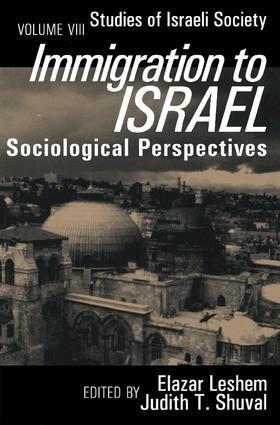
This eighth volume in the Studies of Israeli Society series presents a broad array of topics related to the sociology of immigration to Israel. The focus is on immigration and migration during the 1980s and 1990s. The chapters were selected from a list of approximately 450 articles on the subject by Israeli sociologists. The book covers such issues as migrants in the occupational structure; migration and health; formal and informal mechanisms of integration; ethnic identities and processes of integration; and processes of migration and their implications.Immigration to Israel opens with two papers written specifically for this volume. The first is a theoretical-historical chapter by the editors. They discuss the role and contribution of Israeli sociologists to the ongoing literature of migration.The second by Sergio DellaPergola, provides a historical and comparative perspective of the underlying demographic characteristics of migration to Israel in the context of global Jewish migration processes.Other chapters and contributors include: "New Entrepreneurs and Entrepreneurial Aspirations among Immigrants from the Former USSR in Israel" by M. Lerner and Y. Hendeles, "New Immigrants as a Special Group in the Israeli Armed Forces" by V. Azarya and B. Kimmerling; "Iranian Ethnicity in Israel" by J. L. Goldstein; "Ethiopian Immigrants in Israel" by S. Kaplan and C. Rosen; 'The Attitudes of Israeli Youth Toward Inter-ethnic and Intra-ethnic Marriage" by R. Shachar; and "Jewish Immigrants from Israel in the United States" by Z. Eisenbach. Immigration to Israel: Sociological Perspectives concludes with a selected bibliography. This volume contains a wealth of information and will be important to sociologists, historians, scholars of Israeli culture, and ethnicity specialists.
578 kr
Skickas inom 10-15 vardagar
The sociology of language and the sociology of communication are well-established fields in Israeli sociology, but it is only recently that their departments have grown vigorously in Israel's various universities. They are long-standing, respected disciplines in international sociology, as is evidenced by their academic associations and the reputation of their specialized journals. Language and Communication in Israel, the ninth volume of the Studies of Israeli Society series, presents a broad range of the various approaches and questions that preoccupy Israel's sociologists of language and communication.The collection starts with studies that focus on the presence of language and communication in daily life. Subsequent chapters analyze the relation of language and communication to social and cultural pluralism. Also included is a study of linguistic and communication aspects of politics and elections. A special chapter consists of an examination of the role of language and communication in the Israeli-Arab conflict and an analysis of the intermingling of mass media and the state.In their introduction, the editors discuss each of the chapters under the guidance of a key question, namely, the significance of the studies presented for the profile of the Israeli society, on the one hand, and of the Israeli scholarship of these fields, on the other. Two concluding chapters are also included in this landmark volume, one by Joshua A. Fishman and one by Elihu Katz. Each author emphasizes what he thinks is of major importance to the future of the sociology of language and the sociology of communication. Language and Communication in Israel is an enlightening study of two growing fields. It is essential reading for scholars of linguistics and communications as well as for sociologists and Israeli studies specialists. Hanna Herzog is associate professor in the department of sociology at Tel-Aviv University. She is the author of Political Ethnicity, Contest of Symbols, Realistic Women, and Gendering Politics.
673 kr
Skickas inom 10-15 vardagar
This eighth volume in the Studies of Israeli Society series presents a broad array of topics related to the sociology of immigration to Israel. The focus is on immigration and migration during the 1980s and 1990s. The chapters were selected from a list of approximately 450 articles on the subject by Israeli sociologists. The book covers such issues as migrants in the occupational structure; migration and health; formal and informal mechanisms of integration; ethnic identities and processes of integration; and processes of migration and their implications.Immigration to Israel opens with two papers written specifically for this volume. The first is a theoretical-historical chapter by the editors. They discuss the role and contribution of Israeli sociologists to the ongoing literature of migration.The second by Sergio DellaPergola, provides a historical and comparative perspective of the underlying demographic characteristics of migration to Israel in the context of global Jewish migration processes.Other chapters and contributors include: "New Entrepreneurs and Entrepreneurial Aspirations among Immigrants from the Former USSR in Israel" by M. Lerner and Y. Hendeles, "New Immigrants as a Special Group in the Israeli Armed Forces" by V. Azarya and B. Kimmerling; "Iranian Ethnicity in Israel" by J. L. Goldstein; "Ethiopian Immigrants in Israel" by S. Kaplan and C. Rosen; 'The Attitudes of Israeli Youth Toward Inter-ethnic and Intra-ethnic Marriage" by R. Shachar; and "Jewish Immigrants from Israel in the United States" by Z. Eisenbach. Immigration to Israel: Sociological Perspectives concludes with a selected bibliography. This volume contains a wealth of information and will be important to sociologists, historians, scholars of Israeli culture, and ethnicity specialists.