Moshe Semyonov - Böcker
Visar alla böcker från författaren Moshe Semyonov. Handla med fri frakt och snabb leverans.
5 produkter
5 produkter
2 103 kr
Skickas inom 10-15 vardagar
The Arab Minority in Israel's Economy considers the Arab population as an integral, albeit disadvantaged, part of Israeli society. Using data from a thirty-year period, the book looks at Arab participation in the economy, especially in the labor market, showing how significant socioeconomic inequality persists despite a fundamental tenet of Israel's declaration of independence asserting equality of political and social rights of all its citizens. Taking an ethnic competition perspective, the authors explore the extent of inequality, uncovering the institutional and social processes that influence it. They examine the role of local labor markets and individual human resources, giving special attention to the growing labor force participation of Arab women. They also consider the gains of the majority Jewish population that have resulted from competition and economic discrimination against Arabs. Although the Arab community in Israel has been studied in the past, this book is unique in its detailed analysis of employment activity within and outside of the Arab sector and in examining both Arabs and Jews within the stratification system. The book fosters deeper understanding of Israeli society and of multi-ethnic societies more generally.
621 kr
Skickas inom 10-15 vardagar
The Arab Minority in Israel's Economy considers the Arab population as an integral, albeit disadvantaged, part of Israeli society. Using data from a thirty-year period, the book looks at Arab participation in the economy, especially in the labor market, showing how significant socioeconomic inequality persists despite a fundamental tenet of Israel's declaration of independence asserting equality of political and social rights of all its citizens. Taking an ethnic competition perspective, the authors explore the extent of inequality, uncovering the institutional and social processes that influence it. They examine the role of local labor markets and individual human resources, giving special attention to the growing labor force participation of Arab women. They also consider the gains of the majority Jewish population that have resulted from competition and economic discrimination against Arabs. Although the Arab community in Israel has been studied in the past, this book is unique in its detailed analysis of employment activity within and outside of the Arab sector and in examining both Arabs and Jews within the stratification system. The book fosters deeper understanding of Israeli society and of multi-ethnic societies more generally.
2 088 kr
Skickas inom 10-15 vardagar
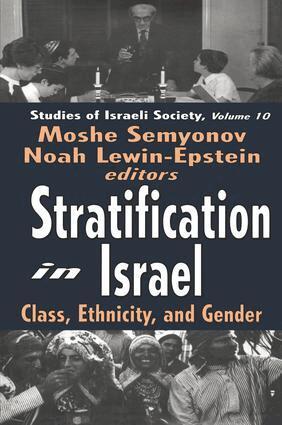
Until recently, issues surrounding ethnic-linked inequality, whether between Jews and Arabs or between Jewish ethnic groups, have dominated research on stratification in Israel to the exclusion of other dimensions. Rapidly growing inequality in Israeli society, and its intergenerational persistence, however, have generated several new trends in research. The chapters included in this volume represent the range and depth of recent developments in the study of social stratification, mobility, and inequality. Although they address a variety of issues, they have in common a focus on the institutional mechanisms that govern the allocation of rewards.The volume is divided into five parts: Part 1, "The Role of Education in the Stratification Process"; Part 2, "Class and Intergenerational Process"; Part 3, "The Ethnic Organization of the Labor Market"; Part 4, "Gender in the Stratification Process"; Part 5, "The State and the Stratification Process." Some chapters apply to Israel classical status attainment models and labor market research, developed primarily in American sociology, highlighting the peculiarities of Israeli society. Others start out with particular characteristics of Israeli society, most notably the centrality of the state apparatus, and explore their consequences for social stratification. Gender inequality inside and outside the military is examined as well as the issue of gender-related labor market inequality. Together these chapters provide a comprehensive picture of the structure of domination and subordination in various spheres of Israeli society, ranging from educational institutions to the labor market, housing, standard of living, and the cultural arena.This volume portrays the multiple dimensions of stratification and inequality in Israel by bringing together some of the most informative sociological research conducted during the past decade. It will be of particular interest to sociologists, social scientists, and students of Judaica.
508 kr
Tillfälligt slut
Until recently, issues surrounding ethnic-linked inequality, whether between Jews and Arabs or between Jewish ethnic groups, have dominated research on stratification in Israel to the exclusion of other dimensions. Rapidly growing inequality in Israeli society, and its intergenerational persistence, however, have generated several new trends in research. The chapters included in this volume represent the range and depth of recent developments in the study of social stratification, mobility, and inequality. Although they address a variety of issues, they have in common a focus on the institutional mechanisms that govern the allocation of rewards.The volume is divided into five parts: Part 1, "The Role of Education in the Stratification Process"; Part 2, "Class and Intergenerational Process"; Part 3, "The Ethnic Organization of the Labor Market"; Part 4, "Gender in the Stratification Process"; Part 5, "The State and the Stratification Process." Some chapters apply to Israel classical status attainment models and labor market research, developed primarily in American sociology, highlighting the peculiarities of Israeli society. Others start out with particular characteristics of Israeli society, most notably the centrality of the state apparatus, and explore their consequences for social stratification. Gender inequality inside and outside the military is examined as well as the issue of gender-related labor market inequality. Together these chapters provide a comprehensive picture of the structure of domination and subordination in various spheres of Israeli society, ranging from educational institutions to the labor market, housing, standard of living, and the cultural arena.This volume portrays the multiple dimensions of stratification and inequality in Israel by bringing together some of the most informative sociological research conducted during the past decade. It will be of particular interest to sociologists, social scientists, and students of Judaica.
1 707 kr
Skickas inom 7-10 vardagar
This insightful study explores the growth of the two largest post-industrial immigrant nations since the Second World War - Australia and Israel. Almost one in four Australians were born outside the country, more than one in three Israelis. Immigration and Nation Building brings a comparative approach to the discussion of patterns of immigration, legal structures, the labour market, civil society, public opinion, and integration of the second generation. The result is a thought provoking analysis of the distinctive and universal in the development of two immigrant nations. By comparing the experiences of these two countries, this ground-breaking study of immigration and its impact will appeal to policy analysts and researchers in government and academia, as well as students in the areas of sociology, politics, economics and history.