SIAM Spotlights - Böcker
Visar alla böcker i serien SIAM Spotlights. Handla med fri frakt och snabb leverans.
8 produkter
8 produkter
Preconditioning and the Conjugate Gradient Method in the Context of Solving PDEs
Häftad, Engelska, 2014
559 kr
Skickas inom 7-10 vardagar
This first title in SIAM’s Spotlights book series is about the interplay between modeling, analysis, discretization, matrix computation, and model reduction. The authors link PDE analysis, functional analysis, and calculus of variations with matrix iterative computation using Krylov subspace methods and address the challenges that arise during formulation of the mathematical model through to efficient numerical solution of the algebraic problem.The book’s central concept, preconditioning of the conjugate gradient method, is traditionally developed algebraically using the preconditioned finite-dimensional algebraic system. In this text, however, preconditioning is connected to the PDE analysis, and the infinite-dimensional formulation of the conjugate gradient method and its discretization and preconditioning are linked together.This text challenges commonly held views, addresses widespread misunderstandings, and formulates thought-provoking open questions for further research.
559 kr
Skickas inom 7-10 vardagar
Scientists and engineers use computer simulations to study relationships between a model's input parameters and its outputs. However, thorough parameter studies are challenging, if not impossible, when the simulation is expensive and the model has several inputs. To enable studies in these instances, the engineer may attempt to reduce the dimension of the model's input parameter space. Active subspaces are an emerging set of dimension reduction tools that identify important directions in the parameter space. This book describes techniques for discovering a model's active subspace and proposes methods for exploiting the reduced dimension to enable otherwise infeasible parameter studies.Readers will find:New ideas for dimension reduction.Easy-to-implement algorithms.Several examples of active subspaces in action.
559 kr
Skickas inom 7-10 vardagar
Based on first principle quantum mechanics, electronic structure theory is widely used in physics, chemistry, materials science, and related fields and has recently received increasing research attention in applied and computational mathematics. This book provides a self-contained, mathematically oriented introduction to the subject and its associated algorithms and analysis. It will help applied mathematics students and researchers with minimal background in physics understand the basics of electronic structure theory and prepare them to conduct research in this area.A Mathematical Introduction to Electronic Structure Theory begins with an elementary introduction of quantum mechanics, including the uncertainty principle and the Hartree–Fock theory, which is considered the starting point of modern electronic structure theory. The authors then provide an in-depth discussion of two carefully selected topics that are directly related to several aspects of modern electronic structure calculations: density matrix based algorithms and linear response theory. Chapter 2 introduces the Kohn–Sham density functional theory with a focus on the density matrix based numerical algorithms, and Chapter 3 introduces linear response theory, which provides a unified viewpoint of several important phenomena in physics and numerics. An understanding of these topics will prepare readers for more advanced topics in this field. The book concludes with the random phase approximation to the correlation energy.The book is written for advanced undergraduate and beginning graduate students, specifically those with mathematical backgrounds but without a priori knowledge of quantum mechanics, and can be used for self-study by researchers, instructors, and other scientists. The book can also serve as a starting point to learn about many-body perturbation theory, a topic at the frontier of the study of interacting electrons.
559 kr
Skickas inom 7-10 vardagar
This book presents the first survey of the Localized Orthogonal Decomposition (LOD) method, a pioneering approach for the numerical homogenization of partial differential equations with multiscale data beyond periodicity and scale separation. The authors provide a careful error analysis, including previously unpublished results, and a complete implementation of the method in MATLAB. They also reveal how the LOD method relates to classical homogenization and domain decomposition. Illustrated with numerical experiments that demonstrate the significance of the method, the book is enhanced by a survey of applications including eigenvalue problems and evolution problems.Numerical Homogenization by Localized Orthogonal Decomposition is appropriate for graduate students in applied mathematics, numerical analysis, and scientific computing. Researchers in the field of computational partial differential equations will find this self-contained book of interest, as will applied scientists and engineers interested in multiscale simulation.
559 kr
Skickas inom 7-10 vardagar
The conjugate gradient (CG) algorithm is almost always the iterative method of choice for solving linear systems with symmetric positive definite matrices. This book describes and analyzes techniques based on Gauss quadrature rules to cheaply compute bounds on norms of the error. The techniques can be used to derive reliable stopping criteria. Computation of estimates of the smallest and largest eigenvalues during CG iterations is also shown. The algorithms are illustrated by many numerical experiments, and they can be easily incorporated into existing CG codes.
559 kr
Skickas inom 7-10 vardagar
Matrix eigenvalue problems arise in a wide variety of fields in science and engineering, so it is important to have reliable and efficient methods for solving them. Of the methods devised, bulge-chasing algorithms, such as the famous QR and QZ algorithms, are the most important. This book focuses on pole-swapping algorithms, a new class of methods that are generalizations of bulge-chasing algorithms and a bit faster and more accurate owing to their inherent flexibility. The pole-swapping theory developed by the authors sheds light on the functioning of the whole class of algorithms, including QR and QZ.The only book on the topic, Pole-Swapping Algorithms for the Eigenvalue Problem describes the state of the art on eigenvalue methods and provides an improved understanding and explanation of why these important algorithms work.AudienceThis book is for researchers and students in the field of matrix computations, software developers, and anyone in academia or industry who needs to understand how to solve eigenvalue problems, which are ubiquitous in science and engineering.
625 kr
Skickas inom 7-10 vardagar
Research on the Anderson Acceleration (AA) has exploded in the last 15 years. This book brings together these recent fundamental results applied to nonlinear solvers for PDEs, which are ubiquitous across mathematics, science, engineering, and economics as predictive models for a vast quantity of important phenomena. Coverage includes:AA convergence theory for both contractive and non-contractive operators, filtering techniques for AA, showing how the convergence theory can be fit to various application problems, andAA’s effect on sublinear convergence, andhow AA can be best combined with Newton’s method.The authors provide proofs of the main theorems and results of many of the test examples. Code for the test examples is provided in an online repository.AudienceAnderson Acceleration for Numerical PDE is intended for mathematicians, scientists, and engineers who solve nonlinear problems when Newton’s method either fails or is inefficient. Graduate students in applied mathematics and computational science will also find the book useful. It has sufficient theory and coding for use in a second-year graduate course.
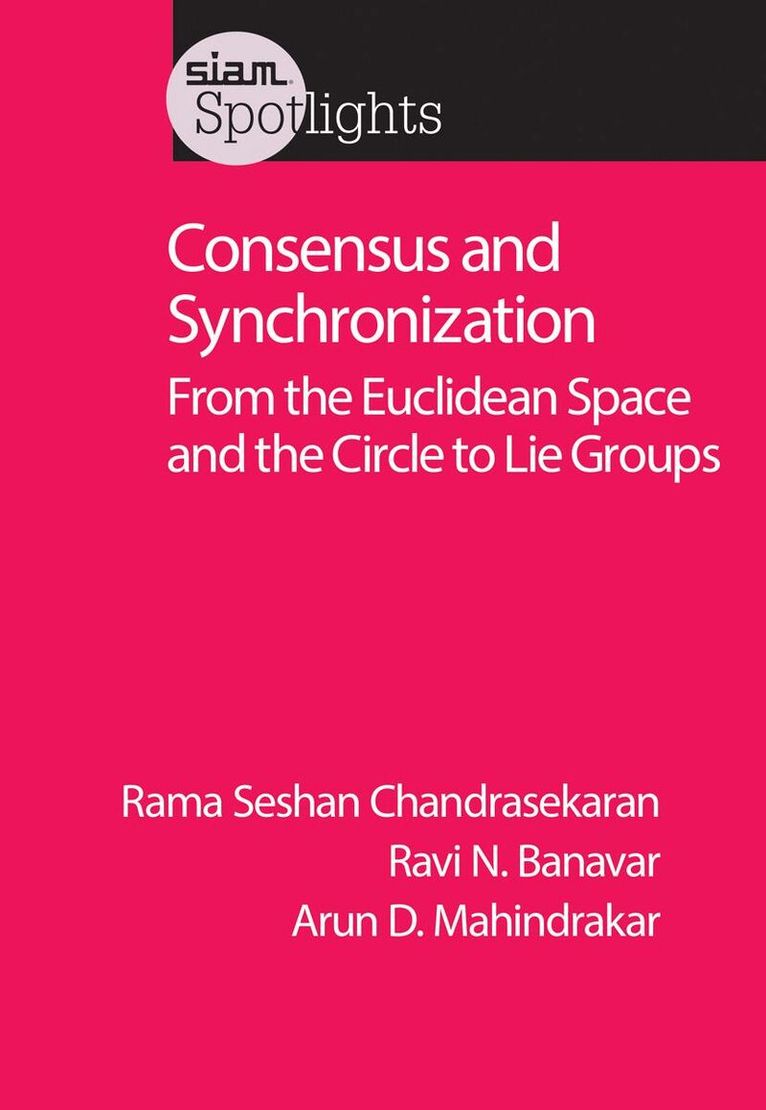
Consensus and Synchronization
From the Euclidean Space and the Circle to Lie Groups
Häftad, Engelska, 2026
625 kr
Skickas inom 7-10 vardagar
Coordination, consensus, and synchronization are found in diverse natural phenomena and engineering applications. Examples are flocking birds, illuminating fireflies, a school of fish, and distributed control and sensing. The simplest of such problems are set in the Euclidean spaces and the circle. Consensus and Synchronization: From the Euclidean Space and the Circle to Lie Groups moves beyond this domain to the more sophisticated setting of Lie groups with bi-invariant metrics and extends the mathematical theories of consensus and synchronization for generic scenarios. This is relevant to applications such as robotics, autonomous vehicles, and spacecraft.