Singleton Center Books in Premodern Europe - Böcker
Visar alla böcker i serien Singleton Center Books in Premodern Europe. Handla med fri frakt och snabb leverans.
4 produkter
4 produkter
484 kr
Tillfälligt slut
During the Renaissance, collections of letters both satisfied humanist enthusiasm for ancient literary forms and provided the flexibility of a format appropriate to many types of inquiry. The printed collections of medical letters by Giovanni Manardo of Ferrara and other physicians in early sixteenth-century Europe may thus be regarded as products of medical humanism. The letters of mid- and late sixteenth-century Italian and German physicians examined in "Communities of Learned Experience" by Nancy G. Siraisi also illustrate practices associated with the concepts of the Republic of Letters: open and relatively informal communication among a learned community and a liberal exchange of information and ideas. Additionally, such published medical correspondence may often have served to provide mutual reinforcement of professional reputation. Siraisi uses some of these collections to compare approaches to sharing medical knowledge across broad regions of Europe and within a city, with the goal of illuminating geographic differences as well as diversity within social, urban, courtly, and academic environments.The collections she has selected include essays on general medical topics addressed to colleagues or disciples, some advice for individual patients (usually written at the request of the patient's doctor), and a strong dose of controversy.
Creatures Born of Mud and Slime
The Wonder and Complexity of Spontaneous Generation
Inbunden, Engelska, 2018
509 kr
Skickas inom 11-20 vardagar
We accept that, at some point in the history of our universe, living creatures emerged from nonliving matter. Yet from the time of Aristotle until the late nineteenth century, many people believed in spontaneous generation, that living creatures sprang into existence from rotting material. As Daryn Lehoux explains in this fascinating book, spontaneous generation was perhaps the last stand of the ancient scientific worldview. In Creatures Born of Mud and Slime, Lehoux shows that-far from being a superstitious, gullible, or simplistic belief-spontaneous generation was a sophisticated and painstakingly grounded fact that stood up to the best scientific testing. Starting with the ancient Greeks' careful and detailed investigations into how animals are generated straight through to the early modern period, Lehoux brings to life the intellectual contexts, rivalries, observational evidence, and complex and fascinating theories that were used to understand and explain the phenomena. The book highlights both the weirdness and the wonder that lie at the heart of investigations into nature.Lehoux concludes with a new look at a set of conflicting experiments that demonstrate that even the best scientific evidence can end up muddying what we take to be the truth about the world. Creatures Born of Mud and Slime is a compelling look at how we understand conceptions of scientific change, truth, and progress.
469 kr
Skickas
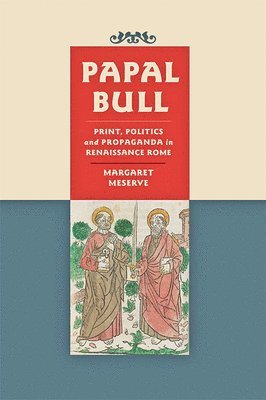
How did Europe's oldest political institution come to grips with the disruptive new technology of print?Printing thrived after it came to Rome in the 1460s. Renaissance scholars, poets, and pilgrims in the Eternal City formed a ready market for mass-produced books. But Rome was also a capital city—seat of the Renaissance papacy, home to its bureaucracy, and a hub of international diplomacy—and print played a role in these circles, too. In Papal Bull, Margaret Meserve uncovers a critical new dimension of the history of early Italian printing by revealing how the Renaissance popes wielded print as a political tool. Over half a century of war and controversy—from approximately 1470 to 1520—the papacy and its agents deployed printed texts to potent effect, excommunicating enemies, pursuing diplomatic alliances, condemning heretics, publishing indulgences, promoting new traditions, and luring pilgrims and their money to the papal city. Early modern historians have long stressed the innovative press campaigns of the Protestant Reformers, but Meserve shows that the popes were even earlier adopters of the new technology, deploying mass communication many decades before Luther. The papacy astutely exploited the new medium to broadcast ancient claims to authority and underscore the centrality of Rome to Catholic Christendom. Drawing on a vast archive, Papal Bull reveals how the Renaissance popes used print to project an authoritarian vision of their institution and their capital city, even as critics launched blistering attacks in print that foreshadowed the media wars of the coming Reformation. Papal publishing campaigns tested longstanding principles of canon law promulgation, developed new visual and graphic vocabularies, and prompted some of Europe's first printed pamphlet wars. An exciting interdisciplinary study based on new literary, historical, and bibliographical evidence, this book will appeal to students and scholars of the Italian Renaissance, the Reformation, and the history of the book.
850 kr
Kommande
How Renaissance writers rebuilt ancient texts, one fragment at a time.Across the European Renaissance, ancient literature circulated in damaged, incomplete, and fragmentary forms. Missing lines, lost endings, and textual gaps were not obstacles to reading the classics; instead, they were invitations to fill in the blanks. In Antiquity Made Whole, Leah Whittington studies the practice of composing supplements, continuations, and completions composed for such works and places this practice at the center of Renaissance literary culture. Whittington uncovers a hidden literary archive in which authors set out to restore and revive antiquity through creative means. Though often overlooked in studies of classical transmission and reception, supplements appeared in manuscripts and printed books wherever classical literature was studied and published between 1400 and 1700. These texts were closely tied to the scholarly practices that defined early classical scholarship, sharing methods and materials with textual criticism, translation, and imitation. Studying ancient writers such as Vergil, Plautus, and Cicero alongside the early modern authors who wrote in the gaps, from Maffeo Vegio to Chaucer, Spenser, and Thomas May, Whittington shows how supplement writers worked across historical and fictional registers. Their work helps to refine modern distinctions between literary creativity and historical scholarship and reveals how Renaissance readers understood preservation as an active, generative process. By situating supplements within the history of philology, Antiquity Made Whole offers a new account of Renaissance classical culture and its afterlives, providing timely insight into contemporary debates about restoration, conservation, and the stewardship of the past.