Social Text Book - Böcker
Visar alla böcker i serien Social Text Book. Handla med fri frakt och snabb leverans.
6 produkter
6 produkter
501 kr
Skickas inom 3-6 vardagar
In this significant Marxist critique of contemporary American imperialism, the cultural theorist Randy Martin argues that a finance-based logic of risk control has come to dominate Americans’ everyday lives as well as U.S. foreign and domestic policy. Risk management-the ability to adjust for risk and to leverage it for financial gain-is the key to personal finance as well as the defining element of the massive global market in financial derivatives. The United States wages its amorphous war on terror by leveraging particular interventions (such as Iraq) to much larger ends (winning the war on terror) and by deploying small numbers of troops and targeted weaponry to achieve broad effects. Both in global financial markets and on far-flung battlegrounds, the multiplier effects are difficult to foresee or control.Drawing on theorists including Michel Foucault, Giorgio Agamben, Michael Hardt, Antonio Negri, and Achille Mbembe, Martin illuminates a frightening financial logic that must be understood in order to be countered. Martin maintains that finance divides the world between those able to avail themselves of wealth opportunities through risk taking (investors) and those who cannot do so, who are considered “at risk.” He contends that modern-day American imperialism differs from previous models of imperialism, in which the occupiers engaged with the occupied to “civilize” them, siphon off wealth, or both. American imperialism, by contrast, is an empire of indifference: a massive flight from engagement. The United States urges an embrace of risk and self-management on the occupied and then ignores or dispossesses those who cannot make the grade.
415 kr
Skickas inom 7-10 vardagar
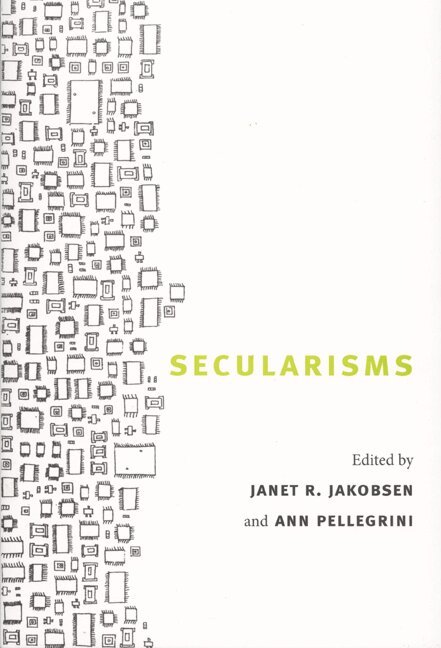
At a time when secularism is put forward as the answer to religious fundamentalism and violence, Secularisms offers a powerful, multivoiced critique of the narrative equating secularism with modernity, reason, freedom, peace, and progress. Bringing together essays by scholars based in religious studies, gender and sexuality studies, history, science studies, anthropology, and political science, this volume challenges the binary conception of “conservative” religion versus “progressive” secularism. With essays addressing secularism in India, Iran, Turkey, Great Britain, China, and the United States, this collection crucially complicates the dominant narrative by showing that secularism is multifaceted. How secularism is lived and experienced varies with its national, regional, and religious context. The essays explore local secularisms in relation to religious traditions ranging from Islam to Judaism, Hinduism to Christianity. Several contributors explicitly take up the way feminism has been implicated in the dominant secularization story. Ultimately, by dislodging secularism’s connection to the single (and singular) progress narrative, this volume seeks to open spaces for other possible narratives about both secularism and religion-as well as for other possible ways of inhabiting the contemporary world.Contributors: Robert J. Baird, Andrew Davison, Tracy Fessenden, Janet R. Jakobsen, Laura Levitt,Molly McGarry, Afsaneh Najmabadi, Taha Parla, Geeta Patel, Ann Pellegrini, Tyler Roberts,Ranu Samantrai, Banu Subramaniam, Rajeswari Sunder Rajan, Angela Zito
Security Archipelago
Human-Security States, Sexuality Politics, and the End of Neoliberalism
Inbunden, Engelska, 2013
1 243 kr
Skickas inom 7-10 vardagar
In The Security Archipelago, Paul Amar provides an alternative historical and theoretical framing of the refashioning of free-market states and the rise of humanitarian security regimes in the Global South by examining the pivotal, trendsetting cases of Brazil and Egypt. Addressing gaps in the study of neoliberalism and biopolitics, Amar describes how coercive security operations and cultural rescue campaigns confronting waves of resistance have appropriated progressive, antimarket discourses around morality, sexuality, and labor. The products of these struggles-including powerful new police practices, religious politics, sexuality identifications, and gender normativities-have traveled across an archipelago, a metaphorical island chain of what the global security industry calls "hot spots." Homing in on Cairo and Rio de Janeiro, Amar reveals the innovative resistances and unexpected alliances that have coalesced in new polities emerging from the Arab Spring and South America's Pink Tide. These have generated a shared modern governance model that he terms the "human-security state."
Security Archipelago
Human-Security States, Sexuality Politics, and the End of Neoliberalism
Häftad, Engelska, 2013
362 kr
Skickas inom 7-10 vardagar
In The Security Archipelago, Paul Amar provides an alternative historical and theoretical framing of the refashioning of free-market states and the rise of humanitarian security regimes in the Global South by examining the pivotal, trendsetting cases of Brazil and Egypt. Addressing gaps in the study of neoliberalism and biopolitics, Amar describes how coercive security operations and cultural rescue campaigns confronting waves of resistance have appropriated progressive, antimarket discourses around morality, sexuality, and labor. The products of these struggles-including powerful new police practices, religious politics, sexuality identifications, and gender normativities-have traveled across an archipelago, a metaphorical island chain of what the global security industry calls "hot spots." Homing in on Cairo and Rio de Janeiro, Amar reveals the innovative resistances and unexpected alliances that have coalesced in new polities emerging from the Arab Spring and South America's Pink Tide. These have generated a shared modern governance model that he terms the "human-security state."
1 362 kr
Skickas inom 11-20 vardagar
Far from creating a borderless world, contemporary globalization has generated a proliferation of borders. In Border as Method, Sandro Mezzadra and Brett Neilson chart this proliferation, investigating its implications for migratory movements, capitalist transformations, and political life. They explore the atmospheric violence that surrounds borderlands and border struggles across various geographical scales, illustrating their theoretical arguments with illuminating case studies drawn from Europe, Asia, the Pacific, the Americas, and elsewhere. Mezzadra and Neilson approach the border not only as a research object but also as an epistemic framework. Their use of the border as method enables new perspectives on the crisis and transformations of the nation-state, as well as powerful reassessments of political concepts such as citizenship and sovereignty.
322 kr
Skickas inom 7-10 vardagar
Far from creating a borderless world, contemporary globalization has generated a proliferation of borders. In Border as Method, Sandro Mezzadra and Brett Neilson chart this proliferation, investigating its implications for migratory movements, capitalist transformations, and political life. They explore the atmospheric violence that surrounds borderlands and border struggles across various geographical scales, illustrating their theoretical arguments with illuminating case studies drawn from Europe, Asia, the Pacific, the Americas, and elsewhere. Mezzadra and Neilson approach the border not only as a research object but also as an epistemic framework. Their use of the border as method enables new perspectives on the crisis and transformations of the nation-state, as well as powerful reassessments of political concepts such as citizenship and sovereignty.