Southover Press Historic Cookery and Housekeeping – Serie
Visar alla böcker i serien Southover Press Historic Cookery and Housekeeping. Handla med fri frakt och snabb leverans.
8 produkter
8 produkter
413 kr
Skickas inom 5-8 vardagar
870 kr
Skickas inom 3-6 vardagar
266 kr
Skickas
The Art of Cookery is the only book of its kind to have come out of an English religious community. It is also that very rare thing, a cookery book of the English 18th-century that has the author’s own recipes throughout; nothing seems to have been plagiarized or borrowed from other writers.The Dean of Durham Cathedral, who employed the author, had a lavish grant for entertaining and his generous hospitality meant that his cook had to cater for all levels of society, from canons of the Cathedral with sophisticated tastes such as the gourmand Dr. Jacque Sterne, to tradesmen, poor widows, and those of even more modest status. Thacker’s book keeps many pre-Reformation recipes and thus shows the gradual transition in the Cathedral’s eating habits. This facsimilie is introduced by the well-known food historian Ivan Day who examines the recipes and reveals the remarkable tradition of ecclesiastical hospitality that survived at Durham for more than eight hundred years.
355 kr
Tillfälligt slut
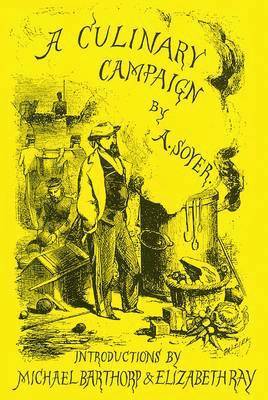
Alexis Soyer is known as the great cook of the Reform Club and author of a number of cookery books who single-handedly transformed Army catering which in the mid-nineteenth century was truly horrific. This is the first reprint of Soyer's extremely rare book, first published in 1857, about his time in the Crimean War. Soyer, a Frenchman by birth who worked his entire life in the UK, went to the front at his own expense. He was a celebrity chef with a social conscience having also fed starving Irish during the Great Famine. His witty first-hand account is informative and vivid and conveys the conviction and diplomatic skills that enabled him to get things done. For instance, he reformed army food and developed the field stove which bears his name was which was still being used in modified form during the Gulf War. He became a friend of Florence Nightingale and used his contacts among the major military figures of the day to transform conditions for the ordinary soldier. Sadly, he himself never recovered from his time in the Crimea and died two years after the war ended. The Army has plans to restore his tomb in Kensal Green, a belated gesture towards a man to whom it owes so much.The Guild of Food Writers have awarded the 2007 prize to "Relish" by Ruth Cowen, a full-scale biography of Alexis Soyer.
435 kr
Skickas inom 3-6 vardagar
Written for the growing middle classes in Elizabethan England and published in 1596/97, this is a sophisticated cookery book which includes many herbal treatments and applications. As a cookery writer, Thomas Dawson place is firmly between the late medieval tradition of the fourteen and fifteenth centuries and the more florid cookery books that came later. Nothing is known about the patrons for whom he worked or wrote this book for but they must have come from the growing middle class. This is good food of a very high order not over-decorated and not too fatty but cooked simply with an interesting variety of tastes.
439 kr
Tillfälligt slut
This is the only available facsimilie of the very rare first impression of the first edition of 1861 making it quite different from other editions available in the market today. It is, for example, the only edition written entirely by Mrs. Beeton and the only edition to bear the splendid colour plates in the style of Baxter prints that graced the original book. The publishing history of Mrs. Beeton's book is in many ways a microcosm of the history of publishing during the last 150 years. Her husband Samuel, whom she married at the age of 20 in 1856, was a publisher of considerable flair and brilliance who had launched "The English Woman's Domestic Magazine" just four years before their marriage. This was the first magazine to be devoted entirely to the interests of women and was a great success, much of it edited by Isabella. The Beetons invited recipe contributions from readers and issued them in 24 monthly parts between 1859 and 1861, when they were bound together for the first edition. Following Isabella's death from puerperal fever in 1865, Samuel faced financial difficulties and sold the rights to Ward, Lock & Tyler.The firm recognized a golden goose when it saw one and continued Samuel's innovation of selling sections of "Household Management" at various prices to suit all pockets, such as "Beeton's Penny Cookery Book, (1d)", "Mrs Beeton's Cottage Cookery Book (3d)" and so forth. They also issued a second edition in 1869 which Samuel helped to edit. In 1888 came a major revision, followed by another update in 1906 and so the marketing and spin-offs continued into the twentieth century, when, in 1995 the rights to use Mrs. Beeton's name was licensed to food manufacturers by the then publishers, Cassell. What of the recipes themselves? Isabella said of her work that she sought recipes that would help people 'to live economically, tastefully and well'. The book is a serious and very good cookery book of mid-Victorian and early 19th century recipes, each of which was tried out in her own kitchen by herself, her cook and her kitchenmaid. Lacking the 'high Edwardianism' and French bias introduced in later revisions, this 1861 edition has particular appeal for today's readers who will appreciate the emphasis on practicality and local ingredients.Her first criterion being that they should be economical, she always included the cost at the end of each recipe as well as how many mouths each dish would feed. When she describes a dish as 'rich' or 'very rich', for example, she is marking the degree of economy that they represent. Like Eliza Acton before her, she listed ingredients for each dish. This edition is a classic and deserves to be on the shelves of every serious amateur and professional cook today.
324 kr
Tillfälligt slut
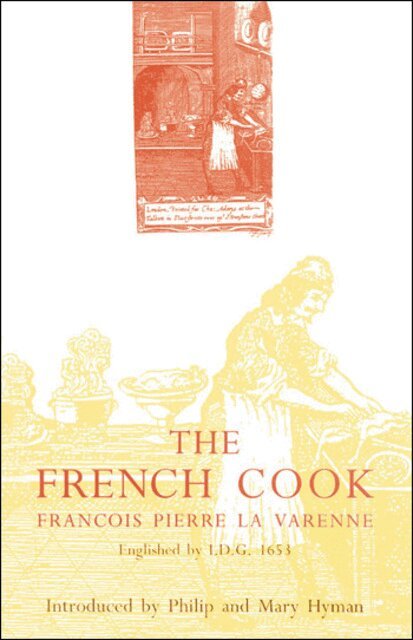
"The French Cook, 1651", is the most important cookery book of the 17th century. It was the first recipe book to receive international acclaim, and European cookery was changed, through its influence, for many centuries to come. This revolutionary recipe book was written by the foremost members of a group of French chefs who wrote for a professional audience in the age of Louis XIV. Little is known of his life or if he himself was responsible for the considerable innovations that appear in his book, but he was certainly the first to write them down. The first translation into English of the second 1652 edition, made in the following year by a certain I.D.G., had a dramatic effect on English cooks and cookery writers. Recipes were adapted to meet English taste and, although there was some later resistance from native cooks such as Hannah Glasse, English food was never to be the same again. This culinary revolution rejected the heavily spiced flavours of the cuisine of the Middle Ages which tended to mask the natural flavours of foods and replaced them with the use of local herbs.Likewise, sweet and sour combinations were abandoned along with the heavy use of sugar outside of desserts. New vegetables appeared. Greater attention was paid to freshness and visual appearance. This is summed up in a saying by Varenne, 'When I eat Cabbage soup, I want it to taste like cabbage'. La Varenne's innovations have now become part of our repertoire, including his omelettes, ragouts, bisques and caramel, new ways of flavouring dishes and many new technical terms, such as au bleu and au naturel.
216 kr
Tillfälligt slut
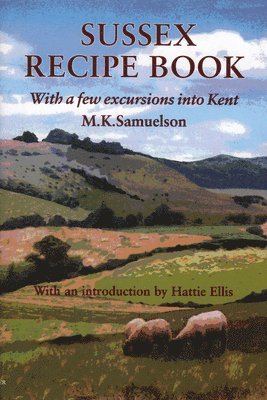
M.K. Samuelson, realising that there was no collection of Sussex recipes, set about making her own. This was first published in 1937 but World War II prevented a reprint. Southover reprinted it in 2005 in response to the renewed interest in regional food. The author was lucky to own a large collection of cookery books herself and luckier that in those days, many local families still kept family recipe books. Many of the mouth-watering dishes in this collection go back to the early 18th century and even earlier. In addition to the recipes the book includes an introduction by contemporary food writer and broadcaster Hattie Ellis as well as a note by Catherine Mant, grandaughter of the author and former Assistant Editor of "The Good Food Guide".