Studies in Cultural History - Böcker
Visar alla böcker i serien Studies in Cultural History. Handla med fri frakt och snabb leverans.
7 produkter
7 produkter
Del 6 - Studies in Cultural History
Awash in a Sea of Faith
Christianizing the American People
Häftad, Engelska, 1992
374 kr
Skickas inom 10-15 vardagar
Challenging the formidable tradition that places early New England Puritanism at the center of the American religious experience, Yale historian Jon Butler offers a new interpretation of three hundred years of religious and cultural development. Butler stresses the instability of religion in Europe where state churches battled dissenters, magic, and astonishingly low church participation. He charts the transfer of these difficulties to America, including the failure of Puritan religious models, and describes the surprising advance of religious commitment there between 1700 and 1865. Through the assertion of authority and coercion, a remarkable sacralization of the prerevolutionary countryside, advancing religious pluralism, the folklorization of magic, and an eclectic, syncretistic emphasis on supernatural interventionism, including miracles, America emerged after 1800 as an extraordinary spiritual hothouse that far eclipsed the Puritan achievement—even as secularism triumphed in Europe.Awash in a Sea of Faith ranges from popular piety to magic, from anxious revolutionary war chaplains to the cool rationalism of James Madison, from divining rods and seer stones to Anglican and Unitarian elites, and from Virginia Anglican occultists and Presbyterians raised from the dead to Jonathan Edwards, Joseph Smith, and Abraham Lincoln. Butler deftly comes to terms with conventional themes such as Puritanism, witchcraft, religion and revolution, revivalism, millenarianism, and Mormonism. His elucidation of Christianity’s powerful role in shaping slavery and of a subsequent African spiritual “holocaust,” with its ironic result in African Christianization, is an especially fresh and incisive account.Awash in a Sea of Faith reveals the proliferation of American religious expression—not its decline—and stresses the creative tensions between pulpit and pew across three hundred years of social maturation. Striking in its breadth and deeply rooted in primary sources, this seminal book recasts the landscape of American religious and cultural history.
407 kr
Skickas inom 10-15 vardagar
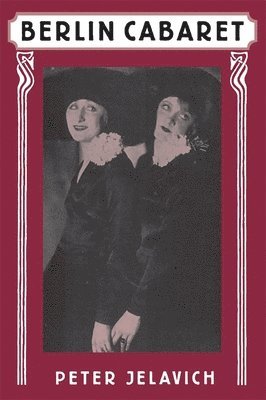
Step into Ernst Wolzogen's Motley Theater, Max Reinhardt's Sound and Smoke, Rudolf Nelson's Chat noir, and Friedrich Hollaender's Tingel-Tangel. Enjoy Claire Waldoff's rendering of a lower-class Berliner, Kurt Tucholsky's satirical songs, and Walter Mehring's Dadaist experiments, as Peter Jelavich spotlights Berlin's cabarets from the day the curtain first went up, in 1901, until the Nazi regime brought it down.Fads and fashions, sexual mores and political ideologies--all were subject to satire and parody on the cabaret stage. This book follows the changing treatment of these themes, and the fate of cabaret itself, through the most turbulent decades of modern German history: the prosperous and optimistic Imperial age, the unstable yet culturally inventive Weimar era, and the repressive years of National Socialism. By situating cabaret within Berlin's rich landscape of popular culture and distinguishing it from vaudeville and variety theaters, spectacular revues, prurient "nude dancing," and Communist agitprop, Jelavich revises the prevailing image of this form of entertainment.Neither highly politicized, like postwar German Kabarett, nor sleazy in the way that some American and European films suggest, Berlin cabaret occupied a middle ground that let it cast an ironic eye on the goings-on of Berliners and other Germans. However, it was just this satirical attitude toward serious themes, such as politics and racism, that blinded cabaret to the strength of the radical right-wing forces that ultimately destroyed it. Jelavich concludes with the Berlin cabaret artists' final performances--as prisoners in the concentration camps at Westerbork and Theresienstadt.This book gives us a sense of what the world looked like within the cabarets of Berlin and at the same time lets us see, from a historical distance, these lost performers enacting the political, sexual, and artistic issues that made their city one of the most dynamic in Europe.
351 kr
Skickas inom 10-15 vardagar
The end of the nineteenth century in France was marked by political scandals, social unrest, dissension, and “decadence.” Yet the fin de siècle was also an era of great social and scientific progress, a time when advantages previously reserved for the privileged began to be shared by the many. Public transportation, electrical illumination, standard time, and an improved water supply radically altered the life of the modest folk, who found time for travel and leisure activities—including sports such as cycling. Change became the nature of things, and people believed that further improvement was not only possible but inevitable.In this thoroughly engaging history, Eugen Weber describes ways of life, not as recorded by general history, but as contemporaries experienced them. He writes about political atmosphere and public prejudices rather than standard political history. Water and washing, bicycles and public transportation engage him more than great scientific discoveries. He discusses academic painting and poster art, the popular stage and music halls, at greater length than avant-garde and classic theater or opera. In this book the importance of telephones, plumbing, and central heating outranks such traditional subjects as international developments, the rise of organized labor, and the spread of socialism.Weber does not neglect the darker side of the fin de siècle. The discrepancy between material advance and spiritual dejection, characteristic of our own times, interests him as much as the idea of progress, and he reminds us that for most people the period was far from elegant. In the lurid context of military defeat, political instability, public scandal, and clamorous social criticism, one had also to contend with civic dirt, unsanitary food, mob violence, and the seeds of modern-day scourges: pollution, drugs, sensationalism, debased art, the erosion of moral character. Yet millions of fin de siècle French lived as only thousands had lived fifty years before; while their advance was slow, their right to improvement was conceded.
Del 14 - Studies in Cultural History
On or About December 1910
Early Bloomsbury and Its Intimate World
Häftad, Engelska, 1997
492 kr
Skickas inom 10-15 vardagar
On or about December 1910 human character changed, Virginia Woolf remarked, and well she might have. The company she kept, the Bloomsbury circle, took shape before the coming of World War I, and would have a lasting impact on English society and culture after the war. This book captures the dazzling world of Bloomsbury at the end of an era, and on the eve of modernism.Peter Stansky depicts the vanguard of a rising generation seizing its moment. He shows us Woolf in that fateful year, in the midst of an emotional breakdown, reaching a turning point with her first novel, The Voyage Out, and E. M. Forster, already a success, offering Howards End and acknowledging his passion for another man. Here are Roger Fry, prominent art critic and connoisseur, remaking tradition with the epochal exhibition “Manet and the Post-Impressionists”; Vanessa Bell and Duncan Grant beginning their most interesting phase as artists; Lytton Strachey signing the contract for his first book; and John Maynard Keynes entering a significant new stage in his illustrious career.Amid the glittering opulence and dismal poverty, the swirl of Suffragists, anarchists, agitators, and organizers, Stansky—drawing upon his historical and literary skills—brings the intimate world of the Bloomsbury group to life. Their lives, relationships, writings, and ideas entwine, casting one member after another in sharp relief. Even their Dreadnought Hoax, a trick played on the sacred institution of the navy, reveals their boldness and esprit. The picture Stansky presents, with all its drama and detail, encompasses the conflicts and sureties of a changing world of politics, aesthetics, and character.
Del 5 - Studies in Cultural History
Sophisticated Rebels
The Political Culture of European Dissent, 1968–1987, With a New Preface by the Author
Häftad, Engelska, 1990
351 kr
Skickas inom 10-15 vardagar
Those who think otherwise, though they may fail, deserve our attention, says H. Stuart Hughes. In Sophisticated Rebels, Hughes shows what happened to the revolutionary spirit after the 1968 suppressions in Prague and Paris: dissenters learned their lesson and began to pursue their goals in patient, realistic, limited fashion, eschewing violence and inflammatory ideological rhetoric. Yet theirs were the voices protesting what even conformists recognize as social evils; the manipulative routine of bureaucratic authority, public and private; the soullessness of life in the sprawling conurbations European cities have become; the deadening of sensibility that allows us to screen out from consciousness the possibility of nuclear war.Hughes takes up in turn the innovations in dissidence during a reactionary age: the foreign workers, especially Moslems, who flooded the more prosperous countries of Europe in the 1970s, creating a large underclass; the advocates of local cultural autonomy, such as the Welsh and Bretons; the independent-minded theologians Hans Küng and Edward Schillebeeckx and Leonardo Boff arrayed against Pope John Paul II, who was himself rebelling against a dilution of Catholic theology; Poland’s Solidarity and with it the longing for reunification of a sundered continent; the frustration of Soviet dissent, from the hope of Khrushchev’s “thaw” to the sufferings of Sakharov; the collapse of Eurocommunism and the falterings of democratic socialism; and the slow advance of the German Greens toward a society on a human scale. Although European dissent, with the exception of the Greens, has failed to shake the hold of conservative rule, Hughes believes the subject matter of dissent—notably the protest against the nuclear menace—has lost none of its timeliness for the century ahead, and the dissenters themselves face the future with both stoicism and hope.Serving as markers throughout the route are brief analyses of the relevance of novelists and social critics, among them Milan Kundera, Adam Michnik, Yuri Trifonov, Roy Medvedev, and Jürgen Habermas.
Del 1 - Studies in Cultural History
When Fathers Ruled
Family Life in Reformation Europe
Häftad, Engelska, 1985
351 kr
Skickas inom 10-15 vardagar
Here is a lively study of marriage and the family during the Reformation, primarily in Gemany and Switzerland, that dispels the commonly held notion of fathers as tyrannical and families as loveless.Did husbands and wives love one another in Reformation Europe? Did the home and family life matter to most people? In this wide-ranging work, Steven Ozment has gathered the answers of contemporaries to these questions. His subject is the patriarchal family in Germany and Switzerland, primarily among Protestants. But unlike modern scholars from Philippe Ariès to Lawrence Stone, Ozment finds the fathers of early modern Europe sympathetic and even admirable. They were not domineering or loveless men, nor were their homes the training ground for passive citizenry in an age of political absolutism. From prenatal care to graveside grief, they expressed deep love for their wives and children. Rather than a place where women and children were bullied by male chauvinists, the Protestant home was the center of a domestic reform movement against Renaissance antifeminism and was an attempt to resolve the crises of family life. Demanding proper marriages for all women, Martin Luther and his followers suppressed convents and cloisters as the chief institutions of womankind’s sexual repression, cultural deprivation, and male clerical domination. Consent, companionship, and mutual respect became the watchwords of marriage. And because they did, genuine divorce and remarriage became possible among Christians for the first time.This graceful book restores humanity to the Reformation family and to family history.
Del 10 - Studies in Cultural History
When Time Shall Be No More
Prophecy Belief in Modern American Culture
Häftad, Engelska, 1994
268 kr
Skickas inom 7-10 vardagar
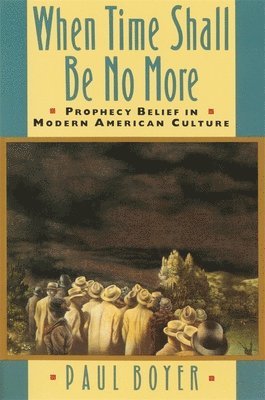
Millions of Americans take the Bible at its word and turn to like-minded local ministers and TV preachers, periodicals and paperbacks for help in finding their place in God’s prophetic plan for mankind. And yet, influential as this phenomenon is in the worldview of so many, the belief in biblical prophecy remains a popular mystery, largely unstudied and little understood. When Time Shall Be No More offers for the first time an in-depth look at the subtle, pervasive ways in which prophecy belief shapes contemporary American thought and culture.Belief in prophecy dates back to antiquity, and there Paul Boyer begins, seeking out the origins of this particular brand of faith in early Jewish and Christian apocalyptic writings, then tracing its development over time. Against this broad historical overview, the effect of prophecy belief on the events and themes of recent decades emerges in clear and striking detail. Nuclear war, the Soviet Union, Israel and the Middle East, the destiny of the United States, the rise of a computerized global economic order—Boyer shows how impressive feats of exegesis have incorporated all of these in the popular imagination in terms of the Bible’s apocalyptic works. Reflecting finally on the tenacity of prophecy belief in our supposedly secular age, Boyer considers the direction such popular conviction might take—and the forms it might assume—in the post–Cold War era.The product of a four-year immersion in the literature and culture of prophecy belief, When Time Shall Be No More serves as a pathbreaking guide to this vast terra incognita of contemporary American popular thought—a thorough and thoroughly fascinating index to its sources, its implications, and its enduring appeal.