Studies in Romance Literatures – serie
Visar alla böcker i serien Studies in Romance Literatures. Handla med fri frakt och snabb leverans.
18 produkter
18 produkter
Häftad, Engelska, 1996
580 kr
Skickas inom 5-8 vardagar
Founded in 1960 by a group of relatively unknown young writers, Tel Quel quickly became one of the most influential literary journals and controversial intellectual movements in France. During the following two decades Tel Quel published the best in French intellectual thought and writing, including Roland Barthes, Georges Bataille, Jacques Derrida, Jean-Pierre Faye, Michel Foucault, Gérard Genette, Julia Kristeva, Bernard-Henri Lévy, Marcelin Pleynet, Philippe Sollers, and Tzvetan Todorov. By focusing on Tel Quel as an instrument of cultural renewal, Danielle Marx-Scouras demonstrates that literature—even when it claims to be disengaged—can never escape its historical ties. The book elucidates the complexities of French intellectual life and the role played by Tel Quel in the evolution of intellectual thought and writing in the 1960s and 1970s. Tel Quel's cultural politics have been fashioned as much by the unpredictable historical changes of the post-World War II and Cold War era as they have by the advances in literary studies, semiotics, philosophy, and psychoanalysis during this period. The journal ceased publication in 1982, shortly before the dissolution of Marxism-Communism marked by the demolition of the Berlin Wall, the reunification of Europe, and the collapse of the Soviet Union. Marx-Scouras ultimately finds in its cultural venture some significant parting thoughts on a vigorous period of European literary and intellectual history.
Inbunden, Engelska, 1999
1 183 kr
Skickas inom 5-8 vardagar
How was the female body perceived in the popular culture of late nineteenth-century Spain? Using a wide array of images from popular magazines of the day, Lou Charnon-Deutsch finds that women were typically presented in ways that were reassuring to the emerging bourgeois culture.Charnon-Deutsch organizes the 190 images reproduced in this book into six broad categories, or "fictions of the feminine": she reads women's bodies as a romantic symbol of beauty or evil, as a privileged link with the natural order, as a font of male inspiration, as a mouthpiece of bourgeois mores, as a focalized point of male fear and desire, and as an eroticized expression of Spanish exoticism and political ambitions. These imaginary visions of femininity, Charnon-Deutsch argues, were a response to, and also helped to create, gendered stereotypes by suggesting ideal feminine behavior and poses. Further, they comprised a reassuring "between-male" cultural medium that provided graphic validation of women's docile body for a culture enthralled with femininity.Integrating the fields of literature and cultural studies, Charnon-Deutsch's approach to this subject is unique. Many of the images collected here are available for the first time, and they represent only a fraction of the two thousand images Charnon-Deutsch collected during her research. This book will appeal to students of Spanish cultural studies and gender studies, as well as to art historians.
Inbunden, Engelska, 2003
762 kr
Skickas inom 5-8 vardagar
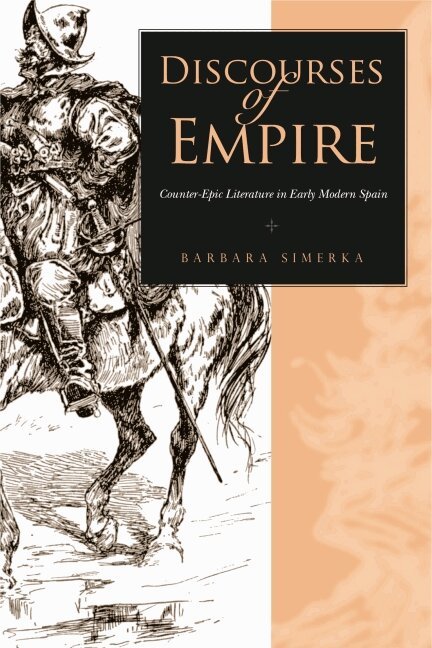
The counter-epic is a literary style that developed in reaction to imperialist epic conventions as a means of scrutinizing the consequences of foreign conquest of dominated peoples. It also functioned as a transitional literary form, a bridge between epic narratives of military heroics and novelistic narratives of commercial success. In Discourses of Empire, Barbara Simerka examines the representation of militant Christian imperialism in early modern Spanish literature by focusing on this counter-epic discourse.Simerka is drawn to literary texts that questioned or challenged the imperial project of the Hapsburg monarchy in northern Europe and the New World. She notes the variety of critical ideas across the spectrum of diplomatic, juridical, economic, theological, philosophical, and literary writings, and she argues that the presence of such competing discourses challenges the frequent assumption of a univocal, hegemonic culture in Spain during the imperial period. Simerka is especially alert to the ways in which different discourses—hegemonic, residual, emergent—coexist and compete simultaneously in the mediation of power. Discourses of Empire offers fresh insight into the political and intellectual conditions of Hapsburg imperialism, illuminating some rarely examined literary genres, such as burlesque epics, history plays, and indiano drama. Indeed, a special feature of the book is a chapter devoted specifically to indiano literature. Simerka's thorough working knowledge of contemporary literary theory and her inclusion of American, English, and French texts as points of comparison contribute much to current studies of Spanish Golden Age literature.
Häftad, Engelska, 2003
654 kr
Skickas inom 5-8 vardagar
Cervantes’s Don Quixote confronts us with a series of enigmas that, over the centuries, have divided even its most expert readers: Does the text pursue a serious or comic purpose? Does it promote the truth of history and the untruth of fiction, or the truth of poetry and the fictiveness of truth itself? In a book that will revise the way we read and debate Don Quixote, Charles D. Presberg discusses the trope of paradox as a governing rhetorical strategy in this most canonical of Spanish literary texts. To situate Cervantes’s masterpiece within the centuries-long praxis of paradoxical discourse in the West, Presberg surveys its tradition in Classical Antiquity, the Middle Ages, and the European Renaissance. He outlines the development of paradoxy in the Spanish Renaissance, centering on works by Fernando de Rojas, Pero Mexía, and Antonio de Guevara. In his detailed reading of portions of Don Quixote, Presberg shows how Cervantes’s work enlarges the tradition of paradoxical discourse by imitating as well as transforming fictional and nonfictional models. He concludes that Cervantes’s seriocomic "system" of paradoxy jointly parodies, celebrates, and urges us to ponder the agency of discourse in the continued refashioning of knowledge, history, culture, and personal identity.This engaging book will be welcomed by literary scholars, Hispanisists, historians, and students of the history of rhetoric and poetics.
Häftad, Engelska, 2000
767 kr
Skickas inom 5-8 vardagar
In The Poetics of Empire in the Indies, James Nicolopulos investigates literary representations of sixteenth-century Iberian colonialism and imperialism by analyzing Alonso de Ercilla’s "La Araucana," a narrative poem that recounts the initial phases of the Spanish conquest of Chile in the mid-sixteenth century, and Luis de Camoens’s "Os Lusíadas," the epic celebration of early Portuguese maritime expansion in the Indian Ocean and beyond.Delving into the epic traditions of the Classical, Medieval, and Renaissance periods, Nicolopulos outlines practices of imitation within the two poems, focusing specifically on the employment of epic models in "La Araucana." Having made powerful connections to Ercilla’s literary and critical predecessors, Nicolopulos demonstrates that the contemporaneous publication of "Os Lusíadas" further affected the content and presentation of "La Araucana." In so doing, he elucidates the rivalries—poetic, political, commercial—between Spain and Portugal during this age of expansion. An investigation into imitation and representation in colonial texts, The Poetics of Empire in the Indies offers new connections between two early literary representations of Iberian imperialism.
Häftad, Engelska, 1999
569 kr
Skickas inom 5-8 vardagar
Within the rich tradition of Spanish theater lies an unexplored dimension reflecting themes from classical mythology. Through close readings of selected plays from early modern and twentieth-century Spanish literature with plots or characters derived from the Greco-Roman tradition, Michael Kidd shows that the concept of desire plays a pivotal role in adapting myth to the stage in each of several historical periods.In Stages of Desire, Kidd offers a new way of looking at the theater in Spain. Reviewing the work of playwrights from Juan del Encina to Luis Riaza, he suggests that desire constitutes a central element in a large number of Greco-Roman myths and shows how dramatists have exploited this to resituate ancient narratives within their own artistic and ideological horizons. Among the works he analyzes are Timoneda's Tragicomedia llamada Filomena, Castro's Dido y Eneas, and Unamuno's Fedra.Kidd explores how seventeenth-century playwrights were constrained by the conventions of the newly formed national theater, and how in the twentieth century mythological desire was exploited by playwrights engaged in upsetting the melodramatic conventions of the entrenched bourgeois theater. He also examines the role of desire both in the demythification of prominent classical heroes during the Franco regime and in the cultural critique of institutionalized discrimination in the current democratic period.Stages of Desire is an original and broad-ranging study that highlights both change and continuity in Spanish theater. By elegantly combining theory, literary history, and close textual analysis, Kidd demonstrates both the resilience of Greco-Roman myths and the continuing vitality of the Spanish stage.
Häftad, Engelska, 1997
580 kr
Skickas inom 5-8 vardagar
Spain in the sixteenth and seventeenth centuries was in the throes of modernization arising from trade with the New World and the rise of an urban society. During this period, Spanish culture came to be dominated by the tension between an old regime of traditional values—honor, lineage, purity of blood—and these modernizing influences.Anthony J. Cascardi examines the literature of the Golden Age as the point at which tensions between the old and the new converged and proposes that this historical drama provided the context for subject-formation in early modern Spain. He examines how Spanish writers envisioned history and studies how these visions revealed or concealed contradictions between social values of their time, particularly between the value systems of caste and class.Ideologies of History in the Spanish Golden Age draws on recent theoretical paradigms in contemporary philosophy, psychoanalysis, political and social theory, and literary history to place Spain's major literary figures in challenging new contexts. By accounting for both modernizing desires and resistances to modernization, Cascardi provides readers interested in theories of ideology and history with a new way of looking at the literature of the Spanish Golden Age.
Häftad, Engelska, 1991
648 kr
Skickas inom 5-8 vardagar
Refiguring the Hero reassesses the social significance of several of the most widely read plays of Spain's Golden Age in light of then-contempory ideas about heroism.The Spanish dramatists Lope de Vega and Pedro Calderón de la Barca, near contemporaries of Shakespeare, are hailed by Hispanists as democrats at heart for making heroes, in both the literary and the positive moral sense, of peasants. Spanish drama is alleged to be the first literature in the Western world to find the common man worthy of heroic status. Refiguring the Hero reevaluates the place of the canon of Spanish Golden Age drama within its European context.The book discusses European literary heroism through the seventeenth century,with particular attention to the Spanish or moral enlightenment were essential characteristics of a hero. However, the protagonists of Spanish "peasant honor" plays do not fit into this heroic tradition. The peasant often murders a nobleman who has offended his honor, and is rewarded by the reigning monarch. The peasants gain official approval by misrepresenting the events leading up to the murders. The generous kings, in their turn, are historical figures known for their failures.While most scholars approaching Spanish Golden Age drama regard these plays a s socially subversive or revolutionary, Dian Fox contends that they are consistent with other contemporary European national dramas in reserving heroism in serious works for socially superior characters. She challenges the "democratic" view of the peasant triumphing over the nobleman as heroic and shows that political and social developments since the seventeenth century have enhanced the sympathy with which modern readers regard the violent acts of the peasants in these plays.
Häftad, Engelska, 1995
648 kr
Skickas inom 5-8 vardagar
This study examines issues in politics and political theory in selected works of Pedro Calderón de la Barca (1600–1681), the major dramatist of the middle and later decades of the seventeenth century in Spain. By analyzing secular dramas (comedias) and religious plays (autos sacramentales), Stephen Rupp demonstrates Calderón's awareness of the ideas and institutions of power in Hapsburg Spain and explores the terms of his intervention in the long debate over the principles of Christian statecraft. Through references to Rivadeneira, Saavedra Fajardo, and Quevedo, Rupp describes the anti-Machiavellian theory of kingship that informs Calderón's political theater.Rupp's argument proceeds from abstract principles of political theory to particular institutions and events at the Hapsburg court. Discussion of two comedias (La vida es sueño and La cisma de Inglaterra) and five autos (La vida es sueño, A Dios por razón de Estado, El maestrazgo del Toisón, El nuevo palacio del Retiro, and El lirio y la azucena) demonstrates Calderón's assimilation of true reason of state to providence, his attitudes concerning the conciliar system and the regime of the royal favorite or valido, and his allegorical treatment of significant state occasions.
Häftad, Engelska, 2003
569 kr
Skickas inom 5-8 vardagar
The counter-epic is a literary style that developed in reaction to imperialist epic conventions as a means of scrutinizing the consequences of foreign conquest of dominated peoples. It also functioned as a transitional literary form, a bridge between epic narratives of military heroics and novelistic narratives of commercial success. In Discourses of Empire, Barbara Simerka examines the representation of militant Christian imperialism in early modern Spanish literature by focusing on this counter-epic discourse.Simerka is drawn to literary texts that questioned or challenged the imperial project of the Hapsburg monarchy in northern Europe and the New World. She notes the variety of critical ideas across the spectrum of diplomatic, juridical, economic, theological, philosophical, and literary writings, and she argues that the presence of such competing discourses challenges the frequent assumption of a univocal, hegemonic culture in Spain during the imperial period. Simerka is especially alert to the ways in which different discourses—hegemonic, residual, emergent—coexist and compete simultaneously in the mediation of power. Discourses of Empire offers fresh insight into the political and intellectual conditions of Hapsburg imperialism, illuminating some rarely examined literary genres, such as burlesque epics, history plays, and indiano drama. Indeed, a special feature of the book is a chapter devoted specifically to indiano literature. Simerka's thorough working knowledge of contemporary literary theory and her inclusion of American, English, and French texts as points of comparison contribute much to current studies of Spanish Golden Age literature.
Häftad, Engelska, 2001
574 kr
Skickas inom 5-8 vardagar
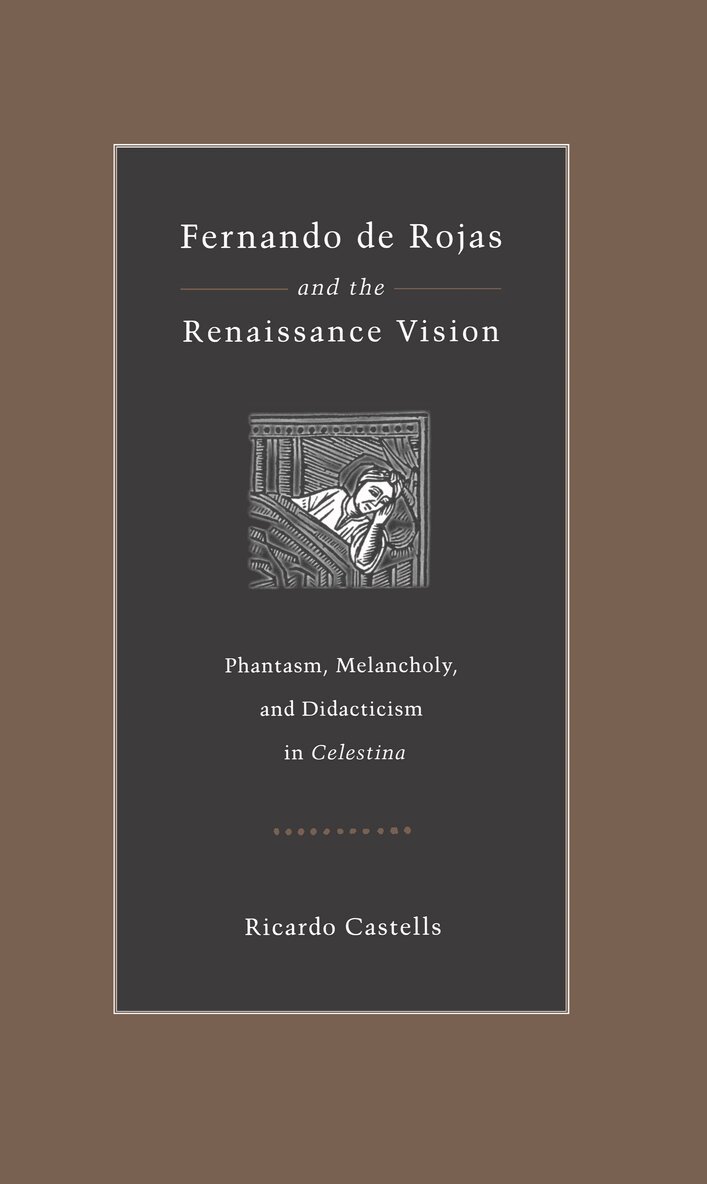
The late medieval masterpiece Celestina has long been the focus of controversy, over both its authorship and the apparent contradictions and inconsistencies within its plot. Scholars trace the publication of Celestina to 1499, when Fernando de Rojas supposedly discovered the first act and completed the remainder of the drama within a two-week period. The plot centers on the ill-fated love of Calisto and Melibea and the fascinating character of the old bawd, Celestina. Scholars disagree about how to interpret the meeting of the two lovers in the first scene, when they share an unusual conversation that is incongruous with their comportment in the remainder of the work. Ricardo Castells seeks to resolve this and other seeming contradictions by tracing the oneiric, phantasmal, and melancholic traditions of the Renaissance and their effect on the composition of Celestina. Castells explores the European cultural and literary tradition—works of both fiction and nonfiction that would have been available to Rojas—to discover theoretical approaches to the physiology of lovesickness and its accompanying dreams and visions. He employs the themes of love, medicine, and dreams in these works to explain the seemingly illogical progression of the play’s action and the ultimately detrimental effects of melancholy, lovesickness, and sensual contamination on the protagonist, Calisto. In so doing, Castells places Celestina within its appropriate cultural and historical context, enriching our perception not only of the text itself but also of the traditions that helped to produce it.
Häftad, Engelska, 1996
569 kr
Skickas inom 5-8 vardagar
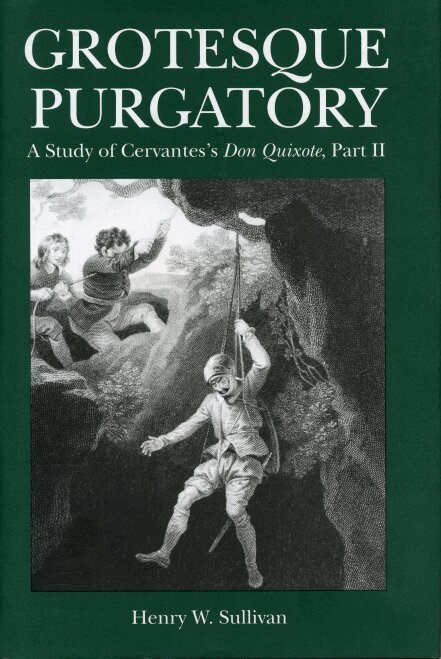
Cervantes's great novel Don Quixote is a diptych, the first part of which was published in 1605 and the second in 1615. Focusing almost entirely on the novel's second part, Henry W. Sullivan is the first critic to offer a systematic account of Don Quixote's passage from madness to sanity. Sullivan argues that Part II of the novel is a salvation epic, within which the Cave of Montesinos episode is the single most important pivot in the Knight's confrontation with his own emotional difficulties.In this carefully researched and challenging study, Sullivan shows that chapters 22-24 (the Cave of Montesinos episode) represent an entrance into Purgatory, while chapter 55 is the exit from this realm. The Knight and his Squire are made to suffer excruciating torments in the chapters in between, experiencing a Purgatory in this life. This original reading of the book is coupled with an explanation that this Purgatory is "grotesque" since Don Quixote's and Sancho's sins are venial and can thus be cleansed by theological means against a background of comedy. By combining these two aspects, Sullivan exposes both the deeply agonizing and the comic aspects of the text. In addition, the combination of theological interpretation and Lacanian analysis to show Don Quixote's salvation/cure in this life results in a truly comprehensive vision of the Knight's progress. Sullivan also summarizes, in five different streams of critical tradition, the accumulated reception history of the Cave of Montesinos incident, drawing on scholarly writings from the nineteenth century to the present.
Häftad, Engelska, 2000
569 kr
Skickas inom 5-8 vardagar
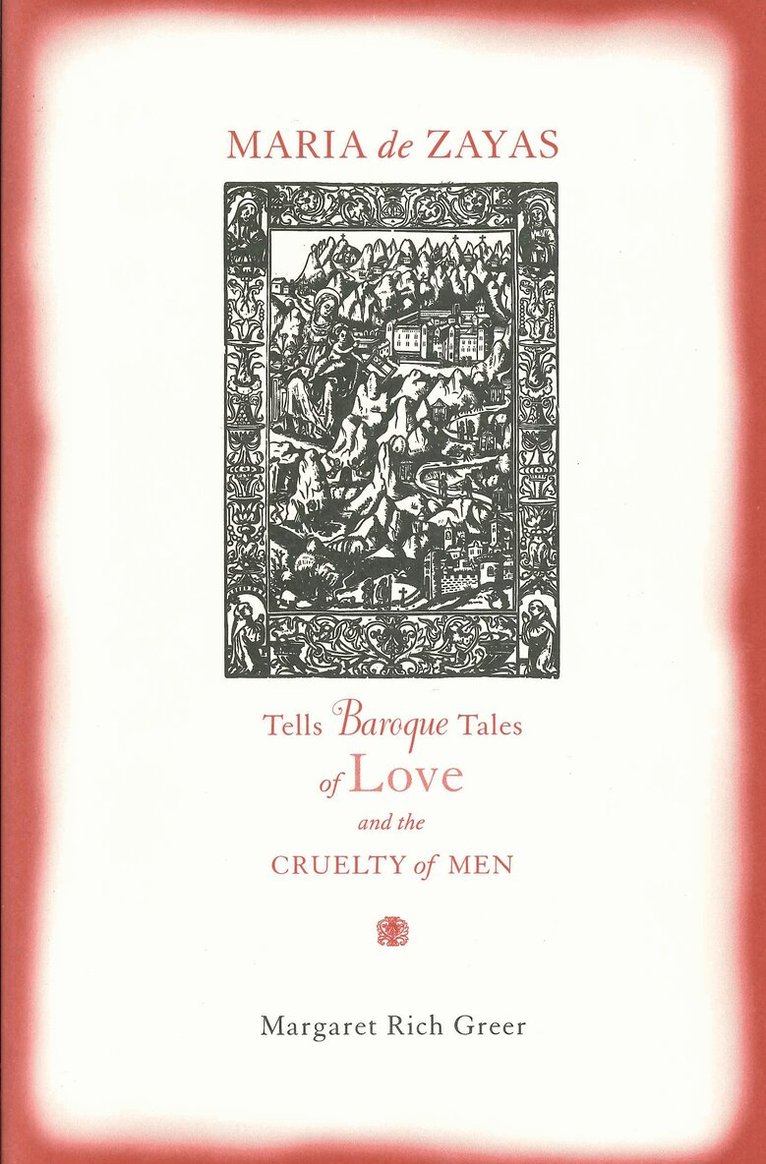
María de Zayas y Sotomayor (1590–1650?) published two collections of novellas, Novelas amorosas y exemplares (1637) and Desengaños amorosos (1647), which were immensely popular in her day. During the nineteenth and early twentieth centuries, Victorian and bourgeois sensibilities exiled her “scandalous” works to the outer fringes of serious literature. Over the last two decades, however, she has gained an enthusiastic and ever-expanding readership, drawing intense critical attention and achieving canonical status as a major figure of the Spanish Golden Age. In this first comprehensive study of Zayas’s prose, Margaret R. Greer explores the relationship between narration and desire, analyzing both the “desire for readers” displayed by Zayas in her Prologue and the sexual desire that drives the telling within the novellas themselves. Greer examines Zayas’s narrative strategies through the twin lenses of feminist and psychoanalytic theory. She devotes close attention to the weight of Renaissance literary traditions and the role of Zayas’s own cultural context in shaping her work. She discusses Zayas’s biography and the reception of her publications; her advocacy of women’s rights; her conflictive loyalty to an aristocratic, patriarchal order; her crafting of feminine tales of desire; and her erasure of the frontiers between the natural and supernatural, indeed, between love and death itself. In so doing, Greer offers an expansive analysis of this recently rediscovered Golden Age writer.
Häftad, Engelska, 1998
569 kr
Skickas inom 5-8 vardagar
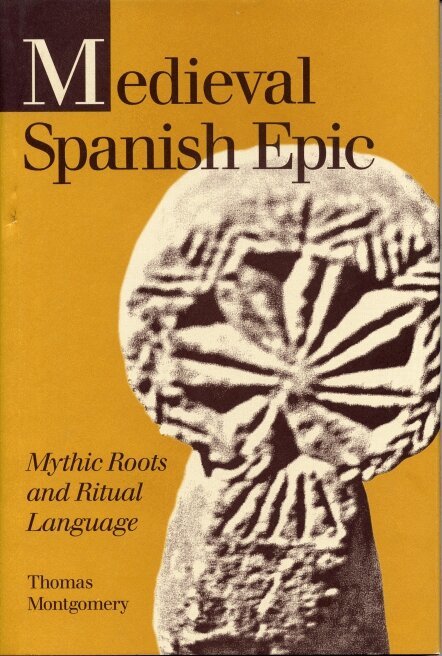
This book takes a new look at the place occupied by medieval Spanish epic within European folk and literary tradition. Thomas Montgomery traces the origins of key parts of most known medieval Spanish epics to an ancient myth. He shows how the myth of the initiation of the young warrior, shown by Georges Dumézil to be fundamental to the belief systems of widely distributed Indo-European peoples, was variously adapted to shape the action of texts including the Siete Infantes de Lara, the Mocedades de Rodrigo, and the Poema de Mio Cid, in which it accounts for the peculiar behavior of the Infantes de Carrión. Montgomery also connects the same mythic tradition to works as diverse as Tristan and the Chanson de Roland.‡In a preliterate society, the oral presentation of this archetypal lore required a special language capable of re-creating the ritualized behavior of the epic characters and maintaining the ceremonial tone of the performance. Focusing on the Poema de Mio Cid, Montgomery examines the ways in which the poetic language worked to evoke a feeling of group unity that absorbed the audience and still works its spell upon today's readers.
Häftad, Engelska, 2000
569 kr
Skickas inom 5-8 vardagar
Despite Eduardo Manet's impressive accomplishments extending over half a century, this extraordinarily talented Cuban-French author remains relatively unknown in the United States. Phyllis Zatlin's book is the first to examine the multifaceted career of this dynamic bilingual writer. Playwright and novelist, theater and film director, Eduardo Manet (b. 1930) has been a major participant in the cultural worlds of both Cuba and France. His works have been internationally acclaimed: he has been nominated for the Prix Goncourt and was awarded a special Goncourt youth prize, and his novels and plays have been translated into twenty-one languages. Manet's work, however, has often been overlooked by both French and Spanish-American critics because of his unique position as a Latin American writing in French. Zatlin sets out to correct this oversight by offering a detailed analysis of Manet's many genres and themes. She begins with his work in Cuba, from his youthful poetry and plays to the films he directed in revolutionary Cuba. She then examines his seven full-length novels, all written in French but typically reflective of Cuban experience. Finally, Zatlin concludes her study by considering Manet's early plays of entrapment and enclosure and his later theater, defined by its metatheatrical and multicultural themes.Through the lenses of multiculturalism, postmodernism, metatheater, and farce, Zatlin provides a perceptive and comprehensive examination of this significant yet neglected figure. Zatlin's book will do the important work of introducing Manet to a North American audience.
Häftad, Engelska, 2001
569 kr
Skickas inom 5-8 vardagar
The plot of the late-medieval Spanish work Celestina (1499) centers on the ill-fated love of Calisto and Melibea and the fascinating character of their intermediary, Celestina. In this ground-breaking rereading of the play, James F. Burke offers a new interpretation of the characters' actions by analyzing medieval theories of perception that would have influenced the composition of Celestina. Drawing upon a variety of texts and thinkers—including the medieval theories of Thomas Aquinas, the Renaissance treatises of Marsilio Ficino, the classical philosophy of Aristotle, and the modern psychology of Jacques Lacan—Burke relates ancient and medieval theories of sensory functions to modern understandings. He demonstrates that modern concepts of "the gaze" have their premodern analogy in the idea of an all-encompassing sensory field, both visual and auditory, that surrounded and enveloped each individual. Touching on medieval theories of the "evil eye," the sonic sphere, and "the banquet of the senses," Burke offers a new perspective on the use and manipulation of sensory input by the characters of Celestina. This book will be welcomed not only by students of Spanish literature but also by those interested in new ways of approaching medieval and Renaissance texts.
Häftad, Engelska, 2012
569 kr
Skickas inom 5-8 vardagar
Published anonymously in 1554, Lazarillo de Tormes upset all the strict hierarchies that governed art and society during the Renaissance. It traces the adventures not of a nobleman or ancient hero, but rather of an ordinary man who struggles for survival in a cruel, corrupt society after growing up under the care of a blind beggar. Giancarlo Maiorino treats this picaresque narrative as a prism for exploring econopoetics, a term he uses to foreground the ways in which literary and economic modes of production feed off one another. His approach introduces readers to the turbulent world of common people of Renaissance Spain even as it affords abundant insights into the historical significance of this literary classic.Although literary historians generally connect the rise of the novel to the needs of the middle classes of England, Maiorino demonstrates that its deepest roots are in the culture of indigence that developed at the peripheries of Renaissance society and challenged—even parodied—its authoritarian ambitions. Seen in this light, Lazarillo de Tormes emerges as a key text in understanding the novel's purchase on visions of escape from authority into alternative modes of existence.Maiorino grounds his far-reaching arguments in recent theories of textuality and the practices of everyday life. His book will be important reading for all those concerned with the Renaissance, Spanish history and culture, and, more generally, theories of the novel.
Häftad, Engelska, 2013
773 kr
Skickas inom 5-8 vardagar
In Don Juan and the Point of Honor, James Mandrell undertakes a systematic examination of the many questions surrounding the legendary character. On the one hand, it might be argued that Don Juan threatens society, since he is supposedly an agent of social anarchy. On the other hand, given his intriguing sexual accomplishments, he could be viewed as a positive expression of life itself. James Mandrell shows what is at stake in the asking of such questions and, moreover, what is at stake in representations and considerations of Don Juan.After a discussion of the ways that Don Juan’s seductive powers infiltrate and influence the interpretations of texts of which he is a part, Mandrell continues with close readings of key Spanish literary works ranging from the seventeenth to the twentieth centuries. All of these works involve interrelated issues as regards Don Juan: the worldly uses and abuses of language; the power of literature to engender and embody other literary texts; seduction and its psychological and social subtexts; and society in relation to Don Juan as well as Don Juan’s role in society. Ultimately, these notions are tied into the concept of honor as it works in literature and society. Mandrell concludes with a study of modern adaptations of Don Juan and his story in various theories of culture, society, and economic organizations. What emerges is a view of Don Juan as a positive social force in patriarchal society and culture—as well as a force operative at the level of desire as it is made manifest in language. Mandrell shows that Don Juan should not be treated as an innocent or outmoded cultural artifact. Instead, he is a character whose story and vicissitudes are still significant in the context of our twenty-first-century world.