• Fri frakt över 249 kr
  • •
  • Snabba leveranser
  • •
  • Billiga böcker
Kundservice

Du är på sajten för privatpersoner.

Företag, bibliotek eller offentlig verksamhet?

Du handlar på classic.bokus.com, där alla dina funktioner finns intakta.
Till classic.bokus.com
Bokus logotyp. Gå till startsidan.
  • Erbjudanden
  • Nyheter
  • Student
  • Topplistor
  • Barn & ungdom
  • Bokus Play
  • E-böcker
  • Pocketböcker
  • Spel & pussel

Må bättre, för mindre! Upp till 50% rabatt på hälsoböcker

Sidfot

Mina sidor

    Hjälp

    • Kundservice
    • Vanliga frågor och svar
    • Frakt och leverans
    • Retur vid ångerrätt
    • Reklamera vara
    • Betalning
    • Köpvillkor
    • Allmänna villkor
    • Information om webbplatsens tillgänglighet

    Om Bokus

    • Om oss
    • Pressrum
    • För studenter
    • För företag
    • För bibliotek och offentlig verksamhet
    • För leverantörer
    • Hållbarhet

    Populärt

    • Aktuella erbjudanden
    • Presentkort
    • Studentlitteratur
    • Nya böcker
    • Topplistor
    • Signerade böcker
    • Engelska böcker

    Inspiration

    • Boktips
    • BookTok
    • Populära bokserier
    • Barnbokskaraktärer
    • Populära författare
    Logotyp för Bokus
    Följ oss på Facebook (extern länk)Följ oss på Instagram (extern länk)Följ oss på YouTube (extern länk)Följ oss på TikTok (extern länk)
    bokus @ CookiesAnpassa cookiesIntegritetspolicyKöpvillkor
    Till Citymail hemsida (extern länk)Till Budbee hemsida (extern länk)Till Postnord hemsida (extern länk)Till Schenker hemsida (extern länk)Till Early Bird hemsida (extern länk)Till Walleys hemsida (extern länk)
    1. Språk och ordböcker
    2. Språkundervisning och språkinlärning

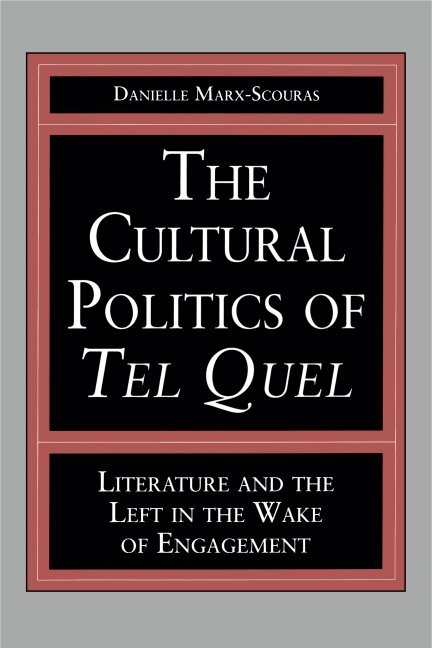
    Cultural Politics of Tel Quel

    Literature and the Left in the Wake of Engagement

    AvDanielle Marx-Scouras

    Häftad, Engelska, 1996

    Del i serien Studies in Romance Literatures

    599 kr

    Beställningsvara. Skickas inom 5-8 vardagar. Fri frakt över 249 kr.

    Beskrivning

    Founded in 1960 by a group of relatively unknown young writers, Tel Quel quickly became one of the most influential literary journals and controversial intellectual movements in France. During the following two decades Tel Quel published the best in French intellectual thought and writing, including Roland Barthes, Georges Bataille, Jacques Derrida, Jean-Pierre Faye, Michel Foucault, Gérard Genette, Julia Kristeva, Bernard-Henri Lévy, Marcelin Pleynet, Philippe Sollers, and Tzvetan Todorov. By focusing on Tel Quel as an instrument of cultural renewal, Danielle Marx-Scouras demonstrates that literature—even when it claims to be disengaged—can never escape its historical ties. The book elucidates the complexities of French intellectual life and the role played by Tel Quel in the evolution of intellectual thought and writing in the 1960s and 1970s. Tel Quel's cultural politics have been fashioned as much by the unpredictable historical changes of the post-World War II and Cold War era as they have by the advances in literary studies, semiotics, philosophy, and psychoanalysis during this period. The journal ceased publication in 1982, shortly before the dissolution of Marxism-Communism marked by the demolition of the Berlin Wall, the reunification of Europe, and the collapse of the Soviet Union. Marx-Scouras ultimately finds in its cultural venture some significant parting thoughts on a vigorous period of European literary and intellectual history.

    Produktinformation

    • Utgivningsdatum:1996-09-15
    • Mått:152 x 229 x 15 mm
    • Vikt:395 g
    • Format:Häftad
    • Språk:Engelska
    • Serie:Studies in Romance Literatures
    • Antal sidor:268
    • Förlag:Pennsylvania State University Press
    • ISBN:9780271025568

    Utforska kategorier

    • Språkundervisning och språkinlärning inom Språk och ordböcker

    Mer om författaren

    Danielle Marx-Scouras is Associate Professor of French at The Ohio State University.

    Recensioner i media

    “The Cultural Politics of “Tel Quel” is an original, vigorously argued, superbly researched piece of work, and I believe that it fills a gap in the cultural-intellectual history of contemporary France. I know of no book in French or English that covers quite the same ground.”—David L. Schalk, Vassar College