SUNY series in Systematic Philosophy - Böcker
Visar alla böcker i serien SUNY series in Systematic Philosophy. Handla med fri frakt och snabb leverans.
10 produkter
10 produkter
566 kr
Skickas inom 3-6 vardagar
This book describes a realist, fallibilist alternative when intuitionism and its psychocentric ontology are rejected. Weissman proposes an agenda for metaphysical inquiry and also a method for testing metaphysical claims. Arguing that science and metaphysics are successive refinements of the maps and plans used in practical life, he affirms that metaphysics is to complete our self-understanding by locating us within a world we have not made.This book is a sequel to Intuition and Ideality which surveys the many versions of intuitionism-intuitionism as it prescribes that reality be identified with mind itself or with the things set before our inspecting mind.
1 057 kr
Tillfälligt slut
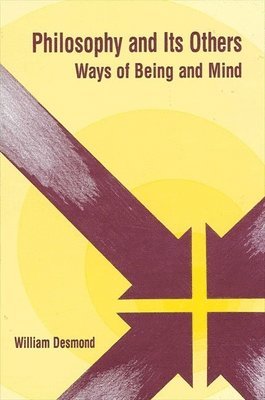
Philosophy and its Others responds to the widespread sense that philosophy must renew its intellectual community with other significant ways of being and mind. The author articulates philosophy's community of mind with the aesthetic, the religious, and the ethical, without losing any of its own distinctive voice. He develops an original and constructive position between these extremes: the Hegelian extreme which reduces the plurality of others to a dialectical totality and the Wittgensteinian and deconstructive options that celebrate plurality, but without a proper sense of the connectedness of philosophy and its others.
608 kr
Skickas inom 3-6 vardagar
Philosophy and its Others responds to the widespread sense that philosophy must renew its intellectual community with other significant ways of being and mind. The author articulates philosophy's community of mind with the aesthetic, the religious, and the ethical, without losing any of its own distinctive voice. He develops an original and constructive position between these extremes: the Hegelian extreme which reduces the plurality of others to a dialectical totality and the Wittgensteinian and deconstructive options that celebrate plurality, but without a proper sense of the connectedness of philosophy and its others.
1 057 kr
Tillfälligt slut
"This is my major thesis. Mystery is inherent in both the nature of things and the nature of rationality. I will sustain this thesis by a review of some of the central issues of philosophy to elucidate their mysterious qualities. More important, however, I will develop in detail an explanation of mystery and trace some of its important ramifications.""I will argue that an ordinal metaphysics, with its associated theory of query, provides an account of mystery that no other theory can provide."While the theory presented here is a theory of philosophical mystery, it has fundamental implications for all branches of knowledge, including the physical and social sciences."In short, I speak against a simplistic view of the world and of experience based on a simplistic and narrow conception of understanding and rationality. Mystery calls not for veneration and awe, but for a full and complex activity of mind, broaching all established conditions in its pursuit of answers....Reason is fulfilled as completely in mysteries which persevere throughout our efforts to resolve them as in mysteries which are resolved and dissipated, passing into new questions to which we must find new answers, in an unterminating process of rational interrogation." - From the Preface by Stephen David Ross
376 kr
Tillfälligt slut
"This is my major thesis. Mystery is inherent in both the nature of things and the nature of rationality. I will sustain this thesis by a review of some of the central issues of philosophy to elucidate their mysterious qualities. More important, however, I will develop in detail an explanation of mystery and trace some of its important ramifications.""I will argue that an ordinal metaphysics, with its associated theory of query, provides an account of mystery that no other theory can provide."While the theory presented here is a theory of philosophical mystery, it has fundamental implications for all branches of knowledge, including the physical and social sciences."In short, I speak against a simplistic view of the world and of experience based on a simplistic and narrow conception of understanding and rationality. Mystery calls not for veneration and awe, but for a full and complex activity of mind, broaching all established conditions in its pursuit of answers....Reason is fulfilled as completely in mysteries which persevere throughout our efforts to resolve them as in mysteries which are resolved and dissipated, passing into new questions to which we must find new answers, in an unterminating process of rational interrogation." - From the Preface by Stephen David Ross
1 057 kr
Tillfälligt slut
Stephen David Ross presents an extensive, detailed, and critical interpretation of Whitehead's mature thought, emphasizing the fundamental role of perspective in Whitehead's cosmology, and tracing the conflicts and difficulties therein to tensions involving perspective in relation to other central features of Whitehead's thought. Ross isolates four principles as having a fundamental role in whitehead's metaphysics: perspective, cosmology, experience, and mechanical analysis. He argues that many of Whitehead's difficulties can be eliminated by raising the principle of perspective to prominence and by revising the other central features of Whitehead's theory accordingly.This book addresses key Whiteheadian texts and secondary interpretations of Whitehead. The discussion ranges over most of Whitehead's theory in Process and Reality, and offers a number of significant and, in some cases, novel views on different aspects of Whitehead's theory: perception, prehension, causation, objective immortality, self-causation, the extensive continuum, natural order, possiblity, concreteness, and God. Ross's concluding suggestions for modifying Whitehead's system promise to occasion much debate among process philosophers, theologians, and anyone concerned with Whitehead's thought.
402 kr
Tillfälligt slut
This book shows how idealism is a consequence of the intuitionist method. Idealism develops from mental content inspected by mind, or as mind characterizing itself. Weissman declares that the idea of an independent world, of a nature whose character and existence are independent of mind, cannot be recovered until we repudiate the intuitionist method. This psycho-centric ontology has been pervasive in Western philosophy since Parmenides and Plato. Intuition and Ideality characterizes its varieties, dialectical cycles, and idealist consequences.What is required is a method that is speculative and testable-a method that makes speculation responsible by testability. Weissman characterizes such a hypothetical method, and he describes some of the categorical features that are discovered in the world as this alternative method is used.
402 kr
Tillfälligt slut
This volume displays fifteen of the many lively options in the field of metaphysics. The authors, having finished their formal education in the 1960s or later, belong to the generation of philosophers whose rebellion was against those who thought they saw metaphysics in the grand sense to be passe or impossible. The authors also share a commitment to the importance of metaphysics for the social and cultural life of our time. Despite the diversity of argued opinions on the fundamental array of metaphysical topics, these essays display the zest of a reborn enterprise, at once appropriating a rich and honorable past and moving into new areas only recently thought illegitimate for philosophy.
1 057 kr
Tillfälligt slut
This is a finely argued, detailed, and comprehensive systematic theory of justice, brilliantly extending Hegelian ethics much as Rawls's Theory of Justice rehabilitated and extended classical Liberalism. Winfield argues that justice, like reason, must be self-grounding, and that to achieve this, it must be self-determined. The theory of justice must therefore abandon its appeal to metaphysically given or transcendentally constituted norms and instead determine the institutions of freedom. In pursuit of this task, Winfield offers insightful discussions of property relations, morality, the family, capital and commodity relations, economic and social justice, and the state. In contrast to Liberalism, which sees the state as instrumental to non-political ends, Winfield defends the democratic state as the just realization of freedom. Throughout, it is argued that justice is defined interactively, where one's freedom is determined by how one's interactions respect and foster the institutional freedom of others.Although the author's arguments proceed systematically, at each stage he deals adroitly with the relevant major thinkers in the Western tradition-not only with Hegel, but with the ancients, the classical liberals, Marx, and contemporaries such as Rawls.
594 kr
Skickas inom 3-6 vardagar
This is a finely argued, detailed, and comprehensive systematic theory of justice, brilliantly extending Hegelian ethics much as Rawls's Theory of Justice rehabilitated and extended classical Liberalism. Winfield argues that justice, like reason, must be self-grounding, and that to achieve this, it must be self-determined. The theory of justice must therefore abandon its appeal to metaphysically given or transcendentally constituted norms and instead determine the institutions of freedom. In pursuit of this task, Winfield offers insightful discussions of property relations, morality, the family, capital and commodity relations, economic and social justice, and the state. In contrast to Liberalism, which sees the state as instrumental to non-political ends, Winfield defends the democratic state as the just realization of freedom. Throughout, it is argued that justice is defined interactively, where one's freedom is determined by how one's interactions respect and foster the institutional freedom of others.Although the author's arguments proceed systematically, at each stage he deals adroitly with the relevant major thinkers in the Western tradition-not only with Hegel, but with the ancients, the classical liberals, Marx, and contemporaries such as Rawls.