• Fri frakt över 249 kr
  • •
  • Snabba leveranser
  • •
  • Billiga böcker
Kundservice

Du är på sajten för privatpersoner.

Företag, bibliotek eller offentlig verksamhet?

Du handlar på classic.bokus.com, där alla dina funktioner finns intakta.
Till classic.bokus.com
Bokus logotyp. Gå till startsidan.
  • Erbjudanden
  • Nyheter
  • Student
  • Topplistor
  • Barn & ungdom
  • Bokus Play
  • E-böcker
  • Pocketböcker
  • Spel & pussel

10% rabatt på allt med kod: NYSTART10 →

Sidfot

Mina sidor

    Hjälp

    • Kundservice
    • Vanliga frågor och svar
    • Frakt och leverans
    • Retur vid ångerrätt
    • Reklamera vara
    • Betalning
    • Köpvillkor
    • Allmänna villkor
    • Information om webbplatsens tillgänglighet

    Om Bokus

    • Om oss
    • Pressrum
    • För studenter
    • För företag
    • För bibliotek och offentlig verksamhet
    • För leverantörer
    • Hållbarhet

    Populärt

    • Aktuella erbjudanden
    • Presentkort
    • Studentlitteratur
    • Nya böcker
    • Topplistor
    • Signerade böcker
    • Engelska böcker

    Inspiration

    • Boktips
    • BookTok
    • Populära bokserier
    • Barnbokskaraktärer
    • Populära författare
    Logotyp för Bokus
    Följ oss på Facebook (extern länk)Följ oss på Instagram (extern länk)Följ oss på YouTube (extern länk)Följ oss på TikTok (extern länk)
    bokus @ CookiesAnpassa cookiesIntegritetspolicyKöpvillkor
    Till Citymail hemsida (extern länk)Till Budbee hemsida (extern länk)Till Postnord hemsida (extern länk)Till Schenker hemsida (extern länk)Till Early Bird hemsida (extern länk)Till Walleys hemsida (extern länk)
    1. Filosofi och religion
    2. Filosofi

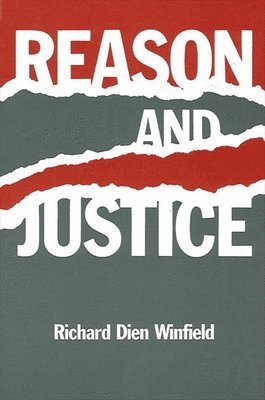
    Reason and Justice

    AvRichard Dien Winfield

    Häftad, Engelska, 1988

    Del i serien SUNY series in Systematic Philosophy

    472 kr

    Beställningsvara. Skickas inom 5-8 vardagar. Fri frakt över 249 kr.

    Fler format och utgåvor

    Inbunden

    Tillf. slut

    Beskrivning

    This is a finely argued, detailed, and comprehensive systematic theory of justice, brilliantly extending Hegelian ethics much as Rawls's Theory of Justice rehabilitated and extended classical Liberalism. Winfield argues that justice, like reason, must be self-grounding, and that to achieve this, it must be self-determined. The theory of justice must therefore abandon its appeal to metaphysically given or transcendentally constituted norms and instead determine the institutions of freedom. In pursuit of this task, Winfield offers insightful discussions of property relations, morality, the family, capital and commodity relations, economic and social justice, and the state. In contrast to Liberalism, which sees the state as instrumental to non-political ends, Winfield defends the democratic state as the just realization of freedom. Throughout, it is argued that justice is defined interactively, where one's freedom is determined by how one's interactions respect and foster the institutional freedom of others.Although the author's arguments proceed systematically, at each stage he deals adroitly with the relevant major thinkers in the Western tradition-not only with Hegel, but with the ancients, the classical liberals, Marx, and contemporaries such as Rawls.

    Produktinformation

    • Utgivningsdatum:1988-07-08
    • Mått:152 x 229 x 20 mm
    • Vikt:472 g
    • Format:Häftad
    • Språk:Engelska
    • Serie:SUNY series in Systematic Philosophy
    • Antal sidor:336
    • Förlag:State University of New York Press
    • ISBN:9780887067112

    Utforska kategorier

    • Filosofi inom Filosofi och religion

    Mer om författaren

    Richard Dien Winfield is Associate Professor of Philosophy at the University of Georgia. He is also the author of The Just Economy.

    Recensioner i media

    "This book is a rigorously argued and uncompromising presentation of the neo-Hegelian view that a foundation-free philosophy is possible, that normative validity derives only from self-determination, and that justice is tied to reason and consists in the reality of freedom. As such, it presents a minority view that is powerful and controversial. In this age when many neo-Hegelians have lost a uniquely Hegelian character by abandoning the system and stressing intersubjectivity and interpretation, Winfield adopts an opposite point of view, presenting a systematic political philosophy based on self-determination, reason, and logic." — Peter G. Stillman, Vassar College"There are several things I like about this book: first, the breadth of the discussion covering the major figures, including Plato, Aristotle, Contractarians, Hegel, and Marx, and their different approaches in the history of philosophy; and, second, the systematic argument sustained through the whole manuscript. Winfield grounds his social philosophy in a new theory of epistemology and of metaphysics. Finally, I like the breadth of topics covered in Winfield's own systematic theory of justice." — Wilfried Ver Eecke, Georgetown University

    Innehållsförteckning

    • Introduction 1. The Two Traditional Approaches to Justification1.1 The Appeal to Privileged Givens1.2 The Appeal to a Privileged Determiner 2. The Challenges of Scepticism and Nihilism 3. The Current Impasse in Normative Theory3.1 The Rehabilitation of the Foundational Approaches to Justice3.2 The Resigned Embrace of Descriptive Theories of Justice 4. The Alternative of a Systematic Philosophy without Foundations Part I. Dilemmas of the Metaphysical Approach to Truth and Justice 1. Given Determinacy and Justification 1.1 Positive Science and the Problem of the Given1.2 The Lure of Privileged Givenness and the Path of Metaphysics1.3 The Problem of Grounding Reason on Privileged Givens1.3.1 The Lesson of Logical Positivism1.3.2 The Impossibility of Justifying Any First Principles of Reasoning1.4 Problems of the Metaphysical Conception of Reality 2. The Metaphysics of Justice 2.1 Plato's Discovery of the Basic Logic of Praxis Theory2.2 Aristotle's Politics and the Internal Collapse of Praxis Theory2.2.1 The Good and the Shadow of Relativism2.2.2 Thje Praxis of Politics and the Appeal to Nature2.2.2.1 The Genesis of the State and the Relation between Politics and Non-Political Associations2.2.2.2 The Constitution of the State and Privileged Givenness Part II. The Critique of the Given and the Appeal to a Privileged Determiner 3. The Futile Temptation of Transcendental Argument 3.1 The Move from the Privileged Givenness to a Privileged Determiner3.2 The Temptation of the Transcendental Project3.3 The Fundamental Dilemmas of Transcendental Philosophy3.4 The Self-Elimination of Transcendental Argument 4. The Justice of Liberty 4.1 From Praxis to Liberty: The Rise of Freedom as the Principle of Justice4.1.1 Freedom and the Validity of Justice4.1.2 The Basic Dilemma of Liberal Theory4.1.3 The Universal, Particular, and Individual Dimensions of Willing4.2 The Logic of Liberty and the Paradoxes of Social Contract4.2.1 The Natural Will and the State of Nature4.2.2 The Perplexities of Social Contract 5. The Promise and Illusion of Practical Reason 5.1 Practical Reason and the Individuality of Freedom5.2 The Impracticality of Practical Reason5.3 Civil Society in the Service of Practical Reason5.4 The Miscarriage of Rawls' Rehabilitation of Social Contract Theory5.4.1 The Hidden Assumptions of Pure Procedural Justice5.4.2 The Collapse of Rawls' Derivation of the Two Principles of Justice5.4.3 The Incoherence of the Move to the Original Position Part III. Freedom from Foundations and the Validity of Self-Determination 6. Self-Determination and Systematic Philosophy 6.1 The Perplexity of Abandoning the Appeal to Privileged Givens and Privileged Determiners6.1.1 The Futile Route of Holism6.2 Indeterminacy, Self-Determination, and Freedom from Foundations6.2.1 Self-Determination as Immanent Development from Indeterminacy6.2.2 The Advance from Indeterminacy as Self-Determination6.3 Moving from Indeterminacy to Determinacy without Foundations 7. The Theory of Determinacy and the Quests for Truth and Justice 7.1 The Nature of the Logic of Determinacy7.1.1 The Theory of Determinacy as a Science of Logic7.1.2 The Argument of the Theory of Determinacy7.1.3 Systematic Philosophy versus Coherence Theories of Truth7.1.4 The Limit of the Theory of Determinacy7.2 The Move from the Theory of Determinacy to the Theory of Reality7.2.1 The Dogma of Realism and Idealism7.2.2 Beyond Realism and Idealism7.3 Normativity, Rational Reconstruction, and the Theory of Justice7.3.1 Freedom as Normativity7.3.2 The Rational Reconstruction of Justice Part IV. The System of Justice 8. The Elementary Structures of Freedom 8.1 Justice as the Reality of Freedom8.1.1 Freedom as Interaction: The Deduction of the Concept of Right8.1.2 The Dilemma of Foundational Theories of Interaction8.1.3 The Minimal Structure of Right8.1.4 The Original Appropriation of Property8.1.5 The Solution to the Vicious Circularity of Original Appropriation8.2 The Move beyond the Minimal Structure of Justice8.2.1 The Limits of Property8.3 Morality and the Realization of Right 9. The Family as an Institution of Freedom9.1 The Basic Structure of the Free Housegold9.2 Natural Difference and Household Rights9.2.1 Gender, Sexual Orientation, and the Rights of Spouses9.2.2 Monogamy and the Nuclear Family9.2.3 Natural versus Ethical Parenthood9.3 The Place of Children in the Family9.4 The Limits of Family Freedom 10. Economic Freedom and the Just Society10.1. Justice and the Just Society10.1.1 The Problem of a Just Economy10.2 The Critique of Political Economy10.2.1 The Dilemma of Political Economy10.2.2 The Failure of Marx's Critique of Political Economy10.2.3 The Promise of Hegel's Critique of Political Economy10.3 Economic Freedom as the Minimal Structure of Social Justice10.3.1 Social Freedom and Commodity Relations 11. Capital and the Legitimacy of Commodity Relations11.1 The Questions Raised by the Conflicting Theories of Hegel and Marx11.2 Justice and Commodity Exchange11.2.1 Needs and Commodities as Factors of Freedom11.2.2 Commodity Exchange and Exchange Value11.2.3 The Labor Theory of Value and the Justice of Exchange11.2.4 Capital and the Just Economy11.2.5 The Subordinate Role of Capital in the Commodity Economy11.3 Class and Economic Justice 12. The Realization of Social Justice12.1 The Limits of Economic Freedom12.2 The Social Enforcement of Property and Household Rights12.3 Economic Interest Groups and the Just Society12.4 Social Freedom and the Public Administration of Welfare12.5 The Limits of Social Freedom 13. Democracy and the Just State13.1 The Mandate of Political Freedom13.1.1 The Injustice of Instrumental Politics13.1.2 The Sovereignty of Politics13.2 The Just Relation between State and Society13.3 The Justice of Democracy13.3.1 The Apparent Injustice of Political Freedom13.3.2 The Wrong Defenses of Democracy13.3.2.1 Jefferson's Appeal to Praxis and Liberty13.3.2.2 Democracy and Rousseau's General Will13.3.2.3 The Pitfall of Lenin's Proletarian Democracy13.3.3 The Three Requirements for the Justification of Democracy13.4 Constitutionality, Positive Law, and Democracy13.5 Constitutional Self-Government and the Division of Powers13.6 Democracy for its Own Sake 14. The Historical Genesis of Justice14.1 The Grounds for Rejecting any Philosophy of Factual Freedom14.2 Freedom and the Genesis of Justice14.3 The Political Character of the Genesis of Justice14.4 The Foundation of the Just State and the Riddle of Constitution-Making14.5 Formal versus Real Constitution-Making14.6 Factual History and the Genesis of Justice Notes Index