Tanner Lectures on Human Values - Böcker
Visar alla böcker i serien Tanner Lectures on Human Values. Handla med fri frakt och snabb leverans.
16 produkter
16 produkter
Del 9 - Tanner Lectures on Human Values
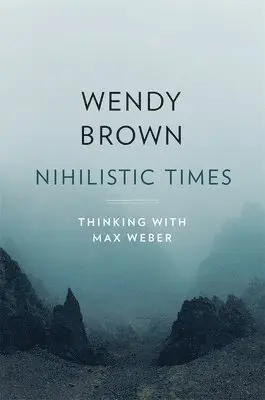
Nihilistic Times
Thinking with Max Weber
Inbunden, Engelska, 2023
244 kr
Skickas inom 7-10 vardagar
One of America’s leading political theorists analyzes the nihilism degrading—and confounding—political and academic life today. Through readings of Max Weber’s Vocation Lectures, she proposes ways to counter nihilism’s devaluations of both knowledge and political responsibility.How has politics become a playpen for vain demagogues? Why has the university become an ideological war zone? What has happened to Truth? Wendy Brown places nihilism at the center of these predicaments. Emerging from European modernity’s replacement of God and tradition with science and reason, nihilism removes the foundation on which values, including that of truth itself, stand. It hyperpoliticizes knowledge and reduces the political sphere to displays of narcissism and irresponsible power plays. It renders the profound trivial, the future unimportant, and corruption banal.To consider remedies for this condition, Brown turns to Weber’s famous Vocation Lectures, delivered at the end of World War I. There, Weber himself decries the effects of nihilism on both scholarly and political life. He also spells out requirements for re-securing truth in the academy and integrity in politics. Famously opposing the two spheres to each other, he sought to restrict academic life to the pursuit of facts and reserve for the political realm the pursuit and legislation of values.Without accepting Weber’s arch oppositions, Brown acknowledges the distinctions they aim to mark as she charts reparative strategies for our own times. She calls for retrieving knowledge from hyperpoliticization without expunging values from research or teaching, and reflects on ways to embed responsibility in radical political action. Above all, she challenges the left to make good on its commitment to critical thinking by submitting all values to scrutiny in the classroom and to make good on its ambition for political transformation by twinning a radical democratic vision with charismatic leadership.
Del 4 - Tanner Lectures on Human Values
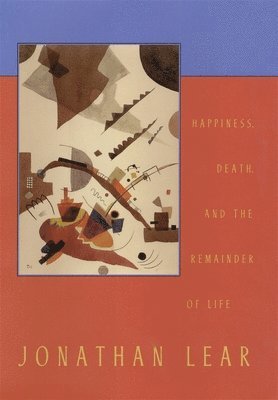
Happiness, Death, and the Remainder of Life
Häftad, Engelska, 2002
258 kr
Skickas inom 7-10 vardagar
Separated by millennia, Aristotle and Sigmund Freud gave us disparate but compelling pictures of the human condition. But if, with Jonathan Lear, we scrutinize these thinkers’ attempts to explain human behavior in terms of a higher principle—whether happiness or death—the pictures fall apart.Aristotle attempted to ground ethical life in human striving for happiness, yet he didn’t understand what happiness is any better than we do. Happiness became an enigmatic, always unattainable, means of seducing humankind into living an ethical life. Freud fared no better when he tried to ground human striving, aggression, and destructiveness in the death drive, like Aristotle attributing purpose where none exists. Neither overarching principle can guide or govern “the remainder of life,” in which our inherently disruptive unconscious moves in breaks and swerves to affect who and how we are. Lear exposes this tendency to self-disruption for what it is: an opening, an opportunity for new possibilities. His insights have profound consequences not only for analysis but for our understanding of civilization and its discontent.
Del 2 - Tanner Lectures on Human Values
American Citizenship
The Quest for Inclusion
Häftad, Engelska, 1998
290 kr
Skickas inom 7-10 vardagar
In this illuminating look at what constitutes American citizenship, Judith Shklar identifies the right to vote and the right to work as the defining social rights and primary sources of public respect. She demonstrates that in recent years, although all profess their devotion to the work ethic, earning remains unavailable to many who feel and are consequently treated as less than full citizens.
Del 5 - Tanner Lectures on Human Values
Frontiers of Justice
Disability, Nationality, Species Membership
Häftad, Engelska, 2007
243 kr
Skickas inom 7-10 vardagar
Theories of social justice are necessarily abstract, reaching beyond the particular and the immediate to the general and the timeless. Yet such theories, addressing the world and its problems, must respond to the real and changing dilemmas of the day. A brilliant work of practical philosophy, Frontiers of Justice is dedicated to this proposition. Taking up three urgent problems of social justice neglected by current theories and thus harder to tackle in practical terms and everyday life, Martha Nussbaum seeks a theory of social justice that can guide us to a richer, more responsive approach to social cooperation.The idea of the social contract--especially as developed in the work of John Rawls--is one of the most powerful approaches to social justice in the Western tradition. But as Nussbaum demonstrates, even Rawls's theory, suggesting a contract for mutual advantage among approximate equals, cannot address questions of social justice posed by unequal parties. How, for instance, can we extend the equal rights of citizenship--education, health care, political rights and liberties--to those with physical and mental disabilities? How can we extend justice and dignified life conditions to all citizens of the world? And how, finally, can we bring our treatment of nonhuman animals into our notions of social justice? Exploring the limitations of the social contract in these three areas, Nussbaum devises an alternative theory based on the idea of "capabilities." She helps us to think more clearly about the purposes of political cooperation and the nature of political principles--and to look to a future of greater justice for all.
Del 9 - Tanner Lectures on Human Values
Nihilistic Times
Thinking with Max Weber
Häftad, Engelska, 2025
187 kr
Skickas inom 7-10 vardagar
A Seminary Co-op Notable Book“What makes Brown’s book especially well worth reading is her impressive ability to show how key themes in Weber’s scholarship—including his emphasis on the defining characteristics of modernity . . . speak to our own time.” —Inside Higher Ed “Presses us to think more carefully and imaginatively about the relationships among human freedom, human value, and something beyond purely human concerns, be it truth, God, or Gaia.” —Commonweal “Worth reading…A timely reminder of the nihilistic air we breathe.” —Law & Liberty “Elegantly and concisely written…this insightful, thought-provoking book illuminates some objective culture factors contributing to the social division and degradation of public life in many democracies today.” —Critical TheologyHow has politics become a playpen for vain demagogues? Why has the university become an ideological war zone? What has happened to Truth? Wendy Brown places nihilism at the center of these predicaments. Emerging from the retreat of God and tradition in the face of science and reason, nihilism removes the foundation on which values, including that of truth, stand. It hyperpoliticizes knowledge and renders the profound trivial, the future unimportant, and corruption banal.In search of remedies, Brown turns to Max Weber’s Vocation Lectures. Weber famously decries the effects of nihilism on scholarly and political life and proposes to keep the two separate, restricting academic work to the pursuit of facts and the political realm to the legislation of values. Without accepting Weber’s arch oppositions, Brown acknowledges the distinctions they mark as she charts reparative strategies for our own times. She calls for retrieving knowledge from hyperpoliticization without expunging values from research or teaching, and she challenges the left to make good on its commitments to critical thinking and democratization.
251 kr
Skickas inom 7-10 vardagar
In 2001, Vanity Fair declared that the Age of Irony was over. Joan Didion has lamented that the United States in the era of Barack Obama has become an "irony-free zone." Jonathan Lear in his 2006 book Radical Hope looked into America’s heart to ask how might we dispose ourselves if we came to feel our way of life was coming to an end. Here, he mobilizes a squad of philosophers and a psychoanalyst to once again forge a radical way forward, by arguing that no genuinely human life is possible without irony.Becoming human should not be taken for granted, Lear writes. It is something we accomplish, something we get the hang of, and like Kierkegaard and Plato, Lear claims that irony is one of the essential tools we use to do this. For Lear and the participants in his Socratic dialogue, irony is not about being cool and detached like a player in a Woody Allen film. That, as Johannes Climacus, one of Kierkegaard’s pseudonymous authors, puts it, “is something only assistant professors assume.” Instead, it is a renewed commitment to living seriously, to experiencing every disruption that shakes us out of our habitual ways of tuning out of life, with all its vicissitudes. While many over the centuries have argued differently, Lear claims that our feelings and desires tend toward order, a structure that irony shakes us into seeing. Lear’s exchanges with his interlocutors strengthen his claims, while his experiences as a practicing psychoanalyst bring an emotionally gripping dimension to what is at stake—the psychic costs and benefits of living with irony.
266 kr
Skickas inom 7-10 vardagar
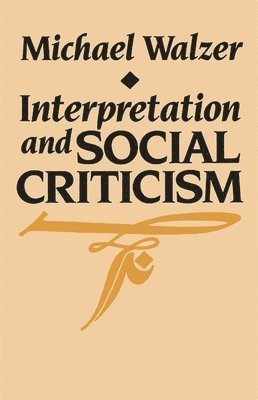
What do social critics do? I How do they go about doing it? Where do their principles come from? How do critics establish their distance from the people and institutions they criticize?Michael Walzer addresses these problems in succinct and engaging fashion, providing a philosophical framework for understanding social criticism as a social practice. Walzer maintains that social criticism is an ordinary activity—less the offspring of scientific knowledge than the “educated cousin of common complaint”—and does not depend for its force or accuracy upon any sort of high theory. In his view, the social critic is not someone radically detached and disinterested, who looks at society as a total stranger and applies objective and universal principles. The true social critic must stand only a little to the side of his society—unlike Jean-Paul Sartre during the Algerian war, for example, who described himself as an enemy of his own people. And unlike Lenin, who judged Russian society against a standard worked out with reference to other places far away.The “connected” critic is the model Walzer offers, one whose distance is measured in inches but who is highly critical nevertheless. John Locke is one example of the connected critic who argued for religious toleration not as a universal right ordained by reason but as a practical consequence of Protestant theology. The biblical prophets, such as Amos, were also men of their own day, with a particular quarrel to conduct with their fellows; the universalism of that quarrel is our own extrapolation. Walzer explains where critical principles come from, how much distance is “critical distance,” and what the historical practice of criticism has actually been like in the work of social philosophers such as Marx, Gramsci, Koestler, Lenin, Habermas, and Rawls.Walzer posits a moral world already in existence, a historical product, that gives structure to our lives but whose ordinances are always uncertain and in need of scrutiny, argument, and commentary. The social critic need bring to his task only the ordinary tools of interpretation. Philosophers, political theorists, and all readers seriously interested in the possibility of a moral life will find sustenance and inspiration in this book.
Del 6 - Tanner Lectures on Human Values
Decline and Fall of the American Republic
Häftad, Engelska, 2013
266 kr
Skickas inom 7-10 vardagar
Bruce Ackerman shows how the institutional dynamics of the last half-century have transformed the American presidency into a potential platform for political extremism and lawlessness. Watergate, Iran-Contra, and the War on Terror are only symptoms of deeper pathologies. Ackerman points to a series of developments that have previously been treated independently of one another—from the rise of presidential primaries, to the role of pollsters and media gurus, to the centralization of power in White House czars, to the politicization of the military, to the manipulation of constitutional doctrine to justify presidential power-grabs. He shows how these different transformations can interact to generate profound constitutional crises in the twenty-first century—and then proposes a series of reforms that will minimize, if not eliminate, the risks going forward. The book aims to begin a new constitutional debate. Americans should not suppose that Barack Obama’s centrism and constitutionalism will typify the presidencies of the twenty-first century. We should seize the present opportunity to confront deeper institutional pathologies before it is too late.
297 kr
Skickas inom 10-15 vardagar
In Singapore, Korea, Taiwan, Japan, and other parts of East and Southeast Asia, as well as China, people are asking, "What does Confucianism have to offer today?" For some, Confucius is still the symbol of a reactionary and repressive past; for others, he is the humanist admired by generations of scholars and thinkers, East and West, for his ethical system and discipline. In the face of such complications, only a scholar of Theodore de Bary's stature could venture broad answers to the question of the significance of Confucianism in today's world.
Del 8 - Tanner Lectures on Human Values
Citizens Divided
Campaign Finance Reform and the Constitution
Häftad, Engelska, 2016
274 kr
Skickas inom 10-15 vardagar
The Supreme Court’s 5–4 decision in Citizens United v. Federal Election Commission, which struck down a federal prohibition on independent corporate campaign expenditures, is one of the most controversial opinions in recent memory. Defenders of the First Amendment greeted the ruling with enthusiasm, while advocates of electoral reform recoiled in disbelief. Robert C. Post offers a new constitutional theory that seeks to reconcile these sharply divided camps.Post interprets constitutional conflict over campaign finance reform as an argument between those who believe self-government requires democratic participation in the formation of public opinion and those who believe that self-government requires a functioning system of representation. The former emphasize the value of free speech, while the latter emphasize the integrity of the electoral process. Each position has deep roots in American constitutional history. Post argues that both positions aim to nurture self-government, which in contemporary life can flourish only if elections are structured to create public confidence that elected officials are attentive to public opinion. Post spells out the many implications of this simple but profound insight. Critiquing the First Amendment reasoning of the Court in Citizens United, he also shows that the Court did not clearly grasp the constitutional dimensions of corporate speech.Blending history, constitutional law, and political theory, Citizens Divided explains how a Supreme Court case of far-reaching consequence might have been decided differently, in a manner that would have preserved both First Amendment rights and electoral integrity.
374 kr
Skickas inom 11-20 vardagar
The Tanner Lectures on Human Values, founded July 1, 1978, at Clare Hall, Cambridge University, was established by the American scholar, industrialist, and philanthropist Obert Clark Tanner. Lectureships are awarded to outstanding scholars or leaders in broadly defined fields of human values, and transcend ethnic, national, religious, or ideological distinctions. Volume 27 features lectures given by Ruth Reichl, James Q. Wilson, Marshall Sahlins, David Brion Davis, Allan Gibbard, and Margaret H. Marshall.
377 kr
Skickas inom 7-10 vardagar
The Tanner Lectures on Human Values, founded July 1, 1978, at Clare Hall, Cambridge University, were established by the American scholar, industrialist, and philanthropist Obert Clark Tanner. Lectureships are awarded to outstanding scholars or leaders in broadly defined fields of human values and transcend ethnic, national, religious, or ideological distinctions. Volume 38 features lectures given during the academic year 2018-2019 at the University of Oxford, Stanford University, the University of Michigan, the University of Utah, and Harvard University.
377 kr
Skickas inom 7-10 vardagar
The Tanner Lectures on Human Values, founded July 1, 1978, at Clare Hall, University of Cambridge, were established by the American scholar, industrialist, and philanthropist Obert Clark Tanner. Lectureships are awarded to outstanding scholars or leaders in broadly defined fields of human values and transcend ethnic, national, religious, or ideological distinctions. Volume 39 includes lectures initially scheduled during the academic year 2019 – 2020 at the University of Michigan, Cambridge, Princeton University, Stanford University, and Yale University. Owing to the global coronavirus pandemic, some were delivered at a later date.
211 kr
Skickas inom 7-10 vardagar
There is no shortage of criticisms of U.S. COVID-19 policy. This book argues that officials at the highest levels lied to the public or deliberately suppressed relevant information, shamelessly over-sold the efficacy of masks and vaccines, and enacted lock-down policies of unproven value that caused massive economic, educational, and psycho-social damage.In How to Respond Better to the Next Pandemic Allen Buchanan argues that, contrary to widespread opinion, the primary cause of flawed COVID-19 policy was not defective leadership, but rather institutional failure. Decisions were made through processes that lacked the most basic safeguards against the large-institution “yes-man” and group-think phenomena and included virtually no provisions for holding decision makers accountable. More fundamentally, policy makers did not fulfill the crucial duty to provide plausible public justifications for their decisions. They disguised the fact that scientific opinion was divided on the appropriateness of the policies they endorsed and labeled those who disagreed with them as anti-scientific. In some cases, they responded to criticism, not by engaging it on the issues, but by branding their critics as quacks.
660 kr
Skickas inom 7-10 vardagar
There is no shortage of criticisms of U.S. COVID-19 policy. This book argues that officials at the highest levels lied to the public or deliberately suppressed relevant information, shamelessly over-sold the efficacy of masks and vaccines, and enacted lock-down policies of unproven value that caused massive economic, educational, and psycho-social damage.In How to Respond Better to the Next Pandemic Allen Buchanan argues that, contrary to widespread opinion, the primary cause of flawed COVID-19 policy was not defective leadership, but rather institutional failure. Decisions were made through processes that lacked the most basic safeguards against the large-institution “yes-man” and group-think phenomena and included virtually no provisions for holding decision makers accountable. More fundamentally, policy makers did not fulfill the crucial duty to provide plausible public justifications for their decisions. They disguised the fact that scientific opinion was divided on the appropriateness of the policies they endorsed and labeled those who disagreed with them as anti-scientific. In some cases, they responded to criticism, not by engaging it on the issues, but by branding their critics as quacks.
541 kr
Kommande
The Tanner Lectures on Human Values, founded July 1, 1978 at Clare Hall, University of Cambridge, were established by the American scholar, industrialist, and philanthropist Obert Clark Tanner. Lectureships are awarded to outstanding scholars or leaders in broadly defined fields of human values and transcend ethnic, national, religious, or ideological distinctions.