Jonathan Lear - Böcker
Visar alla böcker från författaren Jonathan Lear. Handla med fri frakt och snabb leverans.
19 produkter
19 produkter
212 kr
Skickas inom 7-10 vardagar
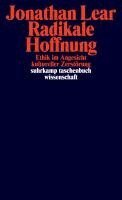
Shortly before he died, Plenty Coups, the last great Chief of the Crow Nation, told his story—up to a certain point. “When the buffalo went away the hearts of my people fell to the ground,” he said, “and they could not lift them up again. After this nothing happened.” It is precisely this point—that of a people faced with the end of their way of life—that prompts the philosophical and ethical inquiry pursued in Radical Hope. In Jonathan Lear’s view, Plenty Coups’s story raises a profound ethical question that transcends his time and challenges us all: how should one face the possibility that one’s culture might collapse?This is a vulnerability that affects us all—insofar as we are all inhabitants of a civilization, and civilizations are themselves vulnerable to historical forces. How should we live with this vulnerability? Can we make any sense of facing up to such a challenge courageously? Using the available anthropology and history of the Indian tribes during their confinement to reservations, and drawing on philosophy and psychoanalytic theory, Lear explores the story of the Crow Nation at an impasse as it bears upon these questions—and these questions as they bear upon our own place in the world. His book is a deeply revealing, and deeply moving, philosophical inquiry into a peculiar vulnerability that goes to the heart of the human condition.
309 kr
Skickas inom 5-8 vardagar
In the early 20th century, Marxist theory was enriched and rejuvenated by adopting the concept of reification, introduced by the Hungarian theorist Georg Lukács to identify and denounce the transformation of historical processes into ahistorical entities, human actions into things that seemed part of an immutable "second nature." For a variety of reasons, both theoretical and practical, the hopes placed in de-reification as a tool of revolutionary emancipation proved vain. In these original and imaginative essays, delivered as the Tanner Lectures at the University of California, Berkeley in 2005, the distinguished third-generation Frankfurt School philosopher Axel Honneth attempts to rescue the concept of reification by recasting it in terms of the philosophy of recognition he has been developing over the past two decades. Three distinguished political and social theorists: Judith Butler, Raymond Geuss, and Jonathan Lear, respond with hard questions about the central anthropological premise of his argument, the assumption that prior to cognition there is a fundamental experience of intersubjective recognition that can provide a normative standard by which current social relations can be judged wanted. Honneth listens carefully to their criticism and provides a powerful defense of his position.
Love and Its Place in Nature: A Philosophical Interpretation of Freudian Psychoanalysis
Häftad, Engelska
490 kr
Tillfälligt slut
1 768 kr
Skickas inom 10-15 vardagar
This book discusses how to write about the process of psychic change without betraying either love or science. It investigates the concepts of subjectivity and objectivity that are appropriate for psychoanalysts, the concepts of internalization and of transference.
2 289 kr
Skickas inom 10-15 vardagar
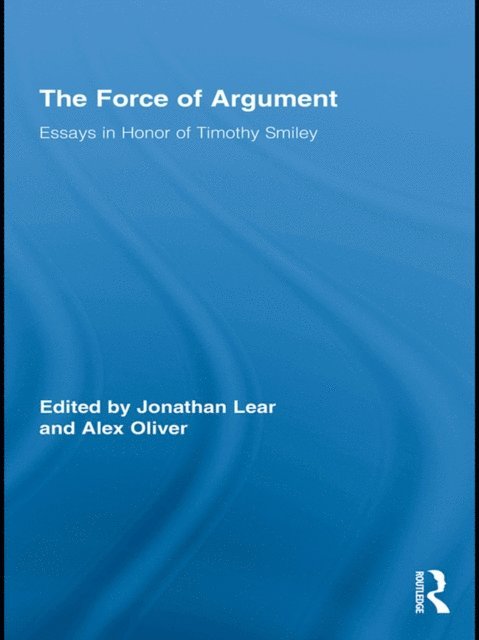
Timothy Smiley has made ground-breaking contributions to modal logic, free logic, multiple-conclusion logic, and plural logic. He has illuminated Aristotle’s syllogistic, the ideas of logical form and consequence, and the distinction between assertion and rejection, and has worked to debunk the theory of descriptions. This volume brings together new articles by an international roster of leading logicians and philosophers in order to honour Smiley’s work. Their essays will be of significant interest to those working across the logical spectrum—in philosophy of language, philosophical and mathematical logic, and philosophy of mathematics.
2 088 kr
Skickas inom 10-15 vardagar
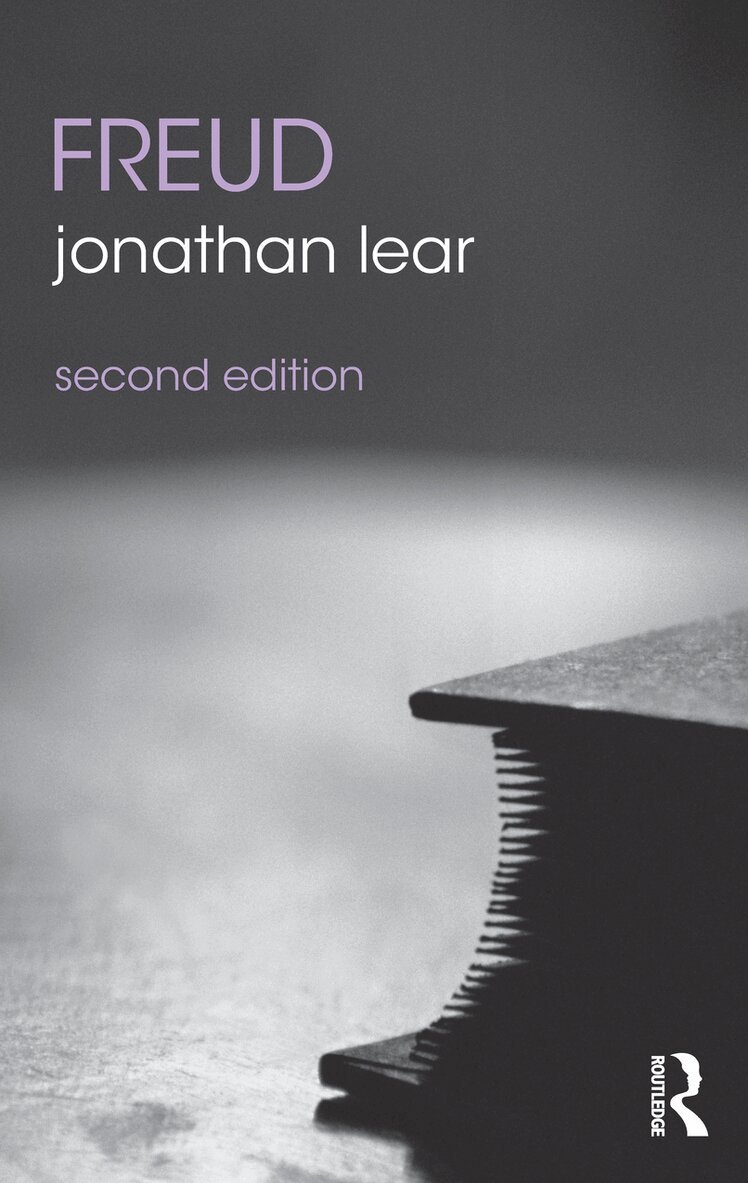
In this fully updated second edition, the author clearly introduces and assesses all of Freud's thought, focusing on those areas of philosophy on which Freud is acknowledged to have had a lasting impact. These include the philosophy of mind, free will and determinism, rationality, the nature of the self and subjectivity, and ethics and religion. He also considers some of the deeper issues and problems Freud engaged with, brilliantly illustrating their philosophical significance: human sexuality, the unconscious, dreams, and the theory of transference. The author's approach emphasizes the philosophical significance of Freud’s fundamental rule – to say whatever comes to mind without censorship or inhibition. This binds psychoanalysis to the philosophical exploration of self-consciousness and truthfulness, as well as opening new paths of inquiry for moral psychology and ethics.The second edition includes a new Introduction and Conclusion. The text is revised throughout, including new sections on psychological structure and object relations and on Freud’s critique of religion and morality.
346 kr
Skickas inom 10-15 vardagar
In this fully updated second edition, the author clearly introduces and assesses all of Freud's thought, focusing on those areas of philosophy on which Freud is acknowledged to have had a lasting impact. These include the philosophy of mind, free will and determinism, rationality, the nature of the self and subjectivity, and ethics and religion. He also considers some of the deeper issues and problems Freud engaged with, brilliantly illustrating their philosophical significance: human sexuality, the unconscious, dreams, and the theory of transference. The author's approach emphasizes the philosophical significance of Freud’s fundamental rule – to say whatever comes to mind without censorship or inhibition. This binds psychoanalysis to the philosophical exploration of self-consciousness and truthfulness, as well as opening new paths of inquiry for moral psychology and ethics.The second edition includes a new Introduction and Conclusion. The text is revised throughout, including new sections on psychological structure and object relations and on Freud’s critique of religion and morality.
257 kr
Skickas inom 7-10 vardagar
Aristotle was the first and one of the greatest logicians. He not only devised the first system of formal logic, but also raised many fundamental problems in the philosophy of logic. In this book, Dr Lear shows how Aristotle's discussion of logical consequence, validity and proof can contribute to contemporary debates in the philosophy of logic. No background knowledge of Aristotle is assumed.
394 kr
Skickas inom 7-10 vardagar
This is a 1988 philosophical introduction to Aristotle, and Professor Lear starts where Aristotle himself starts. The first sentence of the Metaphysics states that all human beings by their nature desire to know. But what is it for us to be animated by this desire in this world? What is it for a creature to have a nature; what is our human nature; what must the world be like to be intelligible; and what must we be like to understand it systematically? Through a consideration of these questions Professor Lear introduces us to the essence of Aristotle's philosophy and guides us through the central Aristotelian texts - selected from the Physics, Metaphysics, Ethics, Politics and from the biological and logical works. The book is written in a direct, lucid style which engages the reader with the themes in an active, participatory manner.
Del 4 - Tanner Lectures on Human Values
Happiness, Death, and the Remainder of Life
Häftad, Engelska, 2002
259 kr
Skickas inom 7-10 vardagar
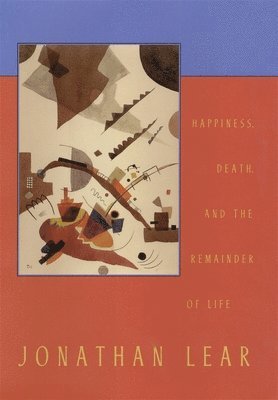
Separated by millennia, Aristotle and Sigmund Freud gave us disparate but compelling pictures of the human condition. But if, with Jonathan Lear, we scrutinize these thinkers’ attempts to explain human behavior in terms of a higher principle—whether happiness or death—the pictures fall apart.Aristotle attempted to ground ethical life in human striving for happiness, yet he didn’t understand what happiness is any better than we do. Happiness became an enigmatic, always unattainable, means of seducing humankind into living an ethical life. Freud fared no better when he tried to ground human striving, aggression, and destructiveness in the death drive, like Aristotle attributing purpose where none exists. Neither overarching principle can guide or govern “the remainder of life,” in which our inherently disruptive unconscious moves in breaks and swerves to affect who and how we are. Lear exposes this tendency to self-disruption for what it is: an opening, an opportunity for new possibilities. His insights have profound consequences not only for analysis but for our understanding of civilization and its discontent.
164 kr
Skickas inom 7-10 vardagar
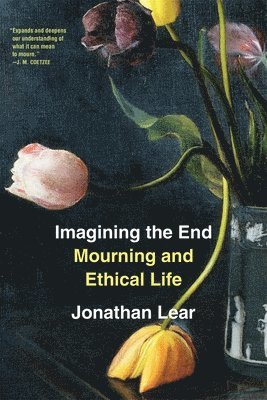
A Washington Post Notable Work of Nonfiction A Chronicle of Higher Education Best Scholarly Book “A deeply insightful and thought-enriching work by one of the most original philosophers writing today. Imagining the End is acutely aware of the danger we stand in of finding ourselves on an uninhabitable planet. But Lear is also aware of how the consciousness of impending loss can bring out the illumination inherent in meaningful life, often occluded in day-to-day living.”–Charles Taylor, author of A Secular Age“Lear is a lovely and subtle writer, someone who has a rare capacity to introduce ways of seeing and interrogating the world that dignify our confusion and pain while also opening up new possibilities for moving forward.”–Daniel Oppenheimer, Washington Post The range of Jonathan Lear’s abilities—as a philosopher and psychoanalyst who draws from ancient and modern thought, personal history, and everyday experience to help us think about how we can flourish in a world of flux and finitude—is on full display in Imagining the End. Lear masterfully explores how we respond to loss, crisis, and hope, considering our bewilderment in the face of planetary catastrophe. He examines the role of the humanities in expanding our imaginative and emotional repertoire. How might we live, he asks, when we realize just how vulnerable the cultures to which we traditionally turn for solace might be? He addresses how mourning can help us thrive, the role of moral exemplars in shaping our sense of the good, and the place of gratitude in human life. Along the way, he touches on figures as diverse as Aristotle, Abraham Lincoln, Sigmund Freud, and the British royals Harry and Meghan. Written with Lear’s characteristic elegance, philosophical depth, and psychological perceptiveness, Imagining the End is a powerful meditation on persistence in an age of turbulence and anxiety.
251 kr
Skickas inom 7-10 vardagar
In 2001, Vanity Fair declared that the Age of Irony was over. Joan Didion has lamented that the United States in the era of Barack Obama has become an "irony-free zone." Jonathan Lear in his 2006 book Radical Hope looked into America’s heart to ask how might we dispose ourselves if we came to feel our way of life was coming to an end. Here, he mobilizes a squad of philosophers and a psychoanalyst to once again forge a radical way forward, by arguing that no genuinely human life is possible without irony.Becoming human should not be taken for granted, Lear writes. It is something we accomplish, something we get the hang of, and like Kierkegaard and Plato, Lear claims that irony is one of the essential tools we use to do this. For Lear and the participants in his Socratic dialogue, irony is not about being cool and detached like a player in a Woody Allen film. That, as Johannes Climacus, one of Kierkegaard’s pseudonymous authors, puts it, “is something only assistant professors assume.” Instead, it is a renewed commitment to living seriously, to experiencing every disruption that shakes us out of our habitual ways of tuning out of life, with all its vicissitudes. While many over the centuries have argued differently, Lear claims that our feelings and desires tend toward order, a structure that irony shakes us into seeing. Lear’s exchanges with his interlocutors strengthen his claims, while his experiences as a practicing psychoanalyst bring an emotionally gripping dimension to what is at stake—the psychic costs and benefits of living with irony.
424 kr
Skickas inom 7-10 vardagar
Freud is discredited, so we don’t have to think about the darker strains of unconscious motivation anymore. We know what moves our political leaders, so we don’t have to look too closely at their thinking either. In fact, everywhere we look in contemporary culture, knowingness has taken the place of thought. This book is a spirited assault on that deadening trend, especially as it affects our deepest attempts to understand the human psyche—in philosophy and psychoanalysis. It explodes the widespread notion that we already know the problems and proper methods in these fields and so no longer need to ask crucial questions about the structure of human subjectivity.“What is psychology?” Open Minded is not so much an answer to this question as an attempt to understand what is being asked. The inquiry leads Jonathan Lear, a philosopher and psychoanalyst, back to Plato and Aristotle, to Freud and psychoanalysis, and to Wittgenstein. Lear argues that Freud and, more generally, psychoanalysis are the worthy inheritors of the Greek attempt to put our mindedness on display. There are also, he contends, deep affinities running through the works of Freud and Wittgenstein, despite their obvious differences. Both are concerned with how fantasy shapes our self-understanding; both reveal how life’s activities show more than we are able to say.The philosophical tradition has portrayed the mind as more rational than it is, even when trying to account for irrationality. Psychoanalysis shows us the mind as inherently restless, tending to disrupt its own functioning. And empirical psychology, for its part, ignores those aspects of human subjectivity that elude objective description. By triangulating between the Greeks, Freud, and Wittgenstein, Lear helps us recover a sense of what it is to be open-minded in our inquiries into the human soul.
369 kr
Skickas inom 7-10 vardagar
Wisdom Won from Illness brings into conversation two fields of humane inquiry—psychoanalysis and moral philosophy—that seem to have little to say to each other but which, taken together, form a basis for engaged ethical thought about how to live.Jonathan Lear begins by looking to the ancient Greek philosophers for insight into what constitutes the life well lived. Socrates said the human psyche should be ruled by reason, and much philosophy as well as psychology hangs on what he meant. For Aristotle, reason organized and presided over the harmonious soul; a wise person is someone capable of a full, happy, and healthy existence. Freud, plumbing the depths of unconscious desires and pre-linguistic thoughts, revealed just how unharmonious the psyche could be. Attuned to the stresses of modern existence, he investigated the myriad ways people fall ill and fail to thrive. Yet he inherited from Plato and Aristotle a key insight: that the irrational part of the soul is not simply opposed to reason. It is a different manner of thinking: a creative intelligence that distorts what it seeks to understand.Can reason absorb the psyche’s nonrational elements into a whole conception of the flourishing, fully realized human being? Without a good answer to that question, Lear says, philosophy is cut from its moorings in human life. Wisdom Won from Illness illuminates the role of literature in shaping ethical thought about nonrational aspects of the mind, offering rich readings of Shakespeare, Kierkegaard, J. M. Coetzee, Marilynne Robinson, and others.
820 kr
Skickas inom 10-15 vardagar
Timothy Smiley has made ground-breaking contributions to modal logic, free logic, multiple-conclusion logic, and plural logic. He has illuminated Aristotle’s syllogistic, the ideas of logical form and consequence, and the distinction between assertion and rejection, and has worked to debunk the theory of descriptions. This volume brings together new articles by an international roster of leading logicians and philosophers in order to honour Smiley’s work. Their essays will be of significant interest to those working across the logical spectrum—in philosophy of language, philosophical and mathematical logic, and philosophy of mathematics.
Monkey-Proof Box
Curriculum design for building knowledge, developing creative thinking and promoting independence
Häftad, Engelska, 2019
275 kr
Skickas
The Monkey-Proof Box is a manifesto on how to dismantle the curriculum we’re told to deliver and construct in its place the curriculum we need to deliver.A group of monkeys. A box full of nuts. A lever on its front that releases the nuts down a chute. The monkeys excitedly poke at the box with rocks … nothing happens. Meanwhile, one monkey sits to the side observing. But when the others wander off, he gets up and, with a curious push of his palm, presses down on the lever. Immediately, the nuts tumble down the chute. He can’t believe his luck and eats them all up. He then presses the lever again and again, each time getting more and more nuts.In the early years, our youngest learners get to have a go at such a monkey-proof box on a daily basis, but then as they get older – and as learning becomes more formal – we ditch the monkey-proofing for the path of least resistance. They are suddenly given the nuts on a plate, and their curiosity and creative thinking begins to fade. But what if it didn’t? What if we kept hold of some of that monkey-ness? In The Monkey-Proof Box, Jonathan Lear sets out how teachers can deliver a curriculum rich in authentic learning experiences that enable children to learn from one another and grow into empowered, knowledgeable and creative thinkers driven by insatiable curiosity.
507 kr
Skickas inom 10-15 vardagar
This book argues that properly understood, irony plays a crucial role in therapeutic action. It is written as an invitation to clinicians to renew their own engagement with the fundamental concepts of their practice. It investigates the concepts of subjectivity and objectivity that are appropriate for psychoanalysts, the concept of internalisation and of transference. It will be of interest to anyone concerned with the central concepts of psychoanalysis.
211 kr
Skickas inom 3-6 vardagar
204 kr
Skickas
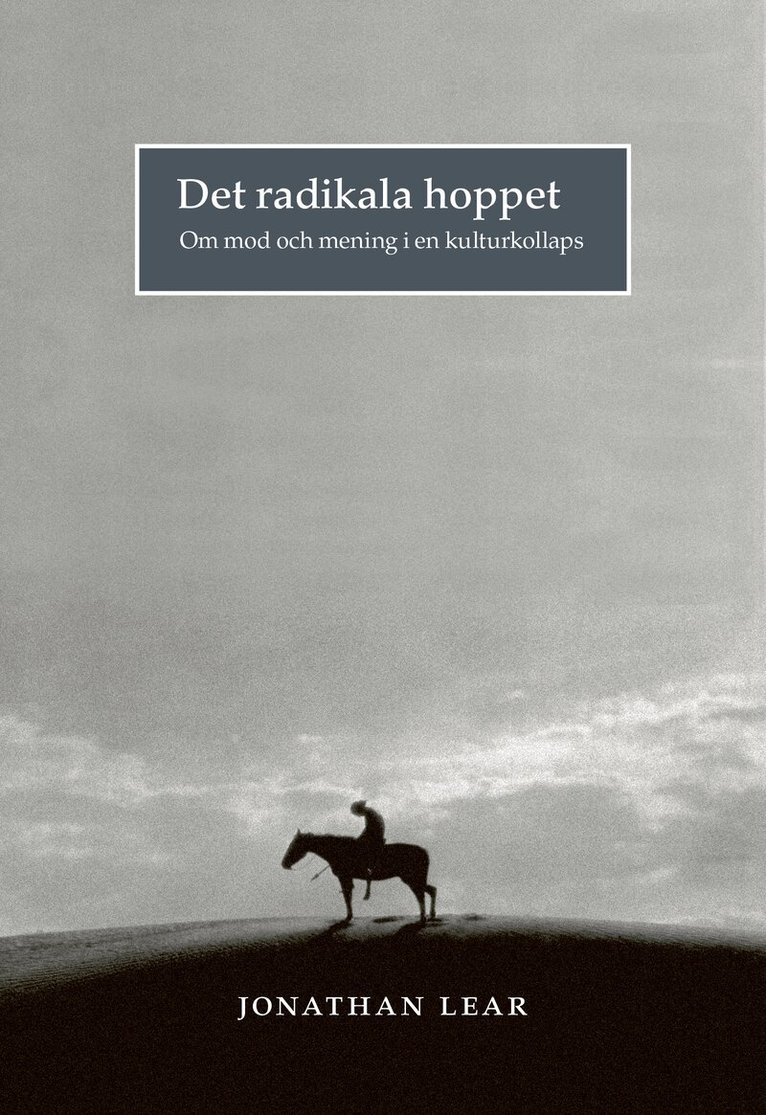
Vad skulle hända med oss om våra kollektiva livsvillkor förändrades drastiskt? Om de föreställningar, möjligheter och ritualer som strukturerar vår tillvaro tömdes på relevans eller till och med begriplighet och våra invanda liv blev mer eller mindre olevbara? Filosofen Jonathan Lears essä "Det radikala hoppet" handlar om en sådan genomgripande social och kulturell omställning: kråkindianernas övergång från en nomadisk tillvaro som självständiga buffeljägare på prärien till jordbrukande reservatsinvånare i slutet på 1800-talet. I centrum för framställningen står den både principfaste och pragmatiske hövdingen Plenty Coups och hans försök att lotsa kråkindianerna genom den mest utmanande tiden i stammens historia. Det radikala hoppet belyser samtidigt vår grundläggande ”ontologiska sårbarhet” som människor och de utmaningar den sårbarheten kan ställa oss inför praktiskt och moraliskt, individuellt och kollektivt. För Lear förkroppsligar Plenty Coups ett ”radikalt hopp” i sammanhanget: en tillit till någonting gott kan uppstå också ur omvälvningar som inte går att förutsäga eller överblicka. Jonathan Lear är John U. Nef Distinguished Service Professor vid Committee on Social Thought och Department of Philosophy, University of Chicago.