The ^ABerkeley Tanner Lectures - Böcker
Visar alla böcker i serien The ^ABerkeley Tanner Lectures. Handla med fri frakt och snabb leverans.
2 produkter
2 produkter
355 kr
Skickas inom 5-8 vardagar
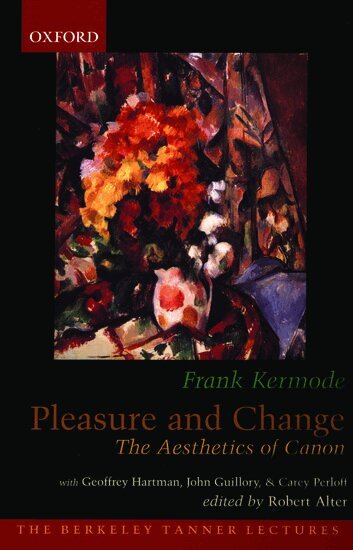
The question of the canon has been the subject of debate in academic circles for over fifteen years. Pleasure and Change contains two lectures on this important subject by the distinguished literary critic Sir Frank Kermode. In essays that were originally delivered as Tanner Lectures at Berkeley in November of 2001, Kermode reinterprets the question of canon formation in light of two related and central notions: pleasure and change. He asks how aesthetic pleasure informs what we find valuable, and how this perception changes over time. Kermode also explores the role of chance, observing the connections between canon formation and unintentional and sometimes even random circumstance. Geoffrey Hartmann (Yale University), John Guillory (New York University), and Carey Perloff (director of the American Conservatory Theatre) offer incisive comments on these essays, to which Kermode responds in a lively rejoinder. The volume begins with a helpful introduction by Robert Alter. The result is a stimulating and accessible discussion of a highly significant cultural debate.
537 kr
Skickas inom 5-8 vardagar
In the early 20th century, Marxist theory was enriched and rejuvenated by adopting the concept of reification, introduced by the Hungarian theorist Georg Lukács to identify and denounce the transformation of historical processes into ahistorical entities, human actions into things that seemed part of an immutable "second nature." For a variety of reasons, both theoretical and practical, the hopes placed in de-reification as a tool of revolutionary emancipation proved vain. In these original and imaginative essays, delivered as the Tanner Lectures at the University of California, Berkeley in 2005, the distinguished third-generation Frankfurt School philosopher Axel Honneth attempts to rescue the concept of reification by recasting it in terms of the philosophy of recognition he has been developing over the past two decades. Three distinguished political and social theorists: Judith Butler, Raymond Geuss, and Jonathan Lear, respond with hard questions about the central anthropological premise of his argument, the assumption that prior to cognition there is a fundamental experience of intersubjective recognition that can provide a normative standard by which current social relations can be judged wanted. Honneth listens carefully to their criticism and provides a powerful defense of his position.