The Hsu-Tang Library of Classical Chinese Literature – serie
Visar alla böcker i serien The Hsu-Tang Library of Classical Chinese Literature. Handla med fri frakt och snabb leverans.
10 produkter
10 produkter
Early Daoist Hagiographies
The Revelations of Yang Xi and the Inner Tradition of Han Emperor Wu
Inbunden, Engelska, 2026
354 kr
Skickas inom 5-8 vardagar
Early Daoist Hagiographies offers an engaging new translation of six key Daoist texts that illuminate the interplay between religion and literature in medieval China. Five of the texts are hagiographies from the fourth-century Supreme Purity (Shangqing) tradition, attributed to Yang Xi, who claimed to receive divine revelations from perfected beings during nightly séances. These narratives recount the trials and spiritual practices of early Daoist practitioners who ascended to godhood, serving as models for moral and ritual behavior. Complementing these is the Inner Tradition of Han Emperor Wu, an early sixth-century tale of Emperor Wu's failed pursuit of immortality, blending Daoist cosmology with cautionary themes about human desire. Together, these texts showcase the dynamic ways Daoist religious traditions shaped literary imagination during a period of political upheaval and cultural innovation. They provide insights into early medieval Daoist practices--such as meditative techniques, alchemy, and celestial bureaucracy--while reflecting the social lives and concerns of the era's elite. Through detailed introductions, this book reveals how esoteric Daoist beliefs were adapted into more accessible, popular forms, influencing Tang poetry, historiography, and public memory. The result is a fascinating glimpse into a time when gods, mortals, and cosmic forces converged to create enduring narratives of transcendence and caution.
Laureate Dong's Story of the Western Wing
Passion and Desire in a Buddhist Temple
Inbunden, Engelska, 2026
354 kr
Kommande
The Story of the Western Wing, one of China's most famous love operas, tells the story of Student Zhang and a teenage girl named Oriole who begin a passionate relationship in a Chinese monastery. The couple are promised to each other but only if Student Zhang passes the highest level of civil examinations. However, while he is away, another suitor, a boorish cad, manages to elicit a marriage promise for Oriole based on familial relations, and Student Zhang is turned away by Oriole's mother upon his return. The pair of lovers run away to elope but are followed by the new suitor, who throws himself down stone stairs to commit suicide upon being rebuffed. The story is a powerful account of young love. Stephen H. West's translation draws upon an earlier version of the story by Dong Jieyuan, a talented writer who had a wit to match Oscar Wilde. Dong's is the only fully extant text of this musical ballad from the heyday of its performance in the thirteenth-fifteenth centuries, and until now, has only existed in Ming editions. The Story of the Western Wing is critical to understanding Chinese vernacular and performative literature, and this translation--accompanied by explanatory notes from a distinguished scholar of Chinese drama--offers a unique perspective on literary and social values in China's early modern period.
354 kr
Skickas inom 5-8 vardagar
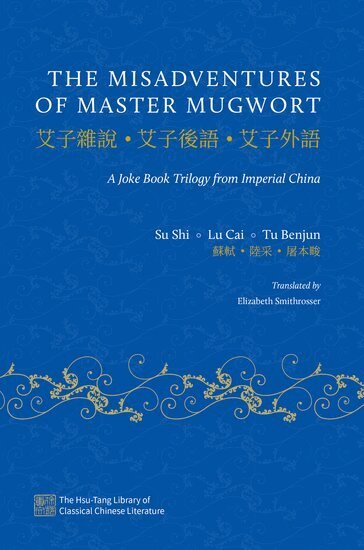
The Hsu-Tang Library presents authoritative and eminently readable translations of classical Chinese literature, in bilingual editions, ranging across three millennia and the entire Sinitic world.The Misadventures of Master Mugwort: A Joke Book Trilogy from Imperial China is a translation of three collections of humorous episodes revolving around the beloved fictional character of Master Mugwort (Aizi). Set in the ancient Warring States period, Master Mugwort counsels kings in the art of statecraft, takes on other masters in mock philosophical debates, and wisecracks his way through this age of opportunity and intrigue, disciples in tow.The explosive popularity of the original collection from the late 1000s, attributed to literatus-extraordinaire Su Shi, inspired sequels centuries later: in 1516 by precocious teenager Lu Cai; and in 1608 by whimsical retiree Tu Benjun. Together, these three books represent a time-honored tradition of Chinese humor as well as a light-hearted interpretation of a bygone age that remained of enduring importance to the writers' own day and age. Translated in full for the first time by Elizabeth Smithrosser, with an introduction and explanatory notes, this volume introduces a once bestselling, if today much overlooked, tradition of Chinese literature to new audiences.
354 kr
Skickas inom 5-8 vardagar
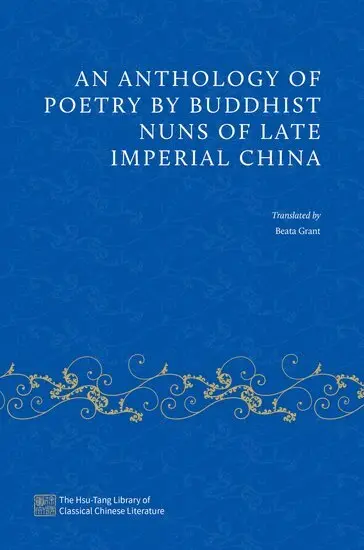
The Hsu-Tang Library presents authoritative and eminently readable translations of classical Chinese literature, in bilingual editions, ranging across three millennia and the entire Sinitic world.This anthology opens up new religious and poetic worlds for readers. It consists of translations of poems written by Buddhist nuns from China's late imperial period (1368-1911). Appreciation of these poems is enhanced by individual biographical accounts for each of the sixty-five nun-poets and an Introduction to the historical, religious, and literary context of these poems, including a concise discussion of Chinese Buddhism and Chinese Buddhist poetry.The nuns in this anthology come from a range of backgrounds: some were placed in convents when very young; others were former palace ladies or courtesans who found refuge in the religious life; others were women left widowed or destitute in the wake of the various political and social upheavals of the times, especially the violent transition between the Ming and Qing dynasties in the mid-seventeenth century. This period was also marked by a flourishing of women's culture, as more and more women from the gentry-class began not only to receive the classical education required to write poetry, but also to have their works printed and circulated. Most of the poet-nuns in this volume were from this gentry class, and almost all of them had at least one collection of writings, usually poetry, printed in their names. Although most of these collections are now lost, some of their poems have fortunately been preserved in various anthologies from this period, including anthologies dedicated exclusively to women's poetry, as well as in collections of Buddhist records.
354 kr
Tillfälligt slut
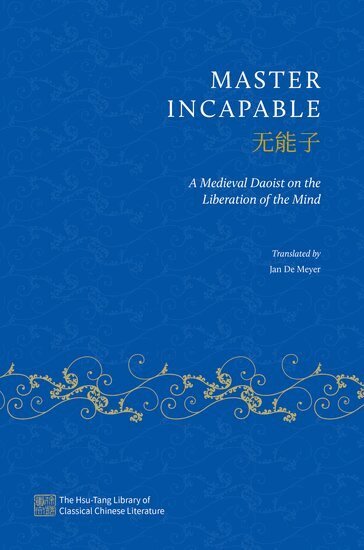
The Hsu-Tang Library presents authoritative and eminently readable translations of classical Chinese literature, in bilingual editions, ranging across three millennia and the entire Sinitic world.Master Incapable (Wunengzi) is an important but relatively little-known Daoist work written in 887, as the Tang dynasty (618-907) was breathing its last. The unknown author, a former government official now living as a recluse, witnesses internecine warfare, widespread poverty, and rampant social injustice, and attempts to explain why humanity seems to be plunging into a state of utter chaos. The nucleus of Master Incapable's analysis is his view of the separation of humanity from the natural world, caused by an abnormal growth of the intellect. His critique is as radical as that in the so-called "primitivist" chapters of the Daoist classic Zhuangzi, in which civilization is considered a disease spread by an intellectual and societal elite, "those who are called sages." The way out of mankind's predicament, he argues, consists in deconstructing conventional wisdom, and in ridding oneself of desire and intentionality, thereby finding one's way back to naturalness and effortless action.Fiercely egalitarian in tone, Master Incapable also criticizes superstition, offers a coherent philosophy of reclusion, and holds highly original views on life and death, and language and intellect in the animal world. As a work of literature, it combines forcefully argued discussions and alternative interpretations on well-known historical episodes with glimpses into the private life of the philosopher, his family members and entourage. This fully annotated translation, the first in English, also includes an introduction to help explain the unique position the work occupies in the history of Daoism.
354 kr
Skickas inom 5-8 vardagar
The Chronicles of Japan--or The Nihon Shoki--compiled in 720 CE, is the oldest official history of the Japanese state. Following a 672 coup, the state of Wa renamed itself Japan and produced this dynastic historical text, legitimizing its hegemony of the archipelago. The first volume begins with the creation of the universe and the divine genealogy that underpins imperial legitimacy. Although the text was originally produced as a record of dynastic history, it is now considered the single most valuable source of information about the life, language, culture, myths, and customs of early Japan. To this day it inspires new adaptations in film, media, and video games. Written in Literary Sinitic with vernacular Japanese notes and songs, the text illustrates the process by which non-Chinese speaking peoples adapted Classical Chinese script and syntax to inscribe their own languages. Matthieu Felt's full English translation of this text is accompanied by explanatory notes, maps, and charts, making it valuable to any reader interested in the history of Japan, Shinto, mythology, the history of writing, Japanese literature and culture, and premodern Asian history.
Daoist Master Changchun's Journey to the West
To the Court of Chinggis Qan and Back
Inbunden, Engelska, 2023
354 kr
Skickas inom 5-8 vardagar
The Hsu-Tang Library presents authoritative and eminently readable translations of classical Chinese literature, in bilingual editions, ranging across three millennia and the entire Sinitic world.In the early years of the Mongol empire, the Quanzhen Daoist master Qiu Chuji (1148-1227, religious name Changchun) made an arduous three-year round-trip journey from north China to the Hindu Kush in 1221-23 in response to a summons by Chinggis Qan. The record of this journey compiled by Li Zhichang (1193-1255), one of Qiu's disciples, offers a detailed eyewitness account of travel across the Mongolian plateau as well as Central Asia in the immediate aftermath of Mongol conquest. It stands out from other thirteenth-century Chinese travel narratives in length, quality, and thoroughness of detail, endowing it with unique historical, geographical, cultural, and literary value. Ruth Dunnell, Stephen West, and Shao-yun Yang's new, complete, and annotated translation of the text for the first time renders all of Qiu Chuji's poems in the original Chinese. Omitted from older translations as insipid or irrelevant, Qiu's poetry opens a window into the Quanzhen practice of self-cultivation and its proselytizing mission and captures an educated Chinese observer's impressions of a vast, unfamiliar world of grasslands, deserts, and towering mountain ranges. This book includes an appendix with translations of related documents (such as the edicts of Chinggis Qan to Qiu), and concise yet detailed notes drawing upon a wealth of recent scholarship to guide both general and specialist readers. In addition to an introduction that situates the reader in the worlds inhabited by Qiu Chuji and his patron, the Mongol Qan, the translators have provided a digital StoryMap of Changchun's journey.
354 kr
Skickas inom 5-8 vardagar
Interweaving a star-crossed romance with the decline and fall of the Ming dynasty in mid seventeenth-century China, The Peach Blossom Fan by Kong Shangren (1648-1718) is a masterpiece of world literature. This sweeping historical drama encompasses the pleasures and passions of courtesan culture, the allure and pitfalls of political idealism, the complex twists of court intrigues, and the horrors and trauma of war. While the play traces the fall of the Ming dynasty through the love story of its two main characters—Hou Fangyu, a young scholar, and a courtesan named Li Xiangjun (or,"Sovereign Fragrance")—its cast of characters also includes various scholars and military commanders; a villain who is also a playwright; an ambiguous mediator who is also a painter, a storyteller who becomes a fisherman; a singing teacher who becomes a woodcutter; an officer who becomes a Daoist; and a ritual master who is both onstage and a member of the audience.As the play takes the readers inside the choices, dilemmas, and emotional turmoil of its diverse characters, it asks probing questions: How and why did the Ming dynasty, almost three hundred years old, come to an end? What is the scope of human agency during historical cataclysms? What forces shape memory and historical judgment? This compelling, readable, and faithful translation of the play includes an introduction on interpretive perspectives and the life and times of the playwright Kong Shangren as well as explanatory notes and a preface for each scene that serve as guides for the reader.
354 kr
Skickas inom 5-8 vardagar
The Hsu-Tang Library presents authoritative and eminently readable translations of classical Chinese literature, in bilingual editions, ranging across three millennia and the entire Sinitic world.New Tales Told While Trimming the Wick by the talented scholar and poet of the Ming dynasty, Qu You (1347-1433), was the first work of fiction officially banned in China, but also the first internationally acclaimed collection of Chinese short stories. These tales often seem quite modern in their character development and plot intricacies, with characters facing ethical and moral challenges that are just as difficult to navigate today as they were over six hundred years ago. This collection is a crucial and delightful bridge between the classical tales of the Tang dynasty and Pu Songling's famous Strange Tales from Liaozhai in the Qing. Despite being fiction filled with supernatural elements, New Tales offers fascinating insights into the life and society of China during the turbulent transition between the Yuan and Ming dynasties. Translated in full for the first time, with a contextual introduction to the stories and their author, historical and literary annotations to aid the reader, and bibliographical support, this volume introduces a collection of tales that have had a profound influence on literature across all of Asia.
354 kr
Skickas inom 5-8 vardagar
Yu Xuanji (c. 843-868) is one of the most interesting poets in premodern Chinese literature, and her approximately fifty extant poems include some of the most arresting writing from the Tang dynasty--a period known as the golden age of Chinese poetry. Born a commoner, by fifteen Yu had become the concubine of a man from an illustrious family, until he abandoned her and she became a Daoist priestess, where she took on an active role as a poet as well as a religious practitioner. She was only a priestess for two years before she was executed at the age of twenty-six on dubious accusations of murder.Yu's story is fascinating, but her poetry is even more so. Despite her relatively slim output and the patriarchal culture in which she lived, she became known for writing that combines late Tang lushness with a rare frankness about what it meant to be a woman in the ninth century. Yu was an incisive and expressive poet, and her work treats a wide range of topics, such as love, spirituality, abandonment, female friendship, sex, and sexuality. Preceded by a critical introduction explaining the possibility of a tradition of women's poetry in medieval China, as well as Yu's relationship with the dominant tradition of male poets, this collection of innovative translations combines scholarly accuracy with a poet's demand for creative solutions in handling the crossover between languages and literary styles.