Beata Grant – författare
Visar alla böcker från författaren Beata Grant. Handla med fri frakt och snabb leverans.
4 produkter
4 produkter
Inbunden, Engelska, 2023
361 kr
Skickas inom 5-8 vardagar
The Hsu-Tang Library presents authoritative and eminently readable translations of classical Chinese literature, in bilingual editions, ranging across three millennia and the entire Sinitic world.This anthology opens up new religious and poetic worlds for readers. It consists of translations of poems written by Buddhist nuns from China's late imperial period (1368-1911). Appreciation of these poems is enhanced by individual biographical accounts for each of the sixty-five nun-poets and an Introduction to the historical, religious, and literary context of these poems, including a concise discussion of Chinese Buddhism and Chinese Buddhist poetry.The nuns in this anthology come from a range of backgrounds: some were placed in convents when very young; others were former palace ladies or courtesans who found refuge in the religious life; others were women left widowed or destitute in the wake of the various political and social upheavals of the times, especially the violent transition between the Ming and Qing dynasties in the mid-seventeenth century. This period was also marked by a flourishing of women's culture, as more and more women from the gentry-class began not only to receive the classical education required to write poetry, but also to have their works printed and circulated. Most of the poet-nuns in this volume were from this gentry class, and almost all of them had at least one collection of writings, usually poetry, printed in their names. Although most of these collections are now lost, some of their poems have fortunately been preserved in various anthologies from this period, including anthologies dedicated exclusively to women's poetry, as well as in collections of Buddhist records.
Del 231 - Harvard East Asian Monographs
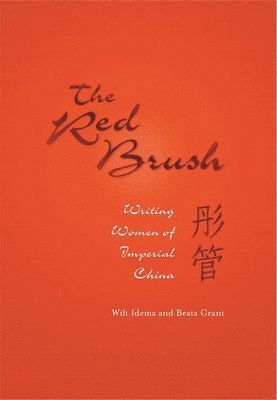
Red Brush
Writing Women of Imperial China
Häftad, Engelska, 2004
388 kr
Skickas inom 5-8 vardagar
One of the most exciting recent developments in the study of Chinese literature has been the rediscovery of an extremely rich and diverse tradition of women's writing of the imperial period (221 BCE-1911 CE). Many of these writings are of considerable literary quality. Others provide us with moving insights into the lives and feelings of a surprisingly diverse group of women living in Confucian China, a society that perhaps more than any other is known for its patriarchal tradition. Because of the burgeoning interest in the study of both premodern and modern women in China, several scholarly books, articles, and even anthologies of women's poetry have been published in the last two decades. This anthology differs from previous works by offering a glimpse of women's writings not only in poetry but in other genres as well, including essays and letters, drama, religious writing, and narrative fiction. The authors have presented the selections within their respective biographical and historical contexts. This comprehensive approach helps to clarify traditional Chinese ideas on the nature and function of literature as well as on the role of the woman writer.
E-bok
Engelska, 2012102 kr
Läs direkt efter köp
Women played major roles in the history of Buddhist China, but given the paucity of the remaining records, their voices have all but faded. In Daughters of Emptiness, Beata Grant renders a great service by recovering and translating the enchanting verse - by turns assertive, observant, devout - of forty-eight nuns from sixteen centuries of imperial China. This selection of poems, along with the brief biographical accounts that accompany them, affords readers a glimpse into the extraordinary diversity and sometimes startling richness of these women''s lives. A sample poem for this stunning collection: The sequence of seasons naturally pushes forward, Suddenly I am startled by the ending of the year. Lifting my eyes I catch sight of the winter crows, Calling mournfully as if wanting to complain. The sunlight is cold rather than gentle, Spreading over the four corners like a cloud. A cold wind blows fitfully in from the north, Its sad whistling filling courtyards and houses. Head raised, I gaze in the direction of Spring, But Spring pays no attention to me at all. Time a galloping colt glimpsed through a crack, The tap [of Death] at the door has its predestined time. How should I not know, one who has left the world, And for whom floating clouds are already familiar? In the garden there grows a rosary-plum tree: Whose sworn friendship makes it possible to endure. - Chan Master Jingnuo
E-bok
Engelska, 201795 kr
Läs direkt efter köp
The voices of three female Zen masters reverberate in this much-needed collection.Too often the history of Zen seems to be written as an unbroken masculine line: male teacher to male student. In this timely volume, Beata Grant shows us that women masters do exist—and have always existed. Zen Echoes is a collection of classic koans from Zen’s Chinese history that were first collected and commented on by Miaozong, a twelfth-century nun so adept that her teacher, the legendary Dahui Zonggao, used to tell other students that perhaps if they practiced hard enough, they might be as realized as her. Nearly five hundred years later, the seventeenth-century nuns Baochi and Zukui added their own commentaries to the collection. The three voices—distinct yet harmonious—remind us that enlightenment is at once universal and individual. In her introduction to this shimmering translation, Professor Grant tells us that the verses composed by these women provide evidence that “in a religious milieu made up overwhelmingly of men, there were women who were just as dedicated to Chan practice, just as advanced in their spiritual realization, and just as gifted at using language to convey that which is beyond language.”