The Rutgers Lectures in Philosophy - Böcker
Visar alla böcker i serien The Rutgers Lectures in Philosophy. Handla med fri frakt och snabb leverans.
4 produkter
4 produkter
412 kr
Skickas inom 7-10 vardagar
Vagueness is a subject of long-standing interest in the philosophy of language, metaphysics, and philosophical logic. Numerous accounts of vagueness have been proposed in the literature but there has been no general consensus on which, if any, should be be accepted. Kit Fine here presents a new theory of vagueness based on the radical hypothesis that vagueness is a "global" rather than a "local" phenomenon. In other words, according to Fine, the vagueness of an object or expression cannot properly be considered except in its relation to other objects or other expressions. He then applies the theory to a variety of topics in logic, metaphysics and epistemology, including the sorites paradox, the problem of personal identity, and the transparency of mental phenomenon.This is the inaugural volume in the Rutgers Lectures in Philosophy series, presenting lectures from the most important contemporary thinkers in the discipline.
Freedom of Speech and Expression
Its History, Its Value, Its Good Use, and Its Misuse
Inbunden, Engelska, 2021
295 kr
Skickas inom 7-10 vardagar
This is the second volume of the new Rutgers Lectures in Philosophy series, which publishes lectures of prominent intellectuals and philosophers delivered annually on the Rutgers New Brunswick campus. Sir Richard Sorabji here examines free speech through a historical lens from antiquity up to today. He first traces the concept's origins in ancient India, Rome, and Greece, and follows its evolution through early Christian, medieval, and Arabic philosophy. He then evaluates historical threats to free speech in literary, political, and religious contexts, and various legal constraints that have attempted to protect it. He discusses the tension between the benefits of free speech and its frustations and abuses, and argues for the use of voluntary self-restraint on such speech that frustrates its benefits, citing for example the art identified by Gandhi as "opening ears." Finally, he closes with an analysis of free speech on social media and the abuse of personal data and voter manipulation. With Freedom of Speech and Expression, Sorabji provides a comprehensive overview of the topic informed by his distinct philosophical analysis and perceptive commentary.
297 kr
Skickas
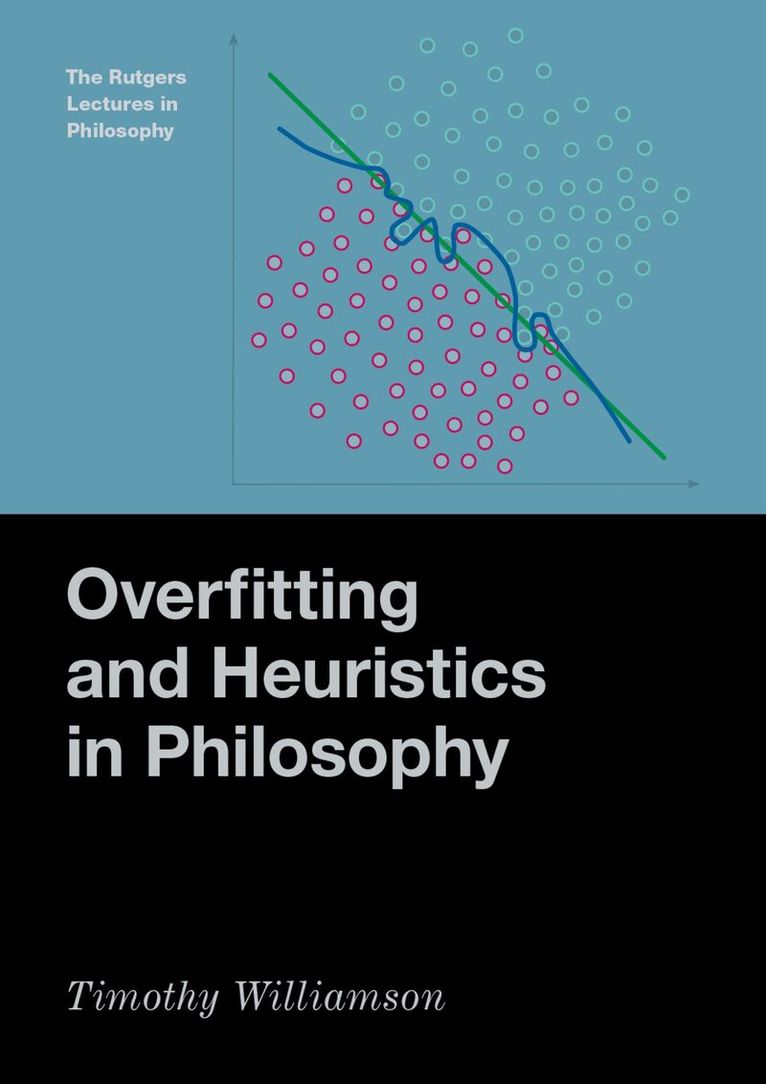
In his Rutgers Lectures, Timothy Williamson explains how contemporary philosophy suffers from a widespread pathology known as overfitting to natural and social scientists, but little understood by most philosophers. Overfitting involves an insufficiently critical attitude towards data, which leads to over-complicated theories designed to fit what are in fact errors in the data. In philosophy, the data typically comprise verdicts on hypothetical or actual cases. Errors in such data can result from our reliance on heuristics, efficient cognitive shortcuts, simple to use but not fully reliable. Just as heuristics embedded in our visual system produce visual illusions, so heuristics embedded in our general cognitive systems produce philosophical paradoxes. Williamson explains the heuristics responsible for paradoxes of vagueness and identity over time, paradoxes of conditionals, paradoxes in ascribing beliefs and other mental states to others, paradoxes of truth and falsity, and paradoxes of weighing reasons and intersectionality. As a case study, Williamson shows how illusions of hyperintensionality can result from a heuristic that projects cognitively significant differences in how explanations are presented onto supposed differences in the non-linguistic world, which then form the starting point for metaphysicians' theorizing. In each case, Williamson provides independent evidence that we commonly use the heuristic, and that it sometimes leads us astray. In short, we are being suckered by our own heuristics, and the result is overfitting. Williamson also discusses how philosophers can best avoid these problems. Williamson's important diagnosis and prescription will be of interest to a wide range of philosophers.
268 kr
Skickas inom 5-8 vardagar
As a prominent figure of the 18th century Enlightenment, Kant advocated faith in reason and in the possibility of human progress through the development of human beings' rational capacities. In contrast, as the founder of 20th century psychoanalysis, Freud revealed that rationality itself is rooted in the non-rational soil of mental life. For Freud, rational thinking is pervaded with irrational motivations for thinking and acting. For Kant, the capacity to affirm and endorse on rational grounds one's beliefs and actions is the highest capacity in human beings, one that raises them above all other living beings. Those contrasts between the two thinkers have led to countless philosophical manifestos pitting Freud and Kant against each other. Some accuse Kant of having played a central role in the promotion of the hubris of modern rationality, which resulted in the domination and destruction of nature. Others accuse Freud of being a prime culprit in the attacks against reason, progress and the very possibility of a better future for humanity. In The Organization of the Mind, Béatrice Longuenesse paints a more nuanced picture. She arguesthat Kant's analysis of our mental capacities reveals deep-seated and irresolvable conflicts within the mind--an insight that brings him closer to Freud than is often recognized. At the same time, Freud's concept of “the unconscious” is as original and revolutionary as Freud claimed. Freud developed that concept in connection to aspects of the mind that earlier philosophers had touched upon but never fully explored: the organization of memory traces and the way they are shaped by emotions and affects. The dynamic interplay of memory, emotion, and affect significantly influences rational thinking itself. Freud's articulation of these connections gives his theory of the unconscious its distinctive power. The Organization of the Mind, based on the author's Rutgers Lectures in Philosophy and the Isaiah Berlin Lectures she gave a year later at Oxford University, creates space for a dialogue between Kant's and Freud's first-personperspectives onthe mind, on the one hand;and, on the other, the third-person approaches of affective and cognitive neuroscience, particularly in the study of memory. These convergences offer fresh directions for contemporary philosophy of mind and psychology.