Twentieth Century Fund Books/Reports/Studies - Böcker
Visar alla böcker i serien Twentieth Century Fund Books/Reports/Studies. Handla med fri frakt och snabb leverans.
4 produkter
4 produkter
Del 4 - Twentieth Century Fund Books/Reports/Studies
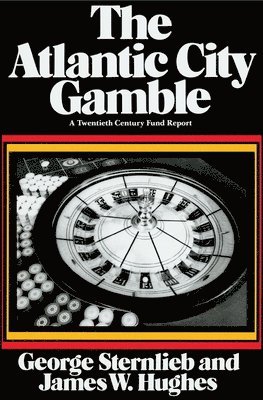
Atlantic City Gamble
A Twentieth Century Fund Report
Häftad, Engelska, 1985
340 kr
Skickas inom 10-15 vardagar
In November 1976, the state of New Jersey embarked upon a bold experiment when the voters approved a referendum to authorize casino gambling in Atlantic City. Expectations were high: the gaming industry could rejuvenate a dying city core, employment would swell, the tax base would broaden and welfare rolls diminish, tourism might spread through the state, and the cruel spectacle of a poverty-stricken community would be eliminated.The Atlantic City Gamble reports the results of this experiment and evaluates casinos as a tool for economic revitalization, a painless source of revenue. The casinos are enormously profitable—but for whom? The city has paid a huge toll in human and economic hardship. There are 30,000 new jobs, but little spillover into non-casino employment. Crime rates have skyrocketed. Housing has been priced beyond the reach of minority groups and the elderly. In 1982, the casinos paid more than $117 million in state taxes, but much of the projected bonanza to Atlantic City has been swallowed by the industry’s need for expanded municipal services, such as police protection. Fears of the old connection between gambling and organized crime may be exaggerated, but few can deny that the gaming industry—with its immense daily cash flow—harbors a vast potential for corruption.The state promoted visions of a glorious rebirth, but it failed to provide a governing mechanism that could produce the promised rewards. Would better planning and research enable any government to cope with such instant large-scale business and the political clout it carries? Economic strangulation has motivated at least eight other states to think about letting in casinos. The decisions they make will have far-reaching social and economic consequences, and must be based on a set of facts as accurate and comprehensive as possible. In searching out the lessons of Atlantic City, the authors have provided a sobering glimpse into the intricacies of legalized gambling.
Del 8 - Twentieth Century Fund Books/Reports/Studies
Losing Time
The Industrial Policy Debate
Häftad, Engelska, 1994
394 kr
Skickas inom 10-15 vardagar
Japan has had one since before the Pacific War. Germany has always had one. Britain has had one after another. Shouldn't the United States get one?Though hotly debated throughout the 1980s, this was the wrong question, leading to years of delay and confusion. The United States already had an Industrial Policy, said Otis Graham, but one which was uncoordinated and often harmful. This policy morass, which continued in the 1990s under George Bush despite the erosion of America's competitive position, owes much to a misunderstood history of government economic policy. Elements of both parties, but especially Reagan Republicans, have obscured our real choices with historical myths.What should the United States have done when the nation saw its industries rapidly becoming globally uncompetitive? What reforms do we need now, asks Graham, to redirect our public policies for competitive strength? Industrial policy reform is an important part of a public-private set of remedies, but it hinges upon an improved use of policy history and of historical perspective generally. He proposes an explicit if minimalist approach by the federal government that would pull together and reform our de facto industrial policies in order to equip the United States with the institutional capacity to formulate industrial interventions guided by continuous learning, strategic vision, and bipartisan participation by both labor and management.Losing Time is important reading for policy-makers, community leaders, academics involved in public policy, economics, and history, and readers generally concerned about their future.
Del 9 - Twentieth Century Fund Books/Reports/Studies
Science at the Bar
Law, Science, and Technology in America
Häftad, Engelska, 1997
352 kr
Skickas inom 10-15 vardagar
Issues spawned by the headlong pace of developments in science and technology fill the courts. How should we deal with frozen embryos and leaky implants, dangerous chemicals, DNA fingerprints, and genetically engineered animals? The realm of the law, to which beleaguered people look for answers, is sometimes at a loss—constrained by its own assumptions and practices, Sheila Jasanoff suggests. This book exposes American law’s long-standing involvement in constructing, propagating, and perpetuating a variety of myths about science and technology.Science at the Bar is the first book to examine in detail how two powerful American institutions—both seekers after truth—interact with each other. Looking at cases involving product liability, medical malpractice, toxic torts, genetic engineering, and life and death, Jasanoff argues that the courts do not simply depend on scientific findings for guidance—they actually influence the production of science and technology at many different levels. Research is conducted and interpreted to answer legal questions. Experts are selected to be credible on the witness stand. Products are redesigned to reduce the risk of lawsuits. At the same time the courts emerge here as democratizing agents in disputes over the control and deployment of new technologies, advancing and sustaining a public dialogue about the limits of expertise. Jasanoff shows how positivistic views of science and the law often prevent courts from realizing their full potential as centers for a progressive critique of science and technology.With its lucid analysis of both scientific and legal modes of reasoning, and its recommendations for scholars and policymakers, this book will be an indispensable resource for anyone who hopes to understand the changing configurations of science, technology, and the law in our litigious society.
Del 6 - Twentieth Century Fund Books/Reports/Studies
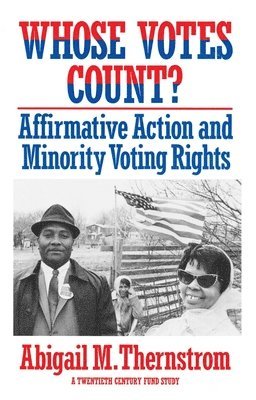
Whose Votes Count?
Affirmative Action and Minority Voting Rights
Häftad, Engelska, 1989
426 kr
Skickas inom 10-15 vardagar
The Fifteenth Amendment to the Constitution of the United States guarantees that all citizens have the right to vote without regard to their “race, color, or previous condition of servitude.” For almost a century the Fifteenth Amendment was a dead letter. Throughout the South millions of nonwhite Americans were excluded from the political process by poll taxes, literacy tests, and other devices. The landmark Voting Rights Act of 1965 sought to end that injustice.In this absorbing book, political scientist Abigail Thernstrom analyzes the radical transformation of the Voting Rights Act in the years since its passage. She shows how a measure carefully crafted to open the polling booths to southern blacks has evolved into a powerful tool for affirmative action in the electoral sphere—a means to promote black and Hispanic officeholding by creating “safe” seats for minority candidates. What began as an effort to give minorities a fair shake has become a means of ensuring a fair share.Thernstrom demonstrates how voting rights have created a “political thicket” in which Congress, the courts, and the justice Department have been lost. Why this should be true, how small statutory changes led to large and unexpected results, how civil rights groups prevailed against a conservative Senate, how Republicans have benefited from gerrymandering to increase black officeholding—these stories are all part of Thernstrom’s well-told tale.Even though the concept of the right to vote retains an aura of moral simplicity, the issue of minority voting rights is perhaps the most complex, yet least studied, of all affirmative action issues. Whose Votes Count? should stimulate the overdue discussion that the subject deserves among all those concerned with American politics.