• Fri frakt över 249 kr
  • •
  • Snabba leveranser
  • •
  • Billiga böcker
Kundservice

Du är på sajten för privatpersoner.

Företag, bibliotek eller offentlig verksamhet?

Du handlar på classic.bokus.com, där alla dina funktioner finns intakta.
Till classic.bokus.com
Bokus logotyp. Gå till startsidan.
  • Erbjudanden
  • Nyheter
  • Student
  • Topplistor
  • Barn & ungdom
  • Bokus Play
  • E-böcker
  • Pocketböcker
  • Spel & pussel

10% rabatt på allt med kod NYSTART10 →

Sidfot

Mina sidor

    Hjälp

    • Kundservice
    • Vanliga frågor och svar
    • Frakt och leverans
    • Retur vid ångerrätt
    • Reklamera vara
    • Betalning
    • Köpvillkor
    • Allmänna villkor
    • Information om webbplatsens tillgänglighet

    Om Bokus

    • Om oss
    • Pressrum
    • För studenter
    • För företag
    • För bibliotek och offentlig verksamhet
    • För leverantörer
    • Hållbarhet

    Populärt

    • Aktuella erbjudanden
    • Presentkort
    • Studentlitteratur
    • Nya böcker
    • Topplistor
    • Signerade böcker
    • Engelska böcker

    Inspiration

    • Boktips
    • BookTok
    • Populära bokserier
    • Barnbokskaraktärer
    • Populära författare
    Logotyp för Bokus
    Följ oss på Facebook (extern länk)Följ oss på Instagram (extern länk)Följ oss på YouTube (extern länk)Följ oss på TikTok (extern länk)
    bokus @ CookiesAnpassa cookiesIntegritetspolicyKöpvillkor
    Till Citymail hemsida (extern länk)Till Budbee hemsida (extern länk)Till Postnord hemsida (extern länk)Till Schenker hemsida (extern länk)Till Early Bird hemsida (extern länk)Till Walleys hemsida (extern länk)
    1. Ekonomi och Ledarskap
    2. Nationalekonomi

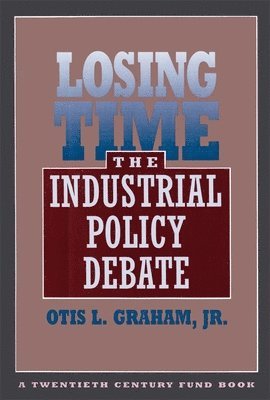
    Losing Time

    The Industrial Policy Debate

    AvOtis Graham

    Häftad, Engelska, 1994

    Del 8 i serien Twentieth Century Fund Books/Reports/Studies

    410 kr

    Beställningsvara. Skickas inom 10-15 vardagar. Fri frakt över 249 kr.

    Beskrivning

    Japan has had one since before the Pacific War. Germany has always had one. Britain has had one after another. Shouldn't the United States get one?Though hotly debated throughout the 1980s, this was the wrong question, leading to years of delay and confusion. The United States already had an Industrial Policy, said Otis Graham, but one which was uncoordinated and often harmful. This policy morass, which continued in the 1990s under George Bush despite the erosion of America's competitive position, owes much to a misunderstood history of government economic policy. Elements of both parties, but especially Reagan Republicans, have obscured our real choices with historical myths.What should the United States have done when the nation saw its industries rapidly becoming globally uncompetitive? What reforms do we need now, asks Graham, to redirect our public policies for competitive strength? Industrial policy reform is an important part of a public-private set of remedies, but it hinges upon an improved use of policy history and of historical perspective generally. He proposes an explicit if minimalist approach by the federal government that would pull together and reform our de facto industrial policies in order to equip the United States with the institutional capacity to formulate industrial interventions guided by continuous learning, strategic vision, and bipartisan participation by both labor and management.Losing Time is important reading for policy-makers, community leaders, academics involved in public policy, economics, and history, and readers generally concerned about their future.

    Produktinformation

    • Utgivningsdatum:1994-01-01
    • Mått:152 x 235 x undefined mm
    • Vikt:544 g
    • Format:Häftad
    • Språk:Engelska
    • Serie:Twentieth Century Fund Books/Reports/Studies
    • Antal sidor:384
    • Förlag:Harvard University Press
    • ISBN:9780674539358

    Utforska kategorier

    • Nationalekonomi inom Ekonomi och Ledarskap
    • Centralt styre och förvaltning inom Samhälle och politik
    • Industrier och branscher inom Ekonomi och Ledarskap

    Innehållsförteckning

    • Foreword by Richard C. Leone Acknowledgments Introduction Part I. Arguing Industrial Policy, 1980-1984 1. The New Economic Order 2. Emergence of the Industrial Policy idea 3. Ousted from Washington 4. Pundits at Floodtide 5. Industrial Visions and History Lessons 6. Alternative Designs 7. The Critics 8. The End of the Beginning Part II. The Persistence of Industrial Policy, 1985-1990 9. America's Unconscious Industrial Plan 10. Doing without Industrial Policy Part III. The Past Speaking to the Future 11. Using and Misusing History 12. Improving on the 1990s Notes Index