Wo Es War - Böcker
Visar alla böcker i serien Wo Es War. Handla med fri frakt och snabb leverans.
3 produkter
3 produkter
314 kr
Skickas inom 3-6 vardagar
In order to render the strange logic of dreams, Freud quoted the old joke about the borrowed kettle: (1) I never borrowed a kettle from you, (2) I returned it to you unbroken, (3) the kettle was already broken when I got it from you. Such an enumeration of inconsistent arguments, of course, confirms exactly what it attempts to deny-that I returned a broken kettle to you.That same inconsistency, Zizek argues, characterized the justification of the attack on Iraq: A link between Saddam's regime and al-Qaeda was transformed into the threat posed by the regime to the region, which was then further transformed into the threat posed to everyone (but the US and Britain especially) by weapons of mass destruction. When no significant weapons were found, we were treated to the same bizarre logic: OK, the two labs we found don't really prove anything, but even if there are no WMD in Iraq, there are other good reasons to topple a tyrant like Saddam ...Iraq: The Borrowed Kettle - which can be considered as a sequel to Zizek's acclaimed post-9/11 Welcome to the Desert of the Real - analyzes the background that such inconsistent argumentation conceals and, simultaneously, cannot help but highlight: what were the actual ideological and political stakes of the attack on Iraq? In classic Zizekian style, it spares nothing and nobody, neither pathetically impotent pacifism nor hypocritical sympathy with the suffering of the Iraqi people.
466 kr
Skickas inom 3-6 vardagar
Jacques Lacan is the foremost psychoanalytic theorist after Freud. Revolutionising the study of social relations, his work has been a major influence on political theory, philosophy, literature and the arts, but his thought has so far been studied without a serious investigation of its foundations. Just what are the influences on his thinking, so crucial to its proper understanding?In Lacan: The Silent Partners Slavoj Zizek, the maverick theorist and pre-eminent Lacan scholar, has marshalled some of the greatest thinkers of our age in support of a dazzling re-evaluation of Lacan's work. Focussing on Lacan's 'silent partners', those who are the hidden inspiration to Lacanian theory, they discuss his work in relation to the Pre-Socratics, Diderot, Hegel, Nietzsche, Schelling, Hölderlin, Wagner, Turgenev, Kafka, Henry James and Artaud.This major collection, including three essays by Zizek, marks a new era in the study of this unsettling thinker, breathing new life into his classic work.
354 kr
Skickas inom 3-6 vardagar
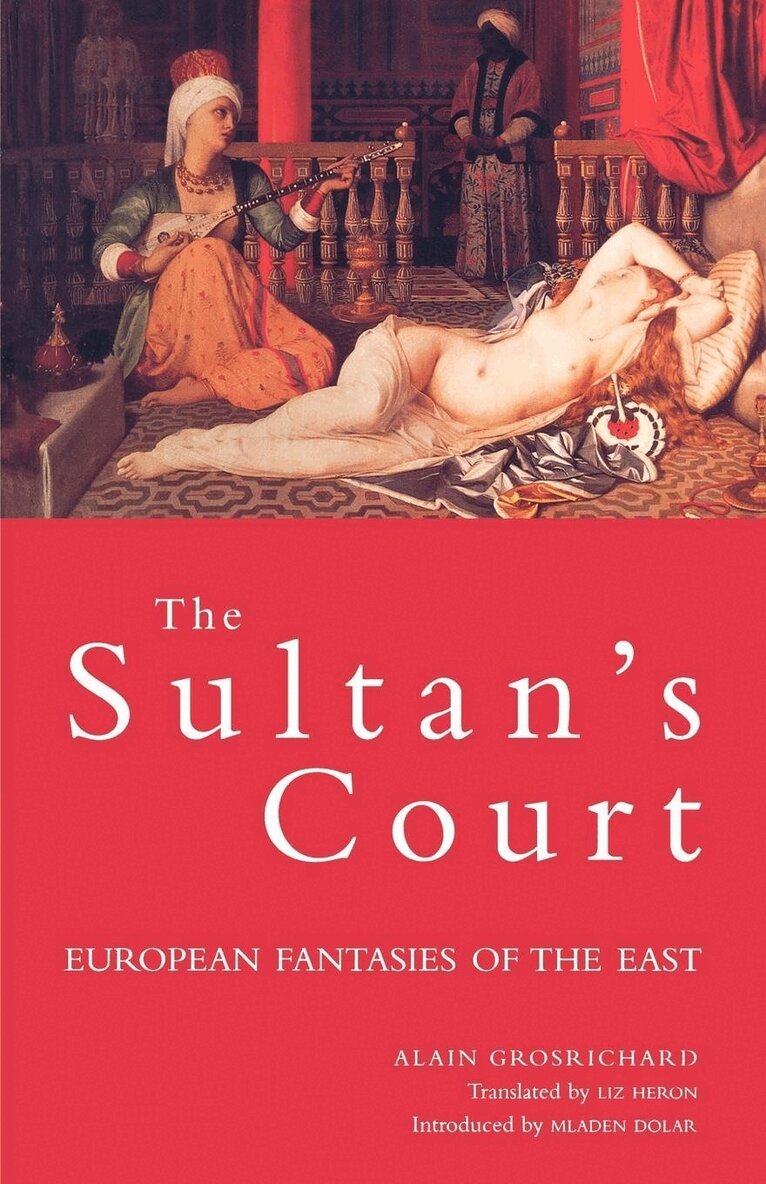
Edward Said's Orientalism (1978) has justly attracted great respect and attention for its account of Western perceptions and representations of the Orient, but the English-speaking world has for too long been unaware of another classic in the same field which appeared in France only a year later. Alain Grosrichard's The Sultan's Court is a fascinating and careful deconstruction of Western accounts of "Oriental despotism" in the seventeenth and eighteenth centuries, focusing particularly on portrayals of the Ottoman Empire and the supposedly enigmatic and opaque structure of the despot's power and his court of viziers, janissaries, mutes, dwarfs, eunuchs and countless wives.Drawing on the writings of travelers and philosophers such as Montesquieu, Rousseau and Voltaire, Grosrichard goes further than merely cataloguing their intense fascination with the vortex of capriciousness, violence, cruelty, lust, sexual perversion and slavery which they perceived in the seraglio. Deftly and subtly using a Lacanian psychoanalytic framework, he describes the process as one in which these leading Enlightenment figures were constructing a fantasmatic Other to counterpose to their project of a rationally based society. The Sultan's Court seeks not to refute the misconceptions but rather to expose the nature of the fantasy and what it can reveal about modern political thought and power relations more generally.