Beskrivning
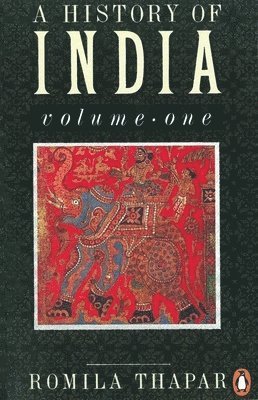
A history of India upto 1300 AD introducing the beginnings of India's cultural dynamics
Produktinformation
- Utgivningsdatum:1990-06-28
- Mått:129 x 198 x 22 mm
- Vikt:281 g
- Format:Häftad
- Språk:Engelska
- Antal sidor:384
- Förlag:Penguin Books Ltd
- ISBN:9780140138351
Utforska kategorier
Mer om författaren
ROMILA THAPAR is emeritus professor of history at Jawaharlal Nehru University, New Delhi. She is a fellow of the British Academy and holds an Hon D.Litt each from the University of Calcutta, University of Oxford and the University of Chicago. In 2008, Thapar was awarded the prestigious Kluge Prize of the US Library of Congress for Lifetime Achievement in the Humanities and Social Sciences. She has authored over twenty-five books.
Innehållsförteckning
- AcknowledgementsPreface1. The AntecedentsThe discovery of India; changing approaches to Indian history; the archaeological background2. The Impact of Aryan CultureSources of evidence; The political organizations of the Aryan tribes; caste and other social institutions; Vedic relgion3. Republics and Kingdoms c. 600-321 B.C.Evolving political patterns; the rise of the kingdom of Magadha; the rule of the Nandas; North-western India and contacts with Persia; the growth of towns; the rise of heterodox sects; Jainism and Buddhism4. The Emergence of Empire 321-185 B.C.The Mauryan kings; Mauryan contacts with neighbouring states; society and economic activity; Mauryan administration; Ashoka and his policy of Dhamma; the decline of the Mauryan empire5. The Disintegration of Empire c. 200 B.C.-A.D. 300The political fragmentation of the sub-continent: the Shunga dynasty, King Kharavela of Kalinga, The Indo-Greek kings, The Shakas, The Kushanas, The Satavhana dynasty, South Indian Kingdoms; trade routes and communications6. The Rise of the Mercantile Community c. 200 B.C.-A.D.300Guilds; Roman trade with south India; interation of Indian and Hellenic ideas in northern India; India's contacts with China and south-east Asia; changes in society; education and literature; Buddhist art and architecture; Mahayana Buddhism; developments in Hinduism; the coming of Christianity7. The Evolution of the "Classical" Pattern c. A.D. 300-700The rule of the Guptas; Hun invasions; some post-Gupta dynasties; the reign of Harsha; changing agrarian relations; trade; the pattern of living; education and learning; Hindu art and architecture; development in Buddhism; changes in Hinduism; philosophical schools; Indian contacts with China and south-east Asia8. Conflict in the Southern Kingdoms c. A.D. 500-900The Chalukya, Pallava, and Pandya conflicts; political organization and administration; the Agrarian system; the status of the brahman; the philosophy of Shankara; the growth of Tamil literature; the Tamil devotional cult; mural painting in the Deccan; temple architecture9. The South in the Ascendant c. A.D. 900-1300The rise of the Cholas; Chola administration; the village in the Chola economy; trade; the role of the temple in Chola society; the development of the languages of the peninsula; popular cults and sects; the philosophy of Ramanuja and Madhva; architecture and sculpture10. The Beginnings of Regional States in Northern India c. A.D. 700-1200Political struggle between the Rashtrakutas, Pratiharas, and Palas; the arrival of the Arabs in Sind; rise of new kingdoms; growth of Raiput power; campaigns of Mahmud of Ghazni; the Afghan army; Muhammad Ghuri11. Feudalism in the Regional States c. A.D. 800-1200Beginnings of regional loyalty; emerging pattern of agrarian relations; social structure; literature in Sanskrit and in the newly developing languages; temples and sculpture; changes in Hinduism, the devotional cult, and the Tantric sects; decline of Buddhism; the arrival of the Sufis12. The Re-alignment of Regional Kingdoms c. A.D. 1200-1526Source material on the Delhi Sultanate; the Slave dynasty and the Khalji dynasty; political organization; the Tughluq dynasty; relations between the rulers and the ruled; the Sayyid and Lodi dynasties; the kingdoms of Gujarat, Mewar, Marwar, and Bengal13. Assimilation on Trial c. A.D. 1200-1526Trends in the impact of Islam on India; balance of power between king and theologian; administrative structure of the Sultanate; the economy; the social framework; religious expression as seen in the Bhakti movement and the Sufis; new languages and literatures; miniature painting; Islamic architecture14. The South Conforms c. A.D. 1300-1526>/b>The rise of the Vijayanagara and Bahmani kingdoms in the Deccan; changes in the socio-economic background; trade; religionChronological tableGlossaryReferences to quotationsGeneral bibliographyBibliographical note on sourcesIndex