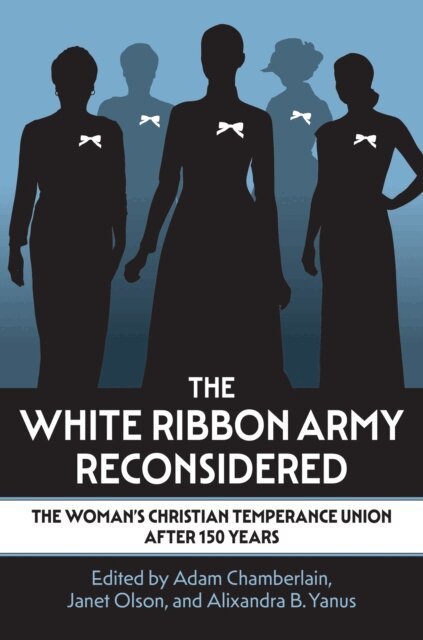
"The Woman’s Christian Temperance Union (WCTU) was unquestionably the most important women’s organization in American history. That its political achievements and profound social legacies remain overlooked and belittled stems from entrenched stereotypes about women’s temperance activism. This edited volume brings together a diverse range of accomplished scholars to set the record straight. The WCTU was a remarkable, multi-faceted, cosmopolitan organization, fighting to liberate women and families from existing forces of political, social, and economic subordination, both in the United States and around the world. The White Ribbon Army Reconsidered is a profound and much-needed historical investigation, that will provide a valuable scholarly touchstone for students of American and transnational history, sociology, gender studies, race and ethnic politics for generations to come."—Mark Schrad, Professor of Political Science at Villanova University, and author of Smashing the Liquor Machine: A Global History of Prohibition"The White Ribbon Army Reconsidered is a rigorous, nuanced, and deeply illuminating reassessment of the Woman’s Christian Temperance Union that decisively moves beyond caricature and reductionism. By centering women’s agency, archival depth, and global complexity, this volume demonstrates how the WCTU shaped religious life, political reform, and social movements in ways that continue to matter for scholars of gender, religion, and American history. This collection is essential reading for anyone seeking to understand how faith-infused women’s activism simultaneously advanced reform, revealed deep tensions, and transformed public life across national and international contexts."—Dr. Ashley Boggan, General Secretary, General Commission on Archives and History of The United Methodist Church, author of Nevertheless: Methodist Women and Women’s Rights and Wesleyan Vile-tality: Reclaiming the Heart of Methodist Identity"Ambitious and revelatory, this landmark volume mines the myriad influences and expansive reach of an influential organization that has too often been overlooked. The White Ribbon Army Reconsidered’s textured narrative demonstrates how the WCTU both reflected and shaped the social currents of its era. The essays in this must-read volume will challenge your suppositions about women’s influence, past and present."—Katherine Turk, Professor and Director of Undergraduate Studies, Department of History, Adjunct Professor of Women’s and Gender Studies, The University of North Carolina at Chapel Hill"The White Ribbon Army Reconsidered comes at a vital time in history, when we are also reassessing the scope of women’s global activism and women’s contributions to our own hard-won democracy—both of which were shaped by WCTU leaders. The strengths of this volume are manifold, but the two that most stand out to me are: its global and comparative perspective, foregrounding the experiences of women of color, and its emphasis on the nuanced nature of WTCU activism, which was at once both traditional and radical."—Kimberly A. Hamlin, PhD, author of Free Thinker: Sex, Suffrage, and the Extraordinary Life of Helen Hamilton Gardener and From Eve to Evolution: Darwin, Science, and Women’.s Rights in Gilded Age America"By examining the work of American and international WCTU women across more than half a century, this book highlights the ways in which WCTU activism both aligns with and challenges dominant understandings of women’s politics in the late 19th and early 20th centuries. The book’s main goal is to prompt scholars & students to re-engage with the WCTU and take it seriously as a major player in global women’s reform movements of the late 19th and early 20th centuries, and it succeeds with flying colors."—Melissa Blair, author of Revolutionizing Expectations: Women’s Organizations, Feminism, and American Politics, 1965–1980"The Woman’s Christian Temperance Union was the largest and most influential women’s organization of the nineteenth century. Marking its 150th anniversary, The White Ribbon Army Reconsidered brings together contributors from women’s history, political science, rhetoric, and religious studies to explore both the organization’s groundbreaking proto-feminism and its troubling nativism. With essays spanning the United States, New Zealand, and India, these essays provide the nuanced reassessment the WCTU has long deserved."—Brian Donovan, Professor of Sociology at the University of Kansas, and author of White Slave Crusades: Race, Gender, and Anti-Vice Activism, 1887–1917