Häftad, Engelska, 1993
Pretending at Home
Av Wendy L. Haight, Peggy J. Miller
383 kr
Tillfälligt slut
Beskrivning
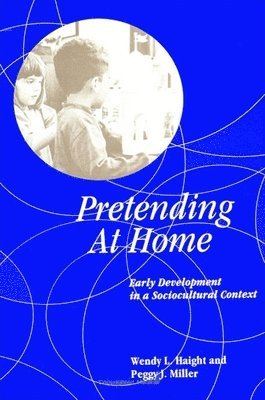
Reveals how young children's pretend play emerges as a deeply social and culturally shaped activity, shaped through everyday interactions with caregivers.How do children learn to pretend—and why is it never just child's play? In Pretending at Home, Wendy L. Haight and Peggy J. Miller look at the development of pretend play in young children, demonstrating that it is fundamentally a social and cultural activity rather than a solitary pastime.Through detailed, long-term observations of nine children and their mothers, Pretending at Home reveals how everyday interactions shape the emergence, structure, and functions of pretend play. The authors explore the interpersonal dynamics, social rules, and physical environments that influence how children and caregivers engage in imaginative activity, offering new insights into early childhood development.Richly illustrated with portraits of children at play and backed by meticulous analysis, Pretending at Home challenges conventional notions about childhood imagination and shows how pretend play fosters social understanding, creativity, and learning within everyday life. Essential reading for researchers, students, and practitioners in child development, psychology, and education, Haight and Miller open a window into the intimate, formative world of early pretend play.
Produktinformation
- Utgivningsdatum: 1993-07-01
- Mått: 152 x 229 x 25 mm
- Vikt: 263 g
- Format: Häftad
- Språk: Engelska
- Serie: SUNY series, Children's Play in Society
- Antal sidor: 150
- Förlag: State University of New York Press
- ISBN: 9780791414729
Utforska kategorier
Betyg & recensioner
0 recensioner
Inga recensioner tillgängliga.