Del i serien SUNY series in Philosophy and Biology
566 kr
Beställningsvara. Skickas inom 3-6 vardagar. Fri frakt över 249 kr.
Beskrivning
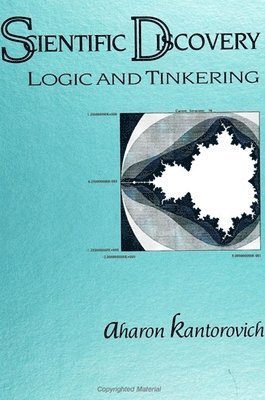
Kantorovich analyzes the notion of discovery. He views the process as inference and questions whether there is logic or method to discovery. He provides an alternative perspective on scientific discovery that explains the difficulties in finding a satisfactory method of discovery. Within the framework of evolutionary epistemology, discovery is treated as a phenomenon in its own right having psychological and social dimensions. Science is viewed as a continuation of the evolutionary process whereby creative discovery plays a role similar to blind mutation in biological evolution. From this perspective, serendipity and tinkering are key notions in understanding the creative process.
Produktinformation
- Utgivningsdatum:1993-07-01
- Mått:152 x 229 x 20 mm
- Vikt:399 g
- Format:Häftad
- Språk:Engelska
- Serie:SUNY series in Philosophy and Biology
- Antal sidor:294
- Förlag:State University of New York Press
- ISBN:9780791414781
Utforska kategorier
Mer om författaren
Aharon Kantorovich is Associate Editor of the Journal of Social and Evolutionary Systems.
Recensioner i media
"This is the best English language book in evolutionary epistemology so far." — Donald T. Campbell, Lehigh University"It's comprehensive, thorough, and synthesizes many different ideas and views. It's intelligent, well argued, clear, and well organized. The work as a whole represents an original and worthwhile approach to an imporant issue." — David B. Resnik, University of Wyoming
Innehållsförteckning
- Acknowledgments Introduction Part I In Search for Logic of Discovery Chapter 1: Exposing and Generating 1.1 What is a Discovery?1.2 The Products of Scientific Discovery1.2.1 What Do Scientists Discover When They Look at the World?1.2.2 Objects and Events Contaminated by the Scientist's Intervention1.2.3 The Plasticity of Theories1.2.4 Explanations, Problems and Solutions1.3 The Kinds of Discovery Processes1.3.1 Exposure1.3.2 Generation1.3.3 Poincaré: The Poverty of Creation1.3.4 Eureka Events and Unintentionality1.4 The Creative Element in Discovery and the Issue of Realism1.4.1 Discovery, Invention and Creativity1.4.2 The Case of Particle Physics: An Active Look at Matter1.4.3 Epistemological Realism: Construction, Transaction and RepresentationChapter 2: The Scope of Method 2.1 The Nature and Function of Method2.1.1 Who Needs a Method?2.1.2 What is a Method of Discovery Supposed to Do?2.1.3 The Origin of Method2.2 Inferring and Reconstructing2.2.1 Reasoning vs. Creativity2.2.2 Discovery as Inference or Reasoning2.2.3 The Quest for Certainty or: How Ampliative Inference Can Be Converted into Deductive Inference2.2.4 The Hierarchy of Material Logics2.2.5 The Discovery Machine2.2.6 Theory-Construction and Research Programs2.2.7 The Calculus of Plausibility: Logic of Pursuit2.2.8 Discovery as a Skill: The Invisible LogicChapter 3: Why did Taditional Philosophy of Science Ignore Discovery 3.1 The Distinction between the Context of Discovery and the Context of Justification3.1.1 John Herschel's Distinction: Consequentialism3.1.2 Reichenbach's D-J Thesis: Generationism3.2 Objections to the Distinction3.2.1 Justification and Discovery are Inseparable3.2.2 Justification is Not Aprioristic3.2.3 Information about Generation is Necessary for Evaluation: Predictability and Novelty3.2.4 The Context of Generation Has an Epistemic DimensionPart II Discovery Naturalized The Prepared Mind: Cultivating the Unintentional Chapter 4: Philosophy of Science: From Justification to Explanation 4.1 Normative Philosophy of Science: Justification Relativized4.1.1 Instrumental Rationality: Science as a Goal-Directed Activity4.1.2 The Dilemma of the Normative Methodologist and Goodman's Solution: Rationality without Goals4.1.3 From Justification to Explication4.1.4 From Explication to Explanation: Paradigms of Rationality4.2 From Description to Explanation4.3 Explanatory Philosophy of Science4.4 Normative Naturalism: Shallow vs. Deep Theories of Scientific Rationality4.4.1 Phenomenological Theories of Rationality4.4.2 Explanatory Theories of Rationality: How the Is-Ought Fallacy is Avoided4.4.3 Ideal Theories of Rationality and the Competence-Performance Distinction4.4.4 The Therapist Model of Rationality and its Implications for Involuntary Processes of DiscoveryChapter 5: An Evolutionary Theory of Discovery: In Search for the Unexpected 5.1 Evolutionary Epistemology: Taking Natural Selection Seriously5.2 Blind Variation: The Principle of Serendipity5.2.1 Are Scientific Discoveries Analogous to Blind Mutations?5.2.2 The Evolutionary-Epistemic Significance of Serendipitous Discovery5.3 Some Implications of the Principle of Serendipity5.3.1 Predictability and Epistemic Profit5.3.2 The Mathematical and the Social Media5.4 Two Landmarks of Serendipity in Physics5.4.1 Kepler: The Conscious Sleepwalker5.4.2 Planck: The Reluctant Revolutionist5.5 Serendipitous Discovery of Natural Phenomena5.6 Cultivating SerendipityChapter 6: Intrapsychic Processes of Creation 6.1 A Psychological Theory of the Creative Process6.1.1 The Chance-Configuration Model6.1.2 Phenomena Explained by the Theory and Evidence for Its Support6.1.3 An Associative Mechanism of Generating Chance Permutations6.2 Implications of the Theory6.2.1 Explaining Serendipity6.2.2 Individual vs. Collective Creativity6.2.3 Cultivating the Creative Potential6.2.4 Multiple DiscoveryChapter 7: A Socio-Evolutionary Theory of Science 7.1 Epistemic Cooperation and the Social Dimension of Discovery7.2 The Social Dimension of Blind Variation, Selection and Dissemination7.3 Has Science Liberated Humankind from the Tyranny of the Genes?7.3.1 Genetically Controlled Human Understanding7.3.2 Transcending Our Natural Habitat7.3.3 Two Patterns of Human Evolution:(a) The Principle of Growth by Expansion(b) The Coevolution of Human Action and Human Understanding7.3.4 The Epistemological Significance of Cooperation in Science: The Evolutionary Perspective7.4 The Tension between Change and Stability7.5 Implications for Discovery7.5.1 The D-J Distinction Revisited7.5.2 Cultivation: Preparing the Collective Mind7.5.3 Strategies of DiscoveryChapter 8: Tinkering and Opportunism: The Logic of Creation 8.1 Evolutionary Tinkering in Science8.2 Tool-Oriented Scientists: Intellectual Migration8.3 Tinkering in Particle Physics8.3.1 Symmetries without Dynamics8.3.2 The Resources of Quantum Field Theory8.3.3 Playing with Quarks8.3.4 Tool-Oriented Particle PhysicistsChapter 9: Completing the Picture: Is There a Role for The Genotype-Phenotype Process? 9.1 Non-Creative Discovery: The Genotype-Phenotype Logic of Growth9.2 The Selection Cycle in ScienceConclusion Epilogue: Implications for Science Education Notes Bibliography Index