
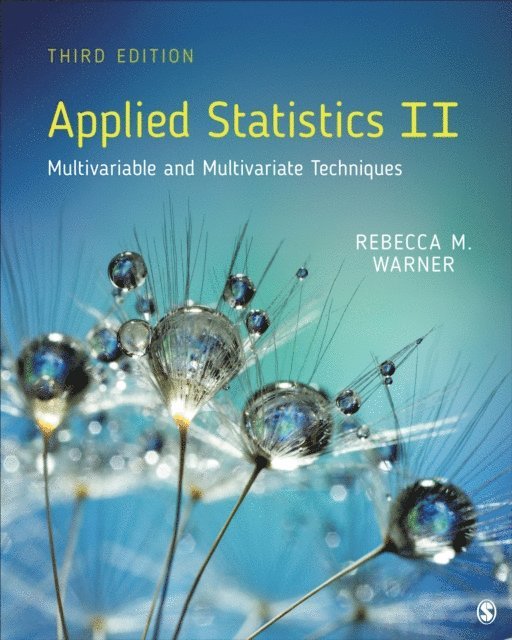
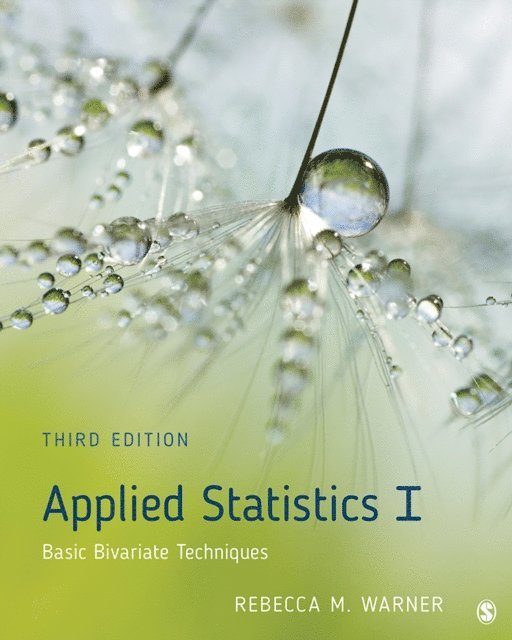
Applied Statistics I - International Student Edition
Basic Bivariate Techniques
Häftad, Engelska, 2020
1 688 kr
Skickas . Fri frakt över 249 kr.
Beskrivning
Applied Statistics I: Basic Bivariate Techniques has been created from the first half of Rebecca M. Warner's popular Applied Statistics: From Bivariate Through Multivariate Techniques. The author's contemporary approach differs from some of the well-worn texts in the market, and reflects current thinking in the field. It spends less time on statistical significance testing, and moves in the direction of the "new statistics" by focusing more on confidence intervals and effect size. Instructors of upper undergraduate or beginning graduate level courses will find that the greater focus on basic concepts such as partition of variance and effect size is more useful to students, particularly as preparation for more advanced courses. Spending less time on statistical significance testing allows for more time to be devoted to more interesting and useful statistics that students will see in journal articles (such as correlation and regression). This introductory statistics text includes examples in SPSS, together with datasets on an accompanying website. A companion study guide reproducing the exercises and examples in R will also be available.
Produktinformation
- Utgivningsdatum:2020-02-20
- Mått:203 x 254 x 28 mm
- Vikt:1 270 g
- Format:Häftad
- Språk:Engelska
- Upplaga:3
- Förlag:SAGE Publications
- ISBN:9781071807491
Utforska kategorier
Mer om författaren
Rebecca M. Warner received a B.A. from Carnegie-Mellon University in Social Relations in 1973 and a Ph.D. in Social Psychology from Harvard in 1978. She has taught statistics for more than 25 years: from Introductory and Intermediate Statistics to advanced topics seminars in Multivariate Statistics, Structural Equation Modeling, and Time Series Analysis. She is currently a Full Professor in the Department of Psychology at the University of New Hampshire. She is a Fellow in the Association for Psychological Science and a member of the American Psychological Association, the International Association for Relationships Research, the Society of Experimental Social Psychology, and the Society for Personality and Social Psychology. She has consulted on statistics and data management for the World Health Organization in Geneva and served as a visiting faculty member at Shandong Medical University in China.
Recensioner i media
Select Guide Rating
Innehållsförteckning
- 1. Evaluating Numeric InformationIntroductionGuidelines for NumeracySource CredibilityMessage ContentEvaluating GeneralizabilityMaking Causal ClaimsQuality Control Mechanisms in ScienceBiases of Information ConsumersEthical Issues in Data Collection and AnalysisLying with Graphs and StatisticsDegrees of BeliefSummary2. Basic Research ConceptsIntroductionTypes of VariablesIndependent and Dependent VariablesTypical Research QuestionsConditions for Causal InferenceExperimental Research DesignNon-experimental Research DesignQuasi- Experimental DesignsOther Issues in Design and AnalysisChoice of Statistical Analysis (Preview)Populations and Samples: Ideal Versus Actual SituationsCommon Problems in Interpretation of ResultsAppendix 2 A: More About Levels of MeasurementAppendix 2 B: Justification for Use of Likert and Other Rating Scales as Quantitative Variables (In Some Situations)3. Frequency Distribution TablesIntroductionUse of Frequency Tables for Data ScreeningFrequency Tables for Categorical VariablesElements of Frequency TablesUsing SPSS to Obtain a Frequency TableMode, Impossible Score Values, and Missing ValuesReporting Data Screening for Categorical VariablesFrequency Tables for Quantitative VariablesFrequency Tables for Categorical Versus Quantitative VariablesReporting Data Screening for Quantitative VariablesWhat We Hope to See in Frequency Tables for Categorical VariablesWhat We Hope to See in Frequency Tables for Quantitative VariablesSummaryAppendix 3 A: Getting Started in IBM SPSS ® version 25Appendix 3 B: Missing Values in Frequency TablesAppendix 3 C: Dividing Scores into Groups or Bins4. Descriptive StatisticsIntroductionQuestions about Quantitative VariablesNotationSample MedianSample Mean (M)An Important Characteristic of M: Sum of Deviations from M = 0Disadvantage of M: It is Not Robust Against Influence of Extreme ScoresBehavior of Mean, Median and Mode in Common Real-World SituationsChoosing Among Mean, Median, and ModeUsing SPSS to Obtain Descriptive Statistics for a Quantitative VariableMinimum, Maximum, and Range: Variation among ScoresThe Sample Variance s2Sample Standard Deviation (s or SD)How a Standard Deviation Describes Variation Among Scores in a Frequency TableWhy Is There Variance?Reports of Descriptive Statistics in Journal ArticlesAdditional Issues in Reporting Descriptive StatisticsSummaryAppendix 4 A Order of Arithmetic OperationsAppendix 4 B Rounding5. Graphs: Bar Charts, Histograms, and Box PlotsIntroductionPie Charts for Categorical VariablesBar Charts for Frequencies of Categorical VariablesGood Practice for Construction of Bar ChartsDeceptive Bar GraphsHistograms for Quantitative VariablesObtaining a Histogram Using SPSSDescribing and Sketching Bell-Shaped DistributionsGood Practices in Setting up HistogramsBox Plot (Box and Whiskers Plot)Telling Stories About DistributionsUses of Graphs in Actual ResearchData Screening: Separate Bar Charts or Histograms for GroupsUse of Bar Charts to Represent Group MeansOther ExamplesSummary6. The Normal Distribution and z ScoresIntroductionLocations of Individual Scores in Normal DistributionsStandardized or “z” ScoresConverting z Scores Back into Original Units of XUnderstanding Values of zQualitative Description of Normal Distribution ShapeMore Precise Description of Normal Distribution ShapeReading Tables of Areas for the Standard Normal DistributionDividing the Normal Distribution Into Three Regions: Lower Tail, Middle, Upper TailOutliers Relative to a Normal DistributionSummary of First Part of ChapterWhy We Assess Distribution ShapeDeparture from Normality: SkewnessAnother Departure from Normality: KurtosisOverall NormalityPractical RecommendationsReporting Information About Distribution Shape, Missing Values, Outliers, and Descriptive Statistics for Quantitative VariablesSummaryAppendix 6 A: The Mathematics of the Normal DistributionAppendix 6 B: How to Select and Remove Outliers in SPSSAppendix 6 C: Quantitative Assessments of Departure from NormalityAppendix 6 D: Why Are Some Real-World Variables Approximately Normally Distributed?7. Sampling Error and Confidence IntervalsDescriptive Versus Inferential Uses of StatisticsNotations for Samples Versus PopulationsSampling Error and the Sampling Distribution for Values of MPrediction ErrorSample Versus Population (Revisited)The Central Limit Theorem: Characteristics of the Sampling Distribution of MFactors that Influence Population Standard ErrorEffect of N on Value of the Population Standard ErrorDescribing the Location of a Single Outcome for M Relative to a Population Sampling Distribution (Setting Up a z Ratio)What We Do When ?? Is UnknownThe Family of t DistributionsTables for t DistributionsUsing Sampling Error to Set Up a Confidence IntervalHow to Interpret a Confidence IntervalEmpirical Example: Confidence Interval for Body TemperatureOther Applications for CIsError Bars in Graphs of Group MeansSummary8. The One-Sample t test: Introduction to Statistical Significance TestsIntroductionSignificance Tests as Yes/No Questions About Proposed Values of Population MeansStating a Null HypothesisSelecting an Alternative HypothesisThe One-Sample t TestChoosing an Alpha (?) LevelSpecifying Reject Regions Based on ?, Halt and dfQuestions for the One-Sample t TestAssumptions for the Use of the One-Sample t TestRules for the Use of NHSTFirst Example: Mean Driving Speed (Nondirectional Test)SPSS Analysis: One Sample t Test for Mean Driving Speed“Exact” p ValuesReporting Results for a Two-tailed One-Sample t TestThe Driving Speed Data Reconsidered Using a One-Tailed TestReporting Results for a One-tailed One-Sample t Test:Advantages/ Disadvantages of One Tailed TestsTraditional NHST Versus New Statistics RecommendationsThings You Should Not Say About p ValuesSummary9. Issues in Significance Tests: Effect Size, Statistical Power, and Decision ErrorsBeyond p ValuesCohen’s d: An Effect Size IndexFactors that Affect the Size of t RatiosStatistical Significance Versus Practical ImportanceStatistical PowerType I and Type II Decision ErrorsMeanings of “Error”Use of NHST in Exploratory Versus Confirmatory ResearchInflated Risk of Type I Error From Multiple Tests Interpretation of Null OutcomesInterpretation of Null OutcomesInterpretation of Statistically Significant OutcomesUnderstanding Past ResearchPlanning Future ResearchGuidelines for Reporting ResultsWhat You Cannot SaySummaryAppendix 9 A Further Explanation of Statistical Power10. Bivariate Pearson CorrelationResearch Situations Where Pearson r Is UsedCorrelation and Causal InferenceHow Sign and Magnitude of r Describe an X, Y RelationshipSetting Up Scatter Plots With Examples of Perfect LinearityMost Associations Are Not PerfectDifferent Situations In Which r = 0Assumptions for Use of Pearson rPreliminary Data Screening for Pearson rEffect of Extreme Bivariate OutliersResearch ExampleData Screening for Research ExampleComputation of Pearson rHow Computation for Correlation Is Related to Pattern of Data Points in the Scatter PlotTesting the Hypothesis That ?0 = 0Reporting Many Correlations and Inflated Risk of Type I ErrorObtaining CIs for CorrelationsPearson’s r and r2 as Effect-Size Indexes and Partition of VarianceStatistical Power and Sample Size for Correlation StudiesInterpretation of Outcomes for Pearson’s rSPSS ExampleResults Sections for One and Several Pearson r ValuesReasons to Be Skeptical of CorrelationsSummaryAppendix 10 A: Nonparametric Alternatives to Pearson rAppendix 10 B: Setting Up a 95% CI for Pearson rAppendix 10 C: Testing Significance of Differences Between CorrelationsAppendix 10 D: Factors That Artifactually Influence the Magnitude of Pearson’s rAppendix 10 E: Analysis of Non Linear Relationships11. Bivariate RegressionResearch Situations Where Bivariate Regression is UsedNew Information Provided by RegressionRegression Equations and LinesTwo Versions of Regression EquationsSteps in Regression AnalysisPreliminary Data ScreeningFormulas for Bivariate Regression CoefficientsStatistical Significance Tests for Bivariate RegressionConfidence Intervals for Regression CoefficientsEffect Size and Statistical PowerEmpirical Example Using SPSS: Salary DataSPSS Output: Salary DataPlotting the Regression Line: Salary DataResults Section: Salary DataUsing Regression Equation to Predict Score for Individual: Joe’s Hr DataPartition of SS in Bivariate Regression: Joe’s Hr DataIssues in Planning a Bivariate Regression StudyPlotting ResidualsStandard Error of the Estimate, sy.xSummaryAppendix 11 A OLS Derivation of Equation for Regression CoefficientsAppendix 11 B Fully Worked Example for SS values: Joe’s HR Data12. The Independent Samples t TestResearch Situations Where the Independent Samples t Test is UsedHypothetical Research ExampleAssumptions for Use of the Independent Samples t TestPreliminary Data Screening: Evaluating Violations of Assumptions and Getting to Know Your DataComputation of Independent Samples t TestStatistical Significance of Independent Samples t TestConfidence Interval Around (M1 – M2)SPSS Commands for Independent Samples t TestSPSS Output for Independent Samples t TestEffect-Size Indexes for tFactors that Influence the Size of tResults SectionGraphing Results: Means and CIsDecisions About Sample Size for the Independent Samples t TestIssues in Designing a StudySummaryAppendix 12 A: A Nonparametric Alternative to the Independent Samples t Test13. One-Way Between-S Analysis of VarianceResearch Situations Where Between-S One-Way ANOVA is UsedQuestions in One-Way Between S ANOVAHypothetical Research ExampleAssumptions and Data Screening for One-Way ANOVAComputations for One-Way Between-S ANOVAPatterns of Scores and Magnitudes of SSbetween and SSwithinConfidence Intervals (CIs) For Group MeansEffect Sizes for One-Way Between-S ANOVAStatistical Power Analysis for One-Way Between-S ANOVAPlanned ContrastsPost Hoc or “Protected” TestsOne Way Between S ANOVA Procedure in SPSSOutput from SPSS for One Way Between S ANOVAReporting Results from One Way Between S ANOVAIssues in Planning a StudySummaryAppendix A ANOVA Model and Division of Scores Into ComponentsAppendix B Expected Value of F When H0 is TrueAppendix C Comparison of ANOVA to t TestAppendix D Nonparametric Alternative to One Way Between S ANOVA14. Paired Samples t-TestIndependent Versus Paired Samples DesignsBetween-S and Within-S or Paired Groups DesignsTypes of Paired SamplesHypothetical Study: Effects of Stress on Heart RateReview: Data Organization for Independent SamplesNew: Data Organization for Paired SamplesA First Look at Repeated Measures DataCalculation of Difference (d) ScoresNull Hypothesis for Paired Samples t TestAssumptions for Paired Samples t TestFormulas for Paired Samples t TestSPSS Paired Samples t Test ProcedureComparison of Results For Independent Samples t and Paired Samples t TestsEffect Size and PowerSome Design Problems in Repeated Measures DesignsResults for Paired Samples t-Test: Stress and HRFurther Evaluation of Assumptions for Larger DatasetSummaryAppendix A Nonparametric Alternative to Paired Samples t: Wilcoxon Signed Rank Test15. One Way Repeated Measures ANOVAIntroductionNull Hypothesis for Repeated Measures ANOVAPreliminary Assessment of Repeated Measures DataComputations for One-Way Repeated Measures ANOVAUse of SPSS Reliability Procedure for One Way Repeated Measures ANOVAPartition of SS in Between-S Versus Within-S ANOVAAssumptions for Repeated Measures ANOVAChoices of Contrasts in GLM Repeated MeasuresSPSS GLM Procedure for Repeated Measures ANOVAOutput for GLM Repeated Measures ANOVAPaired Samples t Tests as Follow UpResultsEffect SizeStatistical PowerCounterbalancing in Repeated Measures StudiesMore Complex DesignsSummaryAppendix 15 A Test for Person by Treatment Interaction16. Factorial Analysis of Variance (Between – S)Research Situations Where Factorial Design Is UsedQuestions in Factorial ANOVANull Hypotheses in Factorial ANOVAScreening for Violations of AssumptionsHypothetical Research SituationComputations for Between-S Factorial ANOVAComputation of SS, df, and MS in Two Way FactorialEffect Size Estimates for Factorial ANOVAStatistical PowerFollow-Up TestsFactorial ANOVA Using the SPSS GLM ProcedureSPSS OutputResultsDesign Decisions and Magnitudes of SS TermsSummaryAppendix 16 A: Unequal Cell ns in Factorial ANOVAAppendix 16 B: Weighted Versus Unweighted MeansAppendix 16 C: Model for Factorial ANOVAAppendix 16 D: Fixed Versus Random Factors17. Chi Square Analysis of Contingency TablesEvaluating Association Between Two Categorical VariablesFirst Example: Contingency Tables for Titanic DataWhat is Contingency?Conditional and Unconditional ProbabilitiesNull Hypothesis for Contingency Table AnalysisSecond Empirical Example: Dog Ownership DataPreliminary Examination of Dog Ownership DataExpected Cell Frequencies If H0 TrueComputation of Chi Squared Significance TestEvaluation of Statistical Significance of ?2.Effect Sizes for Chi SquaredChi Squared Example Using SPSSOutput from Crosstabs ProcedureReporting ResultsAssumptions and Data Screening For Contingency TablesOther Measures of Association for Contingency TablesSummaryAppendix 17 A: Margin of Error For Percentages in SurveysAppendix 17 B: Contingency Tables With Repeated Measures: McNemar TestAppendix 17 C: Fisher Exact TestAppendix 17 D: How Marginal Distributions for X and Y Constrain Maximum Value of ??Appendix 17 E: Other Uses of ?218. Selection of Bivariate Analyses and Review of Key ConceptsSelecting Appropriate Bivariate AnalysesTypes of Independent and Dependent Variables (Categorical Versus Quantitative)Parametric Versus Nonparametric AnalysesComparisons of Means or Medians Across Groups (Categorical IV and Quantitative DV)Problems with Selective Reporting of Evidence and AnalysesLimitations of Statistical Significance Tests and p ValuesStatistical Versus Practical SignificanceGeneralizability IssuesCausal InferenceResults SectionsBeyond Bivariate Analyses: Adding VariablesSome Multivariable or Multivariate AnalysesDegrees of Belief
Hoppa över listan







Du kanske också är intresserad av
- Nyhet
- Nyhet
- Nyhet
- Signerad!
Signerad - Hantverket : recept & berättelser om livet på restaurang
Stefan Ekengren
Inbunden, 2026
279 kr
- Signerad!
Del 3
- -19%
- -21%