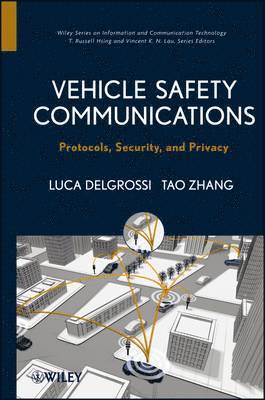
Vehicle Safety Communications
Protocols, Security, and Privacy
Del 103 i serien Information and Communication Technology Series
1 348 kr
Beställningsvara. Skickas inom 7-10 vardagar. Fri frakt över 249 kr.
Beskrivning
Produktinformation
- Utgivningsdatum:2012-11-02
- Mått:163 x 244 x 25 mm
- Vikt:667 g
- Format:Inbunden
- Språk:Engelska
- Serie:Information and Communication Technology Series
- Antal sidor:400
- Förlag:John Wiley & Sons Inc
- ISBN:9781118132722
Utforska kategorier
Mer om författaren
LUCA DELGROSSI, PhD, is Director of Driver Assistance and Chassis Systems U.S. at Mercedes-Benz Research & Development North America, Inc., Chairman of the Board of Directors at the VII Consortium, and coeditor of the IEEE Communications Magazine Automotive Networking Series.TAO ZHANG, PhD, is Chief Scientist for Smart Connected Vehicles at Cisco Systems. He is a Fellow of the IEEE and the coauthor of IP-Based Next-Generation Wireless Networks.
Innehållsförteckning
- Foreword xvRalf G. HerrtwichForeword xviiFlavio BonomiForeword xixAdam DrobotPreface xxiAcknowledgments xxv1 Traffic Safety 11.1 Traffic Safety Facts 11.1.1 Fatalities 21.1.2 Leading Causes of Crashes 31.1.3 Current Trends 51.2 European Union 51.3 Japan 71.4 Developing Countries 7References 82 Automotive Safety Evolution 102.1 Passive Safety 102.1.1 Safety Cage and the Birth of Passive Safety 102.1.2 Seat Belts 112.1.3 Air Bags 112.2 Active Safety 122.2.1 Antilock Braking System 122.2.2 Electronic Stability Control 132.2.3 Brake Assist 132.3 Advanced Driver Assistance Systems 142.3.1 Adaptive Cruise Control 152.3.2 Blind Spot Assist 162.3.3 Attention Assist 162.3.4 Precrash Systems 162.4 Cooperative Safety 17References 183 Vehicle Architectures 203.1 Electronic Control Units 203.2 Vehicle Sensors 213.2.1 Radars 213.2.2 Cameras 213.3 Onboard Communication Networks 223.3.1 Controller Area Network 233.3.2 Local Interconnect Network 233.3.3 FlexRay 243.3.4 Media Oriented Systems Transport 243.3.5 Onboard Diagnostics 243.4 Vehicle Data 253.5 Vehicle Data Security 263.6 Vehicle Positioning 273.6.1 Global Positioning System 273.6.2 Galileo 293.6.3 Global Navigation Satellite System 293.6.4 Positioning Accuracy 30References 304 Connected Vehicles 324.1 Connected Vehicle Applications 324.1.1 Hard Safety Applications 324.1.2 Soft Safety Applications 334.1.3 Mobility and Convenience Applications 334.2 Uniqueness in Consumer Vehicle Networks 344.3 Vehicle Communication Modes 364.3.1 Vehicle-to-Vehicle Local Broadcast 364.3.2 V2V Multihop Message Dissemination 374.3.3 Infrastructure-to-Vehicle Local Broadcast 384.3.4 Vehicle-to-Infrastructure Bidirectional Communications 394.4 Wireless Communications Technology for Vehicles 39References 425 Dedicated Short-Range Communications 445.1 The 5.9 GHz Spectrum 445.1.1 DSRC Frequency Band Usage 455.1.2 DSRC Channels 455.1.3 DSRC Operations 465.2 DSRC in the European Union 465.3 DSRC in Japan 475.4 DSRC Standards 485.4.1 Wireless Access in Vehicular Environments 485.4.2 Wireless Access in Vehicular Environments Protocol Stack 485.4.3 International Harmonization 50References 506 WAVE Physical Layer 526.1 Physical Layer Operations 526.1.1 Orthogonal Frequency Division Multiplexing 526.1.2 Modulation and Coding Rates 536.1.3 Frame Reception 546.2 PHY Amendments 556.2.1 Channel Width 566.2.2 Spectrum Masks 566.2.3 Improved Receiver Performance 576.3 PHY Layer Modeling 576.3.1 Network Simulator Architecture 586.3.2 RF Model 596.3.3 Wireless PHY 61References 627 WAVE Media Access Control Layer 647.1 Media Access Control Layer Operations 647.1.1 Carrier Sensing Multiple Access with Collision Avoidance 647.1.2 Hidden Terminal Effects 657.1.3 Basic Service Set 667.2 MAC Layer Amendments 667.3 MAC Layer Modeling 677.3.1 Transmission 687.3.2 Reception 687.3.3 Channel State Manager 687.3.4 Back-Off Manager 697.3.5 Transmission Coordination 707.3.6 Reception Coordination 717.4 Overhauled ns-2 Implementation 72References 748 DSRC Data Rates 758.1 Introduction 758.2 Communication Density 768.2.1 Simulation Study 778.2.2 Broadcast Reception Rates 788.2.3 Channel Access Delay 818.2.4 Frames Reception Failures 838.3 Optimal Data Rate 858.3.1 Modulation and Coding Rates 858.3.2 Simulation Study 868.3.3 Simulation Matrix 878.3.4 Simulation Results 88References 919 WAVE Upper Layers 939.1 Introduction 939.2 DSRC Multichannel Operations 949.2.1 Time Synchronization 949.2.2 Synchronization Intervals 959.2.3 Guard Intervals 969.2.4 Channel Switching 969.2.5 Channel Switching State Machine 969.3 Protocol Evaluation 979.3.1 Simulation Study 989.3.2 Simulation Scenarios 999.3.3 Simulation Results 999.3.4 Protocol Enhancements 1029.4 WAVE Short Message Protocol 103References 10410 Vehicle-to-Infrastructure Safety Applications 10610.1 Intersection Crashes 10610.2 Cooperative Intersection Collision Avoidance System for Violations 10710.2.1 CICAS-V Design 10710.2.2 CICAS-V Development 11010.2.3 CICAS-V Testing 11610.3 Integrated Safety Demonstration 11810.3.1 Demonstration Concept 11810.3.2 Hardware Components 12010.3.3 Demo Design 121References 12411 Vehicle-to-Vehicle Safety Applications 12611.1 Cooperation among Vehicles 12611.2 V2V Safety Applications 12711.3 V2V Safety Applications Design 12811.3.1 Basic Safety Messages 12911.3.2 Minimum Performance Requirements 12911.3.3 Target Classifi cation 13111.3.4 Vehicle Representation 13211.3.5 Sample Applications 13311.4 System Implementation 13511.4.1 Onboard Unit Hardware Components 13511.4.2 OBU Software Architecture 13511.4.3 Driver–Vehicle Interface 13711.5 System Testing 13811.5.1 Communications Coverage and Antenna Considerations 13811.5.2 Positioning 139References 14012 DSRC Scalability 14112.1 Introduction 14112.2 DSRC Data Traffic 14212.2.1 DSRC Safety Messages 14212.2.2 Transmission Parameters 14312.2.3 Channel Load Assessment 14412.3 Congestion Control Algorithms 14512.3.1 Desired Properties 14512.3.2 Transmission Power Adjustment 14612.3.3 Message Rate Adjustment 14712.3.4 Simulation Study 14812.4 Conclusions 148References 14913 Security and Privacy Threats and Requirements 15113.1 Introduction 15113.2 Adversaries 15113.3 Security Threats 15213.3.1 Send False Safety Messages Using Valid Security Credentials 15213.3.2 Falsely Accuse Innocent Vehicles 15313.3.3 Impersonate Vehicles or Other Network Entities 15313.3.4 Denial-of-Service Attacks Specific to Consumer Vehicle Networks 15413.3.5 Compromise OBU Software or Firmware 15513.4 Privacy Threats 15513.4.1 Privacy in a Vehicle Network 15513.4.2 Privacy Threats in Consumer Vehicle Networks 15613.4.3 How Driver Privacy can be Breached Today 15813.5 Basic Security Capabilities 15913.5.1 Authentication 15913.5.2 Misbehavior Detection and Revocation 16013.5.3 Data Integrity 16013.5.4 Data Confidentiality 16013.6 Privacy Protections Capabilities 16113.7 Design and Performance Considerations 16113.7.1 Scalability 16213.7.2 Balancing Competing Requirements 16213.7.3 Minimal Side Effects 16313.7.4 Quantifi able Levels of Security and Privacy 16313.7.5 Adaptability 16313.7.6 Security and Privacy Protection for V2V Broadcast 16313.7.7 Security and Privacy Protection for Communications with Security Servers 164References 16514 Cryptographic Mechanisms 16714.1 Introduction 16714.2 Categories of Cryptographic Mechanisms 16714.2.1 Cryptographic Hash Functions 16814.2.2 Symmetric Key Algorithms 16914.2.3 Public Key (Asymmetric Key) Algorithms 17014.3 Digital Signature Algorithms 17214.3.1 The RSA Algorithm 17214.3.2 The DSA Algorithm 17814.3.3 The ECDSA Algorithm 18414.3.4 ECDSA for Vehicle Safety Communications 19414.4 Message Authentication and Message Integrity Verifi cation 19614.4.1 Authentication and Integrity Verifi cation Using Hash Functions 19714.4.2 Authentication and Integrity Verifi cation Using Digital Signatures 19814.5 Diffi e–Hellman Key Establishment Protocol 20014.5.1 The Original Diffie–Hellman Key Establishment Protocol 20014.5.2 Elliptic Curve Diffie–Hellman Key Establishment Protocol 20114.6 Elliptic Curve Integrated Encryption Scheme (ECIES) 20214.6.1 The Basic Idea 20214.6.2 Scheme Setup 20214.6.3 Encrypt a Message 20214.6.4 Decrypt a Message 20414.6.5 Performance 204References 20615 Public Key Infrastructure for Vehicle Networks 20915.1 Introduction 20915.2 Public Key Certificates 21015.3 Message Authentication with Certificates 21115.4 Certifi cate Revocation List 21215.5 A Baseline Reference Vehicular PKI Model 21315.6 Confi gure Initial Security Parameters and Assign Initial Certificates 21515.6.1 Vehicles Create Their Private and Public Keys 21615.6.2 Certificate Authority Creates Private and Public Keys for Vehicles 21715.7 Acquire New Keys and Certifi cates 21715.8 Distribute Certifi cates to Vehicles for Signature Verifications 22015.9 Detect Misused Certifi cates and Misbehaving Vehicles 22215.9.1 Local Misbehavior Detection 22315.9.2 Global Misbehavior Detection 22415.9.3 Misbehavior Reporting 22415.10 Ways for Vehicles to Acquire CRLs 22615.11 How Often CRLs should be Distributed to Vehicles? 22815.12 PKI Hierarchy 23015.12.1 Certifi cate Chaining to Enable Hierarchical CAs 23115.12.2 Hierarchical CA Architecture Example 23115.13 Privacy-Preserving Vehicular PKI 23315.13.1 Quantitative Measurements of Vehicle Anonymity 23415.13.2 Quantitative Measurement of Message Unlinkability 234References 23516 Privacy Protection with Shared Certificates 23716.1 Shared Certificates 23716.2 The Combinatorial Certificate Scheme 23716.3 Certificate Revocation Collateral Damage 23916.4 Certified Intervals 24216.4.1 The Concept of Certified Interval 24216.4.2 Certified Interval Produced by the Original Combinatorial Certificate Scheme 24216.5 Reduce Collateral Damage and Improve Certified Interval 24416.5.1 Reduce Collateral Damage Caused by a Single Misused Certificate 24516.5.2 Vehicles Become Statistically Distinguishable When Misusing Multiple Certificates 24816.5.3 The Dynamic Reward Algorithm 25016.6 Privacy in Low Vehicle Density Areas 25316.6.1 The Problem 25316.6.2 The Blend-In Algorithm to Improve Privacy 256References 25917 Privacy Protection with Short-Lived Unique Certificates 26017.1 Short-Lived Unique Certificates 26017.2 The Basic Short-Lived Certificate Scheme 26117.3 The Problem of Large CRL 26317.4 Anonymously Linked Certificates to Reduce CRL Size 26417.4.1 Certificate Tags 26417.4.2 CRL Processing by Vehicles 26517.4.3 Backward Unlinkability 26717.5 Reduce CRL Search Time 26817.6 Unlinked Short-Lived Certificates 26917.7 Reduce the Volume of Certificate Request and Response Messages 27017.8 Determine the Number of Certificates for Each Vehicle 270References 27318 Privacy Protection with Group Signatures 27418.1 Group Signatures 27418.2 Zero-Knowledge Proof of Knowledge 27518.3 The ACJT Group Signature Scheme and its Extensions 27718.3.1 The ACJT Group Signature Scheme 27718.3.2 The Challenge of Group Membership Revocation 28218.3.3 ACJT Extensions to Support Membership Revocation 28318.4 The CG Group Signature Scheme with Revocation 28618.5 The Short Group Signatures Scheme 28818.5.1 The Short Group Signatures Scheme 28818.5.2 Membership Revocation 29118.6 Group Signature Schemes with Verifier-Local Revocation 292References 29319 Privacy Protection against Certificate Authorities 29519.1 Introduction 29519.2 Basic Idea 29519.3 Baseline Split CA Architecture, Protocol, and Message Processing 29719.4 Split CA Architecture for Shared Certifi cates 30119.5 Split CA Architecture for Unlinked Short-Lived Certificates 30219.5.1 Acquire One Unlinked Certifi cate at a Time 30219.5.2 Assign Batches of Unlinked Short-Lived Certifi cates 30419.5.3 Revoke Batches of Unlinked Certifi cates 30619.5.4 Request for Decryption Keys for Certificate Batches 30719.6 Split CA Architecture for Anonymously Linked Short-Lived Certificates 30819.6.1 Assign One Anonymously Linked Short-Lived Certificate at a Time 30819.6.2 Assign Batches of Anonymously Linked Short-Lived Certificates 31119.6.3 Revoke Batches of Anonymously Linked Short-Lived Certificates 31219.6.4 Request for Decryption Keys for Certificate Batches 313References 31420 Comparison of Privacy-Preserving Certificate Management Schemes 31520.1 Introduction 31520.2 Comparison of Main Characteristics 31620.3 Misbehavior Detection 32020.4 Abilities to Prevent Privacy Abuse by CA and MDS Operators 32120.5 Summary 32221 IEEE 1609.2 Security Services 32321.1 Introduction 32321.2 The IEEE 1609.2 Standard 32321.3 Certificates and Certificate Authority Hierarchy 32521.4 Formats for Public Key, Signature, Certificate, and CRL 32721.4.1 Public Key Formats 32721.4.2 Signature Formats 32821.4.3 Certificate Format 32921.4.4 CRL Format 33221.5 Message Formats and Processing for Generating Encrypted Messages 33321.6 Sending Messages 33521.7 Request Certifi cates from the CA 33621.8 Request and Processing CRL 34321.9 What the Current IEEE 1609.2 Standard Does Not Cover 34421.9.1 No Support for Anonymous Message Authentication 34421.9.2 Separate Vehicle-CA Communication Protocols Are Required 34421.9.3 Interactions and Interfaces between CA Entities Not Addressed / 346References 34622 4G for Vehicle Safety Communications 34722.1 Introduction 34722.2 Long-Term Revolution (LTE) 34722.3 LTE for Vehicle Safety Communications/ 35322.3.1 Issues to Be Addressed 35322.3.2 LTE for V2I Safety Communications 35322.3.3 LTE for V2V Safety Communications 35622.3.4 LTE Broadcast and Multicast Services 357References 358Glossary 360Index 367
Mer från samma författare
- Nyhet
China's Financial System Development and Reform
Jiangsheng Chen, Lei Liu, Tao Zhang, Huaiyu Liu
1 394 kr
Mer från samma serie
Digital Signal Processing Techniques and Applications in Radar Image Processing
Bu-Chin Wang
1 573 kr
WiFi, WiMAX, and LTE Multi-hop Mesh Networks
Hung-Yu Wei, Jarogniew Rykowski, Sudhir Dixit
1 410 kr
Du kanske också är intresserad av
Digital Signal Processing Techniques and Applications in Radar Image Processing
Bu-Chin Wang
1 573 kr
WiFi, WiMAX, and LTE Multi-hop Mesh Networks
Hung-Yu Wei, Jarogniew Rykowski, Sudhir Dixit
1 410 kr