• Fri frakt över 249 kr
  • •
  • Snabba leveranser
  • •
  • Billiga böcker
Kundservice

Du är på sajten för privatpersoner.

Företag, bibliotek eller offentlig verksamhet?

Du handlar på classic.bokus.com, där alla dina funktioner finns intakta.
Till classic.bokus.com
Bokus logotyp. Gå till startsidan.
  • Erbjudanden
  • Student
  • Topplistor
  • Barn & ungdom
  • Bokus Play
  • E-böcker
  • Ljudböcker
  • Pocketböcker
  • Spel och pussel

Skapa nya rutiner – hälsoböcker upp till 50% →

Sidfot

Mina sidor

    Hjälp

    • Kundservice
    • Vanliga frågor och svar
    • Frakt och leverans
    • Retur vid ångerrätt
    • Reklamera vara
    • Betalning
    • Köpvillkor
    • Allmänna villkor
    • Information om webbplatsens tillgänglighet

    Om Bokus

    • Om oss
    • Pressrum
    • För studenter
    • För företag
    • För bibliotek och offentlig verksamhet
    • För leverantörer
    • Hållbarhet

    Populärt

    • Aktuella erbjudanden
    • Presentkort
    • Studentlitteratur
    • Nya böcker
    • Topplistor
    • Signerade böcker
    • Engelska böcker

    Inspiration

    • Boktips
    • BookTok
    • Barnbokskaraktärer
    • Populära författare
    Logotyp för Bokus
    Följ oss på Facebook (extern länk)Följ oss på Instagram (extern länk)Följ oss på YouTube (extern länk)Följ oss på TikTok (extern länk)
    bokus @ CookiesAnpassa cookiesIntegritetspolicyKöpvillkor
    Till Citymail hemsida (extern länk)Till Budbee hemsida (extern länk)Till Postnord hemsida (extern länk)Till Schenker hemsida (extern länk)Till Early Bird hemsida (extern länk)Till Walleys hemsida (extern länk)
    1. Naturvetenskap och teknik
    2. Teknik och industri
    3. Elektronik och kommunikationer

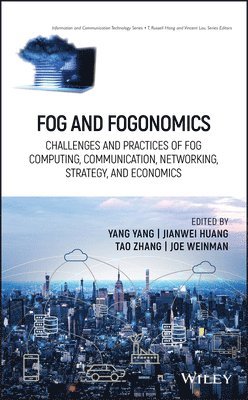
    Fog and Fogonomics

    Challenges and Practices of Fog Computing, Communication, Networking, Strategy, and Economics

    AvYang Yang,Jianwei Huang

    Inbunden, Engelska, 2020

    Del i serien Information and Communication Technology Series

    1 405 kr

    Beställningsvara. Skickas inom 11-20 vardagar. Fri frakt över 249 kr.

    Beskrivning

    THE ONE-STOP RESOURCE FOR ANY INDIVIDUAL OR ORGANIZATION CONSIDERING FOG COMPUTING Fog and Fogonomics is a comprehensive and technology-centric resource that highlights the system model, architectures, building blocks, and IEEE standards for fog computing platforms and solutions. The "fog" is defined as the multiple interconnected layers of computing along the continuum from cloud to endpoints such as user devices and things including racks or microcells in server closets, residential gateways, factory control systems, and more. The authors—noted experts on the topic—review business models and metrics that allow for the economic assessment of fog-based information communication technology (ICT) resources, especially mobile resources. The book contains a wide range of templates and formulas for calculating quality-of-service values. Comprehensive in scope, it covers topics including fog computing technologies and reference architecture, fog-related standards and markets, fog-enabled applications and services, fog economics (fogonomics), and strategy. This important resource: Offers a comprehensive text on fog computingDiscusses pricing, service level agreements, service delivery, and consumption of fog computingExamines how fog has the potential to change the information and communication technology industry in the next decadeDescribes how fog enables new business models, strategies, and competitive differentiation, as with ecosystems of connected and smart digital products and servicesIncludes case studies featuring integration of fog computing, communication, and networking systemsWritten for product and systems engineers and designers, as well as for faculty and students, Fog and Fogonomics is an essential book that explores the technological and economic issues associated with fog computing.

    Produktinformation

    • Utgivningsdatum:2020-03-03
    • Mått:147 x 231 x 23 mm
    • Vikt:748 g
    • Format:Inbunden
    • Språk:Engelska
    • Serie:Information and Communication Technology Series
    • Antal sidor:416
    • Förlag:John Wiley & Sons Inc
    • ISBN:9781119501091

    Utforska kategorier

    • Elektronik och kommunikationer inom Naturvetenskap och teknik

    Mer om författaren

    YANG YANG, PHD is a professor with ShanghaiTech University and a Co-Director of Shanghai Institute of Fog Computing Technology (SHIFT), China. JIANWEI HUANG, PHD is a Presidential Chair Professor and the Associate Dean of School of Science and Engineering, The Chinese University of Hong Kong, Shenzhen, and the Associate Director of Shenzhen Institute of Artificial Intelligence and Robotics for Society, China. TAO ZHANG, PHD is currently with the National Institute of Standards and Technology (NIST), USA. JOE WEINMAN is the former Senior Vice President of Cloud Services and Strategy at Telx, and is the founder of Cloudonomics, which takes a rigorous, multidisciplinary approach to valuing the cloud. He is the Cloud economics and strategy editor for IEEE Cloud Computing magazine and author of Cloudonomics: The Business Value of Cloud Computing and Digital Disciplines: Attaining Market Leadership via the Cloud, Big Data, Social, Mobile, and the Internet of Things.

    Innehållsförteckning

    • List of Contributors xviiPreface xxi1 Fog Computing and Fogonomics 1Yang Yang, Jianwei Huang, Tao Zhang, and Joe Weinman2 Collaborative Mechanism for Hybrid Fog-Cloud Scenarios 7Xavi Masip, Eva Marín, Jordi Garcia, and Sergi Sànchez2.1 The Collaborative Scenario 72.1.1 The F2C Model 112.1.1.1 The Layering Architecture 132.1.1.2 The Fog Node 142.1.1.3 F2C as a Service 162.1.2 The F2C Control Architecture 192.1.2.1 Hierarchical Architecture 202.1.2.2 Main Functional Blocks 242.1.2.3 Managing Control Data 252.1.2.4 Sharing Resources 262.2 Benefits and Applicability 282.3 The Challenges 292.3.1 Research Challenges 302.3.1.1 What a Resource is 302.3.1.2 Categorization 302.3.1.3 Identification 312.3.1.4 Clustering 332.3.1.5 Resources Discovery 332.3.1.6 Resource Allocation 342.3.1.7 Reliability 352.3.1.8 QoS 362.3.1.9 Security 362.3.2 Industry Challenges 372.3.2.1 What an F2C Provider Should Be? 382.3.2.2 Shall Cloud/Fog Providers Communicate with Each Other 382.3.2.3 How Multifog/Cloud Access is Managed 392.3.3 Business Challenges 402.4 Ongoing Efforts 412.4.1 ECC 412.4.2 mF2C 422.4.3 MEC 422.4.4 OEC 442.4.5 OFC 442.5 Handling Data in Coordinated Scenarios 452.5.1 The New Data 462.5.2 The Life Cycle of Data 482.5.3 F2C Data Management 492.5.3.1 Data Collection 492.5.3.2 Data Storage 512.5.3.3 Data Processing 522.6 The Coming Future 52Acknowledgments 54References 543 Computation Offloading Game for Fog-Cloud Scenario 61Hamed Shah-Mansouri and Vincent W.S. Wong3.1 Internet of Things 613.2 Fog Computing 633.2.1 Overview of Fog Computing 633.2.2 Computation Offloading 643.2.2.1 Evaluation Criteria 653.2.2.2 Literature Review 663.3 A Computation Task Offloading Game for Hybrid Fog-Cloud Computing 673.3.1 System Model 673.3.1.1 Hybrid Fog-Cloud Computing 683.3.1.2 Computation Task Models 683.3.1.3 Quality of Experience 713.3.2 Computation Offloading Game 713.3.2.1 Game Formulation 713.3.2.2 Algorithm Development 743.3.2.3 Price of Anarchy 743.3.2.4 Performance Evaluation 753.4 Conclusion 80References 804 Pricing Tradeoffs for Data Analytics in Fog–Cloud Scenarios 83Yichen Ruan, Liang Zheng, Maria Gorlatova, Mung Chiang, and Carlee Joe-Wong4.1 Introduction: Economics and Fog Computing 834.1.1 Fog Application Pricing 854.1.2 Incentivizing Fog Resources 864.1.3 A Fogonomics Research Agenda 864.2 Fog Pricing Today 874.2.1 Pricing Network Resources 874.2.2 Pricing Computing Resources 894.2.3 Pricing and Architecture Trade-offs 894.3 Typical Fog Architectures 904.3.1 Fog Applications 904.3.2 The Cloud-to-Things Continuum 904.4 A Case Study: Distributed Data Processing 924.4.1 A Temperature Sensor Testbed 924.4.2 Latency, Cost, and Risk 954.4.3 System Trade-off: Fog or Cloud 984.5 Future Research Directions 1014.6 Conclusion 102Acknowledgments 102References 1035 Quantitative and Qualitative Economic Benefits of Fog 107Joe Weinman5.1 Characteristics of Fog Computing Solutions 1085.2 Strategic Value 1095.2.1 Information Excellence 1105.2.2 Solution Leadership 1105.2.3 Collective Intimacy 1105.2.4 Accelerated Innovation 1115.3 Bandwidth, Latency, and Response Time 1115.3.1 Network Latency 1135.3.2 Server Latency 1145.3.3 Balancing Consolidation and Dispersion to Minimize Total Latency 1145.3.4 Data Traffic Volume 1155.3.5 Nodes and Interconnections 1165.4 Capacity, Utilization, Cost, and Resource Allocation 1175.4.1 Capacity Requirements 1175.4.2 Capacity Utilization 1185.4.3 Unit Cost of Delivered Resources 1195.4.4 Resource Allocation, Sharing, and Scheduling 1205.5 Information Value and Service Quality 1205.5.1 Precision and Accuracy 1205.5.2 Survivability, Availability, and Reliability 1225.6 Sovereignty, Privacy, Security, Interoperability, and Management 1235.6.1 Data Sovereignty 1235.6.2 Privacy and Security 1235.6.3 Heterogeneity and Interoperability 1245.6.4 Monitoring, Orchestration, and Management 1245.7 Trade-Offs 1255.8 Conclusion 126References 1266 Incentive Schemes for User-Provided Fog Infrastructure 129George Iosifidis, Lin Gao, Jianwei Huang, and Leandros Tassiulas6.1 Introduction 1296.2 Technology and Economic Issues in UPIs 1326.2.1 Overview of UPI models for Network Connectivity 1326.2.2 Technical Challenges of Resource Allocation 1346.2.3 Incentive Issues 1356.3 Incentive Mechanisms for Autonomous Mobile UPIs 1376.4 Incentive Mechanisms for Provider-assisted Mobile UPIs 1406.5 Incentive Mechanisms for Large-Scale Systems 1436.6 Open Challenges in Mobile UPI Incentive Mechanisms 1456.6.1 Autonomous Mobile UPIs 1456.6.1.1 Consensus of the Service Provider 1456.6.1.2 Dynamic Setting 1466.6.2 Provider-assisted Mobile UPIs 1466.6.2.1 Modeling the Users 1466.6.2.2 Incomplete Market Information 1476.7 Conclusions 147References 1487 Fog-Based Service Enablement Architecture 151Nanxi Chen, Siobhán Clarke, and Shu Chen7.1 Introduction 1517.1.1 Objectives and Challenges 1527.2 Ongoing Effort on FogSEA 1537.2.1 FogSEA Service Description 1567.2.2 Semantic Data Dependency Overlay Network 1587.2.2.1 Creation and Maintenance 1597.2.2.2 Semantic-Based Service Matchmarking 1617.3 Early Results 1647.3.1 Service Composition 1657.3.1.1 SeDDON Creation in FogSEA 1677.3.2 Related Work 1687.3.2.1 Semantic-Based Service Overlays 1697.3.2.2 Goal-Driven Planning 1707.3.2.3 Service Discovery 1717.3.3 Open Issue and Future Work 172References 1748 Software-Defined Fog Orchestration for IoT Services 179Renyu Yang, Zhenyu Wen, David McKee, Tao Lin, Jie Xu, and Peter Garraghan8.1 Introduction 1798.2 Scenario and Application 1828.2.1 Concept Definition 1828.2.2 Fog-enabled IoT Application 1848.2.3 Characteristics and Open Challenges 1858.2.4 Orchestration Requirements 1878.3 Architecture: A Software-Defined Perspective 1888.3.1 Solution Overview 1888.3.2 Software-Defined Architecture 1898.4 Orchestration 1918.4.1 Resource Filtering and Assignment 1928.4.2 Component Selection and Placement 1948.4.3 Dynamic Orchestration with Runtime QoS 1958.4.4 Systematic Data-Driven Optimization 1968.4.5 Machine-Learning for Orchestration 1978.5 Fog Simulation 1988.5.1 Overview 1988.5.2 Simulation for IoT Application in Fog 1998.5.3 Simulation for Fog Orchestration 2018.6 Early Experience 2028.6.1 Simulation-Based Orchestration 2028.6.2 Orchestration in Container-Based Systems 2068.7 Discussion 2078.8 Conclusion 208Acknowledgment 208References 2089 A Decentralized Adaptation System for QoS Optimization 213Nanxi Chen, Fan Li, Gary White, Siobhán Clarke, and Yang Yang9.1 Introduction 2139.2 State of the Art 2179.2.1 QoS-aware Service Composition 2179.2.2 SLA (Re-)negotiation 2199.2.3 Service Monitoring 2219.3 Fog Service Delivery Model and AdaptFog 2249.3.1 AdaptFog Architecture 2249.3.2 Service Performance Validation 2279.3.3 Runtime QoS Monitoring 2329.3.4 Fog-to-Fog Service Level Renegotiation 2359.4 Conclusion and Open Issues 240References 24010 Efficient Task Scheduling for Performance Optimization 249Yang Yang, Shuang Zhao, Kunlun Wang, and Zening Liu10.1 Introduction 24910.2 Individual Delay-minimization Task Scheduling 25110.2.1 System Model 25110.2.2 Problem Formulation 25110.2.3 POMT Algorithm 25310.3 Energy-efficient Task Scheduling 25510.3.1 Fog Computing Network 25510.3.2 Medium Access Protocol 25710.3.3 Energy Efficiency 25710.3.4 Problem Properties 25810.3.5 Optimal Task Scheduling Strategy 25910.4 Delay Energy Balanced Task Scheduling 26010.4.1 Overview of Homogeneous Fog Network Model 26010.4.2 Problem Formulation and Analytical Framework 26110.4.3 Delay Energy Balanced Task Offloading 26210.4.4 Performance Analysis 26210.5 Open Challenges in Task Scheduling 26510.5.1 Heterogeneity of Mobile Nodes 26510.5.2 Mobility of Mobile Nodes 26510.5.3 Joint Task and Traffic Scheduling 26510.6 Conclusion 266References 26611 Noncooperative and Cooperative Computation Offloading 269Xu Chen and Zhi Zhou11.1 Introduction 26911.2 Related Works 27111.3 Noncooperative Computation Offloading 27211.3.1 System Model 27211.3.1.1 Communication Model 27211.3.1.2 Computation Model 27311.3.2 Decentralized Computation Offloading Game 27511.3.2.1 Game Formulation 27511.3.2.2 Game Property 27611.3.3 Decentralized Computation Offloading Mechanism 28011.3.3.1 Mechanism Design 28011.3.3.2 Performance Analysis 28211.4 Cooperative Computation Offloading 28311.4.1 HyFog Framework Model 28311.4.1.1 Resource Model 28311.4.1.2 Task Execution Model 28411.4.2 Inadequacy of Bipartite Matching–Based Task Offloading 28511.4.3 Three-Layer Graph Matching Based Task Offloading 28711.5 Discussions 28911.5.1 Incentive Mechanisms for Collaboration 29011.5.2 Coping with System Dynamics 29011.5.3 Hybrid Centralized–Decentralized Implementation 29111.6 Conclusion 291References 29212 A Highly Available Storage System for Elastic Fog 295Jaeyoon Chung, Carlee Joe-Wong, and Sangtae Ha12.1 Introduction 29512.1.1 Fog Versus Cloud Services 29612.1.2 A Fog Storage Service 29712.2 Design 29912.2.1 Design Considerations 29912.2.2 Architecture 30012.2.3 File Operations 30112.3 Fault Tolerant Data Access and Share Placement 30312.3.1 Data Encoding and Placement Scheme 30312.3.2 Robust and Exact Share Requests 30412.3.3 Clustering Storage Nodes 30512.3.4 Storage Selection 30612.3.4.1 File Download Times 30712.3.4.2 Optimizing Share Locations 30712.4 Implementation 30912.4.1 Metadata 31012.4.2 Access Counting 31112.4.3 NAT Traversal 31212.5 Evaluation 31212.6 Discussion and Open Questions 31812.7 Related Work 31912.8 Conclusion 320Acknowledgments 320References 32013 Development of Wearable Services with Edge Devices 325Yuan-Yao Shih, Ai-Chun Pang, and Yuan-Yao Lou13.1 Introduction 32513.2 Related Works 32813.2.1 Without Developer’s Effort 32913.2.2 Require Developer’s Effort 33013.3 Problem Description 33113.4 System Architecture 33213.4.1 End Device 33213.4.2 Fog Node 33313.4.3 Controller 33313.5 Methodology 33313.5.1 End Device 33413.5.1.1 Localization 33413.5.1.2 Speech Recognition 33513.5.1.3 Retrieving Google Calendar Information 33613.5.2 Fog Node 33713.5.3 Controller 33813.6 Performance Evaluation 33913.6.1 Experiment Setup 33913.6.2 Different Computation Loads 34013.6.3 Different Types of Applications 34213.6.4 Remote Wearable Services Provision 34413.6.5 Estimation of Power Consumption 34613.7 Discussion 34813.8 Conclusion 349References 35014 Security and Privacy Issues and Solutions for Fog 353Mithun Mukherjee, Mohamed Amine Ferrag, Leandros Maglaras, Abdelouahid Derhab, and Mohammad Aazam14.1 Introduction 35314.1.1 Major Limitations in Traditional Cloud Computing 35314.1.2 Fog Computing: An Edge Computing Paradigm 35414.1.3 A Three-Tier Fog Computing Architecture 35714.2 Security and Privacy Challenges Posed by Fog Computing 36014.3 Existing Research on Security and Privacy Issues in Fog Computing 36114.3.1 Privacy-preserving 36114.3.2 Authentication 36314.3.3 Access Control 36314.3.4 Malicious attacks 36414.4 Open Questions and Research Challenges 36614.4.1 Trust 36714.4.2 Privacy preservation 36714.4.3 Authentication 36714.4.4 Malicious Attacks and Intrusion Detection 36814.4.5 Cross-border Issues and Fog Forensic 36914.5 Summary 369Exercises 370References 370Index 375
    Hoppa över listan

    Du kanske också är intresserad av

    Joe Weinman, Tao Zhang, Jianwei Huang, Yang Yang - Fog and Fogonomics, E-bok

    Fog and Fogonomics

    Joe Weinman, Tao Zhang, Jianwei Huang, Yang Yang

    E-bok
    2020

    1 566 kr

    Joe Weinman, Tao Zhang, Jianwei Huang, Yang Yang - Fog and Fogonomics, E-bok

    Fog and Fogonomics

    Joe Weinman, Tao Zhang, Jianwei Huang, Yang Yang

    E-bok
    2020

    1 562 kr

    K. Daniel Wong - Fundamentals of Wireless Communication Engineering Technologies, Inbunden
    Del 98

    Fundamentals of Wireless Communication Engineering Technologies

    K. Daniel Wong

    Inbunden, 2012

    1 888 kr

    Shoshana Loeb, Benjamin Falchuk, Thimios Panagos - Fabric of Mobile Services, Inbunden
    Del 94

    Fabric of Mobile Services

    Shoshana Loeb, Benjamin Falchuk, Thimios Panagos

    Inbunden, 2009

    1 288 kr

    Soumya Sen, Carlee Joe-Wong, Sangtae Ha, Mung Chiang - Smart Data Pricing, Inbunden

    Smart Data Pricing

    Soumya Sen, Carlee Joe-Wong, Sangtae Ha, Mung Chiang

    Inbunden, 2014

    1 645 kr

    Bu-Chin Wang - Digital Signal Processing Techniques and Applications in Radar Image Processing, Inbunden
    Del 91

    Digital Signal Processing Techniques and Applications in Radar Image Processing

    Bu-Chin Wang

    Inbunden, 2008

    1 670 kr

    Hanan Luss - Equitable Resource Allocation, Inbunden
    Del 101

    Equitable Resource Allocation

    Hanan Luss

    Inbunden, 2012

    1 121 kr

    Tao Zhang, Luca Delgrossi - Vehicle Safety Communications, Inbunden
    Del 103

    Vehicle Safety Communications

    Tao Zhang, Luca Delgrossi

    Inbunden, 2012

    1 440 kr

    Richard C. Li - RF Circuit Design, Inbunden
    Del 102

    RF Circuit Design

    Richard C. Li

    Inbunden, 2012

    2 000 kr

    Mung Chiang, Bharath Balasubramanian, Flavio Bonomi - Fog for 5G and IoT, Inbunden

    Fog for 5G and IoT

    Mung Chiang, Bharath Balasubramanian, Flavio Bonomi

    Inbunden, 2017

    1 413 kr