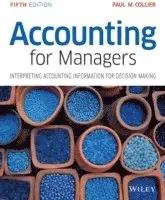
Accounting for Managers
Interpreting Accounting Information for Decision Making
798 kr
Skickas . Fri frakt över 249 kr.
Beskrivning
Produktinformation
- Utgivningsdatum:2015-05-08
- Mått:188 x 234 x 28 mm
- Vikt:1 089 g
- Format:Häftad
- Språk:Engelska
- Antal sidor:544
- Upplaga:5
- Förlag:John Wiley & Sons Inc
- ISBN:9781119002949
Utforska kategorier
Mer om författaren
Dr Paul M. Collier was Professor of Accounting at Monash University in Melbourne, Australia. He was previously at Aston Business School in Birmingham, UK. Paul is currently a consultant and investor in a hospitality business but retains an ongoing association in various academic projects with Monash University. Before becoming an academic, Paul was chief financial officer of a listed company and has worked in senior financial and general management positions in the UK and Australia. He has also conducted numerous executive education courses. Paul has been a board member of a large UK Housing Association and an Australian health service. This book is a result of his practical experience as a producer and user of accounting information as well as his teaching and training experience in the UK and Australia. A comprehensive package of supplementary material is available on the book companion website at www.wileyeurope.com/college/collier, including PowerPoint slides, multiple choice questions for each chapter, and additional questions and solutions.
Innehållsförteckning
- Preface to the Fifth Edition xiiiAbout the Author xviiAcknowledgements xixPart I Context of Accounting 11 Introduction to Accounting 3Accounting, accountability, and the account 3A short history of accounting 5Introducing the functions of accounting 7The role of financial accounting 7The role of management accounting 8Recent developments in accounting 10The relationship between financial accounting and management accounting 12A critical perspective 14Conclusion 16References 16Questions 172 Accounting and its Relationship to Shareholder Value and Corporate Governance 19Capital and product markets 19Shareholder value‐based management 21Shareholder value, strategy, and accounting 23Company regulation and corporate governance 25Risk management, internal control, and accounting 28A critical perspective 29Conclusion 30References 30Questions 313 Recording Financial Transactions and the Principles of Accounting 33Business events, transactions, and the accounting system 33The double entry: recording transactions 35Extracting financial information from the accounting system 38Basic principles of accounting 42Cost terms and concepts: the limitations of financial accounting 45Conclusion 47References 47Questions 474 Management Control, Accounting, and its Rational‐Economic Assumptions 51Management control systems 51Planning and control in organizations 54Non‐financial performance measurement 58A theoretical framework for accounting 64Conclusion 65References 65Websites 67Questions 675 Interpretive and Critical Perspectives on Accounting and Decision Making 69Research and theory in management control and accounting 70Alternative paradigms 73The interpretive paradigm and the social construction perspective 75Culture, control, and accounting 77The radical paradigm and critical accounting 78Power and accounting 80Creative accounting, ethics, and accounting 84Conclusion 90References 91Questions 93Part II The Use of Financial Statements for Decision Making 956 Constructing Financial Statements: IFRS and the Framework of Accounting 97International Financial Reporting Standards (IFRS) 98Framework for the Preparation and Presentation of Financial Statements 100True and fair view 103Reporting profitability: the Income Statement and Statement of Comprehensive Income 104Reporting financial position: the Balance Sheet or Statement of Financial Position 107The matching principle and accruals accounting 109Depreciation 111Specific IFRS accounting treatments 112Reporting cash flow: the Statement of Cash Flows 116Differences between the financial statements 118A theoretical perspective on financial statements 120A critical perspective on financial statements and accounting standards 121Conclusion 122Reference 122Websites 122Appendix to Chapter 6: List of IFRS and FRS 123Questions 1257 Interpreting Financial Statements 129Annual Reports 129The context of financial statements 131Ratio analysis 132Profitability 133Liquidity 135Gearing 135Activity/efficiency 136Working capital 137Managing receivables 138Managing inventory 138Managing payables 139Managing working capital 139Shareholder return 140The relationship between financial ratios 141Interpreting financial statements using ratios 143Using the Statement of Cash Flows 145Limitations of ratio analysis 152A wider view on corporate reporting 156Intellectual capital 157Institutional theory 158Corporate social and environmental responsibility 158Applying different perspectives to financial statements 161Conclusion 162References 163Questions 1638 Accounting for Inventory 171Introduction to inventory 171Methods of costing inventory in manufacturing 175Management accounting statements 180Conclusion 181Questions 182Part III Using Accounting Information for Decision Making, Planning, and Control 1859 Accounting and Information Systems 187Introduction to accounting and information systems 187Methods of data collection 188Big data 190Types of information system 190Business processes 192Information systems design and controls 194Conclusion 196References 196Questions 19610 Marketing Decisions 197Marketing strategy 197Cost behaviour 199Cost–volume–profit analysis 201Alternative approaches to pricing 208Segmental profitability 212Customer profitability analysis 216Conclusion 219References 219Questions 22011 Operating Decisions 223The operations function 223Managing operations – manufacturing 225Managing operations – services 227Accounting for the cost of spare capacity 228Capacity utilization and product mix 229Theory of Constraints 231Operating decisions: relevant costs 232Supply chain management, total cost of ownership, and supplier cost analysis 237The cost of quality 239Environmental cost management 241Conclusion 246References 247Questions 24712 Human Resource Decisions 251Human resources and accounting 251The cost of labour 252Relevant cost of labour 255Conclusion 261References 262Questions 26213 Overhead Allocation Decisions 267Cost classification 267The overhead allocation problem 271Shifts in management accounting thinking 272Alternative methods of overhead allocation 273Differences between absorption and activity‐based costing 282Contingency theory 285International comparisons 286Behavioural implications of management accounting 287Conclusion 290References 291Questions 29214 Strategic Investment Decisions 297Strategy 297Capital expenditure evaluation 298Accounting rate of return 301Payback 304Discounted cash flow 304Comparison of techniques 307Conclusion 311References 311Appendix to Chapter 14: Present value factors 311Questions 31315 Performance Evaluation of Business Units 317Structure of business organizations 317The decentralized organization and divisional performance measurement 320Controllability 323Comparison of methods 326Transfer pricing 327Transaction cost economics 329Conclusion: a critical perspective 330References 331Questions 33216 Budgeting 335What is budgeting? 335The budgeting process 336The profit budget 339Cash forecasting 345A behavioural perspective on budgeting 349A critical perspective: beyond budgeting? 350Conclusion 354References 354Questions 35417 Budgetary Control 359What is budgetary control? 359Variance analysis 361Flexible budgets and sales variances 362Flexible budgets and cost variances 363Interpreting variances 365Criticism of variance analysis 366Applying different perspectives to management accounting 368Conclusion 368References 369Questions 36918 Strategic Management Accounting 371Trends in management accounting 371Strategic management accounting 372Accounting techniques to support strategic management accounting 374Lean production, lean accounting, and backflush costing 381Conclusion 384References 384Further reading 385Questions 386Part IV Supporting Information 387Readings 389Reading 1 Cooper and Kaplan (1988). How cost accounting distorts product costs 390Reading 2 Dent (1991). Accounting and organizational cultures: a field study of the emergence of a new organizational reality 403Glossary of Accounting Terms 435Solutions to Questions 449Index 509
Du kanske också är intresserad av
- Nyhet
Ät för din ålder : Kokbok och guide för dig i klimakteriet
Caroline Wilbois, Johanna Andersson
279 kr
- -30%
- -21%
Hjärnans akilleshälar : hur din hjärna lurar dig, och vad du kan göra åt det
Anders Hansen
229 kr289 kr
- Signerad!
- -22%
- -30%