Beställningsvara. Skickas inom 10-15 vardagar. Fri frakt över 249 kr.
Beskrivning
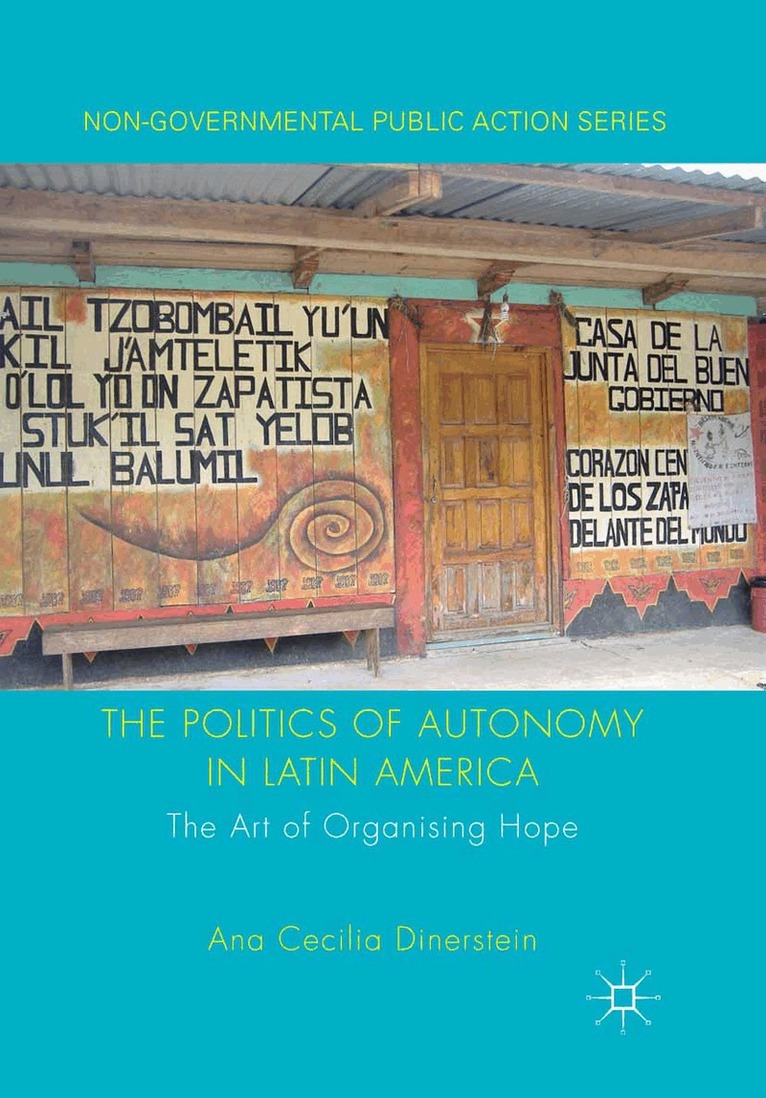
The author contests older concepts of autonomy as either revolutionary or ineffective vis-à-vis the state. Looking at four prominent Latin American movements, she defines autonomy as 'the art of organising hope': a tool for indigenous and non-indigenous movements to prefigure alternative realities at a time when utopia can be no longer objected.
Ana C. Dinerstein is Associate Professor in the Department of Social and Policy Sciences at the University of Bath, UK. She has published extensively on Argentine and Latin American politics, autonomy, subjectivity, labour, social and indigenous movements, emancipatory struggles and the politics of policy. Her main publications include The Labour Debate (2002), La Ruta de los Piqueteros. Luchas y Legados (2010) and La política de la Esperanza en America Latina (2013).
Recensioner i media
'Terrific and necessary. An excellent and informative account of the wonderful movements of revolt in Latin America in recent years, but it is much more than that. Latin America is not just over there (over here in my case) but an inspiration and a challenge for all of us. Even more exciting than the title is the subtitle: The Art of Organising Hope. That is what we so desperately need, that is why the book is so important, and not just for those with a special interest in Latin America.' - John Holloway, Benemerita Universidad Autonoma de Puebla, Mexico 'Ana Cecilia Dinerstein's book is a major intervention, which reframes these questions fundamentally and places the hopes, experiments, contradictions and possibilities of social movements centre-stage while recognising the specificity of Latin American and indigenous experiences. Clear and powerful, this work is badly needed.' Laurence Cox, National University of Ireland Maynooth, Ireland 'The book is terrific. It is teeming with radical scholarship' Mike Neary, University of Lincoln, UK 'What Ana Cecilia Dinerstein has done with this book is to demonstrate how the philosophy of Ernst Bloch cannot be said to exist in a purely abstract vacuum, as is often contended in western philosophical debate. She has pointed out here that the philosophy of hope, of the anticipated realisation of hope in social form, i.e. politically in the form of revolution and change, is central to his concerns and resonates in what were long seemed to be "peripheral" areas. It is no coincidence that Ernst Bloch's works have long been better known in Latin America than in the Anglo-Saxon world as his philosophy of hope bears a great deal of similarities with liberation theology in general. An essential part of his thought is that religion carries within it not only oppressive structures from above but also liberationist tendencies from below and that only when these active, creative tendencies meet up with the grinding realities of economic exploitation, then the likelihood is that some form of transformation will emerge. The strength of this book is to point out that this is an open process and that any movement towards social and political liberation is one which is only partially determined by these economic conditions in the traditional Marxist sense but is carried by the sense of hope and the pre-illuminations of what might be.' - Peter Thompson, University of Sheffield, UK
Innehållsförteckning
1. Embracing the Other Side: An introduction PART I: THEORISING AUTONOMY 2. Meanings of Autonomy: Trajectories, Modes, Differences 3. Autonomy in the Key of Hope: Understanding Prefiguration PART II: NAVIGATING AUTONOMY 4. Organising Negation: Neoliberal Hopelessness, Insurgent Hope (Mexico) 5. Shaping Concrete Utopias: Urban Experiments (Argentina) 6. Resisting Translation: Indigenous-Popular Resistance (Bolivia) 7. Venturing Beyond the Wire: The Sem Terra's Dream (Brazil) PART III: RETHINKING AUTONOMY 8. Confronting Value with Hope. A Prefigurative Critique of Political Economy 9. Living in Blochian Times: Opening Remarks