• Fri frakt över 249 kr
  • •
  • Snabba leveranser
  • •
  • Billiga böcker
Kundservice

Du är på sajten för privatpersoner.

Företag, bibliotek eller offentlig verksamhet?

Du handlar på classic.bokus.com, där alla dina funktioner finns intakta.
Till classic.bokus.com
Bokus logotyp. Gå till startsidan.
  • Erbjudanden
  • Student
  • Topplistor
  • Barn & ungdom
  • Bokus Play
  • E-böcker
  • Ljudböcker
  • Pocketböcker
  • Spel och pussel

5% studentrabatt – använd koden KURSBOK27 →

Sidfot

Mina sidor

    Hjälp

    • Kundservice
    • Vanliga frågor och svar
    • Frakt och leverans
    • Retur vid ångerrätt
    • Reklamera vara
    • Betalning
    • Köpvillkor
    • Allmänna villkor
    • Information om webbplatsens tillgänglighet

    Om Bokus

    • Om oss
    • Pressrum
    • För studenter
    • För företag
    • För bibliotek och offentlig verksamhet
    • För leverantörer
    • Hållbarhet

    Populärt

    • Aktuella erbjudanden
    • Presentkort
    • Studentlitteratur
    • Nya böcker
    • Topplistor
    • Signerade böcker
    • Engelska böcker

    Inspiration

    • Boktips
    • BookTok
    • Barnbokskaraktärer
    • Populära författare
    Logotyp för Bokus
    Följ oss på Facebook (extern länk)Följ oss på Instagram (extern länk)Följ oss på YouTube (extern länk)Följ oss på TikTok (extern länk)
    bokus @ CookiesAnpassa cookiesIntegritetspolicyKöpvillkor
    Till Citymail hemsida (extern länk)Till Budbee hemsida (extern länk)Till Postnord hemsida (extern länk)Till Schenker hemsida (extern länk)Till Early Bird hemsida (extern länk)Till Walleys hemsida (extern länk)
    1. Psykologi och pedagogik
    2. Psykologi
    3. Psykologisk metod

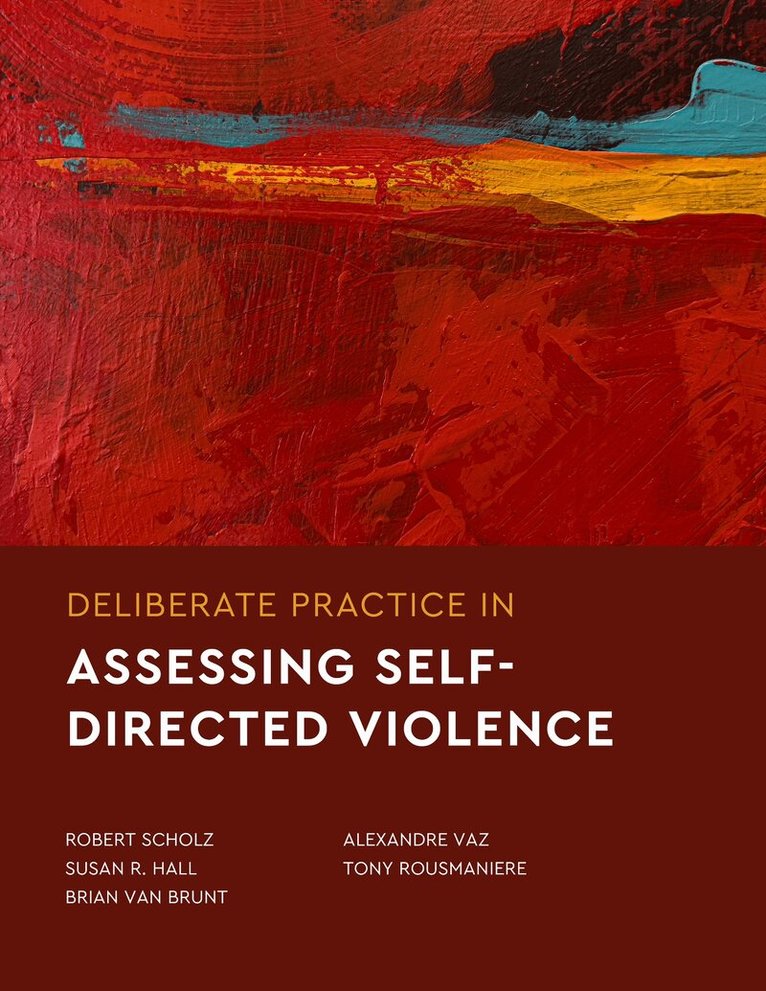
    Deliberate Practice in Assessing Self-Directed Violence

    AvRobert Scholz,Susan R. Hall

    Häftad, Engelska, 2026

    Del i serien Essentials of Deliberate Practice Series

    540 kr

    Beställningsvara. Skickas inom 5-8 vardagar. Fri frakt över 249 kr.

    Beskrivning

    To help address the suicide public health crisis, this book presents deliberate practice exercises to reduce clinicians' fears of talking about suicide and self-injury with clients and assessing for risk with skill and empathy. These exercises present role-playing scenarios in which two trainees act as a client and a therapist, switching back and forth under the guidance of a supervisor. The therapist improvises appropriate and authentic responses to client statements organized into three difficulty levels—beginner, intermediate, and advanced. The first 10 exercises review skills that can be incorporated into any approach to assess self-directed violence (SDV), such as exploring the deeper meaning behind statements that indicate a desire to engage in SDV, asking scaling questions to assess the likelihood of acting on these desires, collaborative safety planning, and communicating with clients about the therapist's ethical and legal responsibilities. Two comprehensive exercises follow in which trainees integrate these skills into a transcribed session and mock therapy sessions. Step-by-step instructions guide participants through the exercises, identify criteria for mastering the skills, and explain how to monitor and adjust difficulty. Guidelines to help trainers and trainees get the most out of training are also provided.To demonstrate how deliberate practice can be fully integrated into a professional curriculum, this series features exercises developed and refined within the clinical training curriculum at the Sentio online/hybrid marriage and family therapy (MFT) therapist training program in California, which is where we started developing this series. These exercises, which have been tested at clinical training sites around the world, are used to enhance clinical outcomes within the first hybrid MFT program approved by the California Board of Behavioral Sciences to fully integrate deliberate practice into its entire curriculum. By integrating these models into its hybrid MFT program in California, Sentio University demonstrates that therapist training graduate programs can use deliberate practice to bridge the gap between theory and clinical mastery through repetitive, feedback-informed practice to support the development of modern, outcome-focused clinicians.

    Produktinformation

    • Utgivningsdatum:2026-03-24
    • Mått:216 x 279 x 15 mm
    • Vikt:484 g
    • Format:Häftad
    • Språk:Engelska
    • Serie:Essentials of Deliberate Practice Series
    • Antal sidor:184
    • Förlag:American Psychological Association
    • ISBN:9781433843433

    Utforska kategorier

    • Psykologisk metod inom Psykologi och pedagogik
    • Psykoterapi som behandlingsmetod inom Medicin
    • Psykisk ohälsa inom Hälsa och familj

    Mer om författaren

    Robert Scholz, MA,LMFT, LPCC, founder of The Change Place, Inc., is a marriage and family therapist and professional clinical counselor. He is well-known for his work as a trainer and consultant in assisting schools and communities prepare for and respond to major crisis events like wildfires, mass shootings, and suicides. A member of the Motivational Interviewing Network of Trainers, Robert has trained thousands in motivational interviewing skills and other evidence-based therapeutic approaches. He has authored publications on disaster mental health, addiction treatment, threat assessment, and men's mental health.Susan R. Hall, JD, PhD, is a tenured associate professor of psychology at Pepperdine University's Graduate School of Education and Psychology. She has published and presented nationally on topics related to clinical/counseling practice and training; trauma and positive psychology; and psychology, public policy and law, including two APA books: Courtroom Modifications for Child Witnesses and Laws Affecting Clinical Practice. Dr. Hall served on the editorial board of the Journal of Youth and Adolescence, was treasurer for APA's Society for Child and Family Policy and Practice (Division 37), and received Pepperdine's Howard A. White Award for Excellence in Teaching.Brian Van Brunt, EdD, is director of behavior and threat management for D-Prep Safety and the president of the Workplace Violence Prevention Association. Author of over a dozen books, Brian has worked as a child and family therapist, university professor, assistant deputy director of training at Secure Community Network, and president of the National Association for Behavioral Intervention and Threat Assessment. He is an internationally recognized expert in behavioral intervention, threat assessment, crisis preparedness, mental illness, and instructional design. Brian has provided consulting services to schools around the world on student mental health, counseling, campus violence, and behavioral intervention. Alexandre Vaz, PhD, is chief academic officer of Sentio University marriage and family therapy (MFT) program in California. This innovative online/hybrid California MFT degree was the first approved by the California Board of Behavioral Science for MFT licensure to fully integrate deliberate practice into its curriculum to ensure superior clinical outcomes. He is also director of clinical training for the Sentio Counseling Center, which is Sentio MFT program's guaranteed practicum site where students provide low-cost online couples therapy in California. Dr. Vaz is the author/coeditor of many books on deliberate practice and psychotherapy training.Tony Rousmaniere, PsyD, is president of Sentio University marriage and family therapy (MFT) program in California. He led the development of the online/hybrid MFT program, which is the first MFT therapist training program approved by the California Board of Behavioral Science for MFT licensure that fully integrates deliberate practice. Dr. Rousmaniere is the author/coeditor of many books on psychotherapy training. He is also the executive director of the Sentio Counseling Center, which is Sentio MFT program's guaranteed practicum site where students provide sliding-scale online therapy in California, and past president of the American Psychological Association's Division 29.

    Recensioner i media

    "I'm thrilled to see the publication of Deliberate Practice in Assessing Self-Directed Violence. Why? Because for decades we've needed a text with clear guidance to help students and practitioners develop skills for assessing self-directed violence (aka suicide assessment). Now we have it. This book moves training and practice in assessing self-directed violence to the next level." - John Sommers-Flanagan, PhD, Director, Center for the Advancement of Positive Education, University of Montana, Missoula, and coauthor of Clinical Interviewing "Finally, a book that bridges the gap between a therapist's knowledge of self-directed violence and how to use that knowledge during times it matters most. What sets this book apart is the shift in mindset, from the assumption therapists get better over time to the fact that intentional training and repetition through deliberate practice is what's needed to bridge the gap between "I know this" and "I nailed it."" - Lisa Pescara-Kovach, PhD, Director, Center for Education in Mass Violence and Suicide; Professor, Educational Studies, The University of Toledo, Toledo, OH; and coauthor of White Supremacist Violence: Understanding the Resurgence and Stopping the Spread "This book provides a clear, evidence-informed framework for training graduate students to competently assess and treat self-directed violence. It translates complex risk assessment concepts into practical, ethical decision-making tools that are accessible without oversimplifying the seriousness of high-risk situations. Through case examples, structured exercises, and step-by-step guidance, the text builds therapist confidence while emphasizing safety, supervision, and collaboration. A major strength is its explicit focus on reducing the trepidation and unease commonly experienced by both trainees and practicing clinicians when outcomes may be severe or life-threatening. Overall, the book meaningfully increases clinical competency and readiness, making it a valuable resource for graduate education and ongoing professional development." - David J. Denino, MS, LPC, Director Emeritus, Counseling Services, Southern Connecticut State University, New Haven, and Disaster Mental Health Lead for CT/RI, American Red Cross

    Innehållsförteckning

    • Series Preface Tony Rousmaniere and Alexandre VazAcknowledgmentsPart I Overview and InstructionsChapter 1. Introduction and Overview of Deliberate Practice in Assessing Self-Directed ViolenceChapter 2. Instructions for the Self-Directed Violence Assessment Deliberate Practice ExercisesPart II Deliberate Practice Exercises for Self-Directed Violence Assessment SkillsExercises for Beginner Self-Directed Violence Assessment SkillsExercise 1. Exploring the Meaning of Client StatementsExercise 2. Assessing Precipitating FactorsExercise 3. Asking Scaling QuestionsExercise 4. Exploring and Encouraging Social SupportExercises for Intermediate Self-Directed Violence Assessment SkillsExercise 5. Safety PlanningExercise 6. Working With AmbivalenceExercise 7. Using Self-Directed Violence Assessment MeasuresExercises for Advanced Self-Directed Violence Assessment SkillsExercise 8. Providing Rationales for Focusing on Self-Directed ViolenceExercise 9. Responding to Ruptures in the Therapeutic AllianceExercise 10. Communicating Therapist Boundaries and ResponsibilitiesComprehensive ExercisesExercise 11. Annotated Transcript of Self-Directed Violence Assessment in a Psychotherapy SessionExercise 12. Mock Sessions for Self-Directed Violence Assessment in PsychotherapyPart III Strategies for Enhancing the Deliberate Practice ExercisesChapter 3. How to Get the Most Out of Deliberate Practice: Additional Guidance for Trainers and TraineesAppendix A. Difficulty Assessments and AdjustmentsAppendix B. Deliberate Practice Diary FormAppendix C. Sample Self-Directed Violence Assessment Skills Syllabus With Embedded Deliberate Practice ExercisesReferencesIndexAbout the Authors