• Fri frakt över 249 kr
  • •
  • Snabba leveranser
  • •
  • Billiga böcker
Kundservice

Du är på sajten för privatpersoner.

Företag, bibliotek eller offentlig verksamhet?

Du handlar på classic.bokus.com, där alla dina funktioner finns intakta.
Till classic.bokus.com
Bokus logotyp. Gå till startsidan.
  • Erbjudanden
  • Student
  • Topplistor
  • Barn & ungdom
  • Bokus Play
  • E-böcker
  • Ljudböcker
  • Pocketböcker
  • Spel & pussel

Upp till 25% på utvalda nyheter →

Sidfot

Mina sidor

    Hjälp

    • Kundservice
    • Vanliga frågor och svar
    • Frakt och leverans
    • Retur vid ångerrätt
    • Reklamera vara
    • Betalning
    • Köpvillkor
    • Allmänna villkor
    • Information om webbplatsens tillgänglighet

    Om Bokus

    • Om oss
    • Pressrum
    • För studenter
    • För företag
    • För bibliotek och offentlig verksamhet
    • För leverantörer
    • Hållbarhet

    Populärt

    • Aktuella erbjudanden
    • Presentkort
    • Studentlitteratur
    • Nya böcker
    • Topplistor
    • Signerade böcker
    • Engelska böcker

    Inspiration

    • Boktips
    • BookTok
    • Populära bokserier
    • Barnbokskaraktärer
    • Populära författare
    Logotyp för Bokus
    Följ oss på Facebook (extern länk)Följ oss på Instagram (extern länk)Följ oss på YouTube (extern länk)Följ oss på TikTok (extern länk)
    bokus @ CookiesAnpassa cookiesIntegritetspolicyKöpvillkor
    Till Citymail hemsida (extern länk)Till Budbee hemsida (extern länk)Till Postnord hemsida (extern länk)Till Schenker hemsida (extern länk)Till Early Bird hemsida (extern länk)Till Walleys hemsida (extern länk)
    1. Psykologi och pedagogik
    2. Pedagogik
    3. Pedagogisk metodik

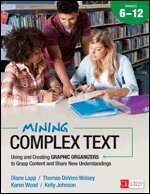
    Mining Complex Text, Grades 6-12

    Using and Creating Graphic Organizers to Grasp Content and Share New Understandings

    AvDiane K. Lapp,Thomas DeVere Wolsey

    Häftad, Engelska, 2014

    Del i serien Corwin Literacy

    356 kr

    Tillfälligt slut

    Beskrivning

    “How many times have you heard ‘a picture is worth a thousand words.’ . . . In this text, Lapp, Wolsey, Wood, and Johnson make a vital connection between reading words and the role of graphics. They demonstrate how teachers and students can blend the two such that great learning occurs in every classroom, every day.”

    —DOUGLAS FISHER
    Coauthor of Rigorous Reading

    Imagine you are a fourth grader, reading about our solar system for the first time. Or you’re a high school student, asked to compare survival in Suzanne Collin’s The Hunger Games and Elie Wiesel’s Night. Reading complex texts of any kind is arduous, and now more than ever, students are being asked to do highly advanced thinking, talking, and writing around their reading. If only there were ingenious new power tools that could give students the space to tease apart complex ideas in order to comprehend and to weld their understandings into a new whole.

    Good news: such tools exist. In the two volumes, Mining Complex Texts, Grades 2-5 and 6-12, a formidable author team shares fresh ways to use the best digital and print graphic organizers in whole-class, small-group, and independent learning.  Big believers of the gradual release method, the authors roll out dozens of examples of dynamic lessons and collaborative work across the content areas so that we see the process of using these visual tools to:

    • Help students read, reread, and take notes on a text
    • Promote students’ oral sharing of information and their ideas 
    • Elevate organized note-making from complex text(s)
    • Scaffold students’ narrative and informational writing
    • Move students to independent thinking as they learn to create their own organizing and note-taking systems

    Gone are the days of fill-‘em-in and forget-‘em graphic organizers. With these two volumes, teachers and professional development leaders have a unified vision of how to use these tools to meet the demands of an information-saturated world, one in which students need to be able to sift, sort, synthesize, and apply knowledge with alacrity and skill.

    Produktinformation

    • Utgivningsdatum:2014-11-27
    • Mått:215 x 279 x 12 mm
    • Vikt:550 g
    • Format:Häftad
    • Språk:Engelska
    • Serie:Corwin Literacy
    • Antal sidor:192
    • Upplaga:1
    • Förlag:SAGE Publications
    • ISBN:9781483316284

    Utforska kategorier

    • Pedagogisk metodik inom Psykologi och pedagogik
    • Skolan och förskolan inom Psykologi och pedagogik

    Mer om författaren

    Diane Lapp, EdD, is a distinguished professor of education at San Diego State University where her work continues to be applied to schools. She is also an instructional coach and teacher at Health Sciences High & Middle College. Throughout her career, Diane has taught in elementary, middle, and high schools. Her major areas of research and instruction regard issues related to the planning and assessment of very intentional literacy instruction and learning. A member of both the California and the International Reading Halls of Fame, Diane has authored, coauthored, and edited numerous articles, columns, texts, handbooks and children’s materials on instruction, assessment, and literacy related issues. Diane is the recipient of the ILA 2023 William S. Gray Citation of Merit, a prestigious award reserved for those who have made outstanding contributions to multiple facets of literacy development. Diane can be reached at lapp@sdsu.edu. Follow her on twitter @lappsdsu As a teacher for online courses hosted by the University of Central Florida, Dr. Thomas DeVere Wolsey is interested in how the interactions of students in digital and face-to-face environments change their learning. While much of his research centers on how visual information, such as graphic organizers, works in tandem with text to improve learning, he is also intrigued by the intersections of traditional literacies with digital literacies, specifically focusing on how those literacies affect teacher preparation and professional development. Dr. Karen Wood has been training literacy specialists for over 25 years at the University of North Carolina at Charlotte, where she is a Professor in the Department of Reading and Elementary Education. Dr. Wood is a published author and former reading teacher, reading specialist, and K–12 instructional coordinator, and much of her writing focuses on translating research and theory into classroom practice across all subjects and grade levels. Dr. Kelly Johnson is currently a faculty member in teacher education at San Diego State University and an instructional coach in the San Diego Unified School District. A Nationally Board Certified teacher, Kelly devotes much of her work to literacy teaching and learning in classrooms. Dr. Johnson is passionate about the teaching and learning connection that results from proper teacher modeling, productive group work, formative assessment, and student engagement.

    Recensioner i media

    "How many times have you heard ‘a picture is worth a thousand words.’ Visual, graphic information is important because human brains are hard-wired to attend to images. The challenge is that students still have to read words to achieve success. In this text, Lapp, Wolsey, Wood, and Johnson make a vital connection between reading words and the role of graphics. They demonstrate how teachers and students can blend the two such that great learning occurs in every classroom, every day."

    Innehållsförteckning

    • AcknowledgmentsChapter 1. Graphic Organizers: Making the Complex ComprehensibleHow to Think About Standards AlignmentHow to Help Students Meet the StandardsTips for Using Graphic Organizers DynamicallyHow to Meet Eight Intertwined Academic GoalsWhat Lies Ahead in This BookChapter 2. Thinking on the Page: The Research Behind Why Graphic Organizers WorkPicture This: Visuals Quicken and Deepen Text LearningGeneral Tips: How to Use Graphic Organizers WellTiered Organizers: Scaffold Student ProgressExamples of Tiered Graphics OrganizersAdapting Graphic Organizers for Tiered LearningA Sample Tiered LessonAt-a-Glance Chart of Graphic Organizers Matched to Academic GoalsChapter 3. Using Graphic Organizers to Acquire Academic VocabularyFrayer OrganizerVocabulary TriangleConcept/Definition MapWord MapChapter 4. Graphic Organizers Support Literary Text Reading and Writing TasksFreytag’s PyramidChapter 5. Graphic Organizers Support Informational Text Reading and Writing TasksText Search and Find Board4-Square With a DiamondModified KWLChapter 6. Graphic Organizers Support Students’ Reading ProficienciesNote-Card OrganizerTabbed Book ManipulativeSomebody-Wanted-But-SoUnderstanding Text Structures: Five Text TypesRereading OrganizerChapter 7. Graphic Organizers Boost Questioning and RespondingI-Chart and I-GuideFlip Chart ManipulativeText-Dependent Question/Response OrganizerChapter 8. Graphic Organizers Foster Understanding and Writing ArgumentsSeven-Part Graphic Organizer for Composing an ArgumentThinking MapChapter 9. Graphic Organizers Support CollaborationProject Management OrganizerConclusionAppendixGlossaryReferencesIndex