• Fri frakt över 249 kr
  • •
  • Snabba leveranser
  • •
  • Billiga böcker
Kundservice

Du är på sajten för privatpersoner.

Företag, bibliotek eller offentlig verksamhet?

Du handlar på classic.bokus.com, där alla dina funktioner finns intakta.
Till classic.bokus.com
Bokus logotyp. Gå till startsidan.
  • Erbjudanden
  • Student
  • Topplistor
  • Barn & ungdom
  • Bokus Play
  • E-böcker
  • Ljudböcker
  • Pocketböcker
  • Spel & pussel

Upp till 25% på utvalda nyheter →

Sidfot

Mina sidor

    Hjälp

    • Kundservice
    • Vanliga frågor och svar
    • Frakt och leverans
    • Retur vid ångerrätt
    • Reklamera vara
    • Betalning
    • Köpvillkor
    • Allmänna villkor
    • Information om webbplatsens tillgänglighet

    Om Bokus

    • Om oss
    • Pressrum
    • För studenter
    • För företag
    • För bibliotek och offentlig verksamhet
    • För leverantörer
    • Hållbarhet

    Populärt

    • Aktuella erbjudanden
    • Presentkort
    • Studentlitteratur
    • Nya böcker
    • Topplistor
    • Signerade böcker
    • Engelska böcker

    Inspiration

    • Boktips
    • BookTok
    • Populära bokserier
    • Barnbokskaraktärer
    • Populära författare
    Logotyp för Bokus
    Följ oss på Facebook (extern länk)Följ oss på Instagram (extern länk)Följ oss på YouTube (extern länk)Följ oss på TikTok (extern länk)
    bokus @ CookiesAnpassa cookiesIntegritetspolicyKöpvillkor
    Till Citymail hemsida (extern länk)Till Budbee hemsida (extern länk)Till Postnord hemsida (extern länk)Till Schenker hemsida (extern länk)Till Early Bird hemsida (extern länk)Till Walleys hemsida (extern länk)
    1. Kultur
    2. Arkitektur
    • Nyhet

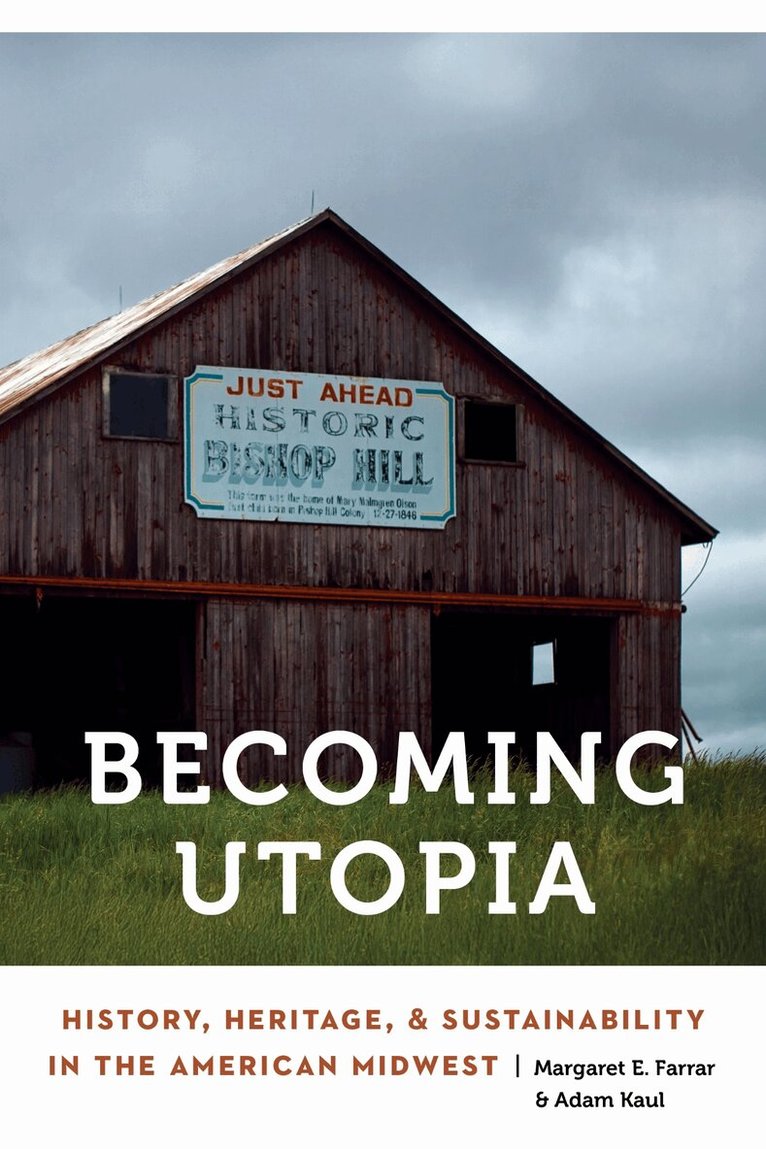
    Becoming Utopia

    History, Heritage, and Sustainability in the American Midwest

    AvMargaret E. Farrar,Adam Kaul

    Häftad, Engelska, 2026

    Del i serien Anthropology of Contemporary North America

    336 kr

    Beställningsvara. Skickas inom 10-15 vardagar. Fri frakt över 249 kr.

    Fler format och utgåvor

    Inbunden

    1 137 kr

    Beskrivning

    Becoming Utopia centers on the tiny community of Bishop Hill, Illinois, whose marketing materials call it "Utopia on the Prairie," home to a radical communal religious sect that emigrated from Sweden in the 1840s. Through rich textual and ethnographic analyses, Margaret E. Farrar and Adam Kaul tell the story of what happens when a small, historically significant Midwestern community negotiates the contradictory impulses of twenty-first-century place-making. At first glance, Bishop Hill is simply a small heritage tourism destination in Midwestern flyover country, but further inspection reveals it to be a complex place that mixes a deep nostalgia for the past undercut by complex origin stories of displacement and colonialism, an active historic preservation movement amid futuristic green energy technologies built by multinational corporations, and a commitment to localism in the context of omnipresent globalization.Based on fifteen years of fieldwork, Becoming Utopia is an interdisciplinary contribution to conversations about the importance and meaning of place-making, heritage-making, and sustainability (social, economic, and environmental) in the twenty-first century.

    Produktinformation

    • Utgivningsdatum:2026-07-01
    • Mått:152 x 229 x 15 mm
    • Vikt:345 g
    • Format:Häftad
    • Språk:Engelska
    • Serie:Anthropology of Contemporary North America
    • Antal sidor:256
    • Förlag:University of Nebraska Press
    • ISBN:9781496247216

    Utforska kategorier

    • Arkitektur inom Kultur
    • Referensverk och tvärvetenskap inom Samhälle och politik
    • Sociologi inom Samhälle och politik

    Mer om författaren

    Margaret E. Farrar is a professor of political science at John Carroll University. She is the author of Building the Body Politic: Power and Urban Space in Washington, D.C. Adam Kaul is a professor of anthropology at Augustana College. He is the author of Turning the Tune: Traditional Music, Tourism, and Social Change in an Irish Village.

    Recensioner i media

    "Heritage politics and environmental politics, both of which are active agents in the Bishop Hill community's ability to sustain itself, are also subjects of broader interest in twenty-first-century America. Within political science and anthropology, Becoming Utopia provides an excellent case study for how heritage and environmental decision-making play out at the local level."—Jennifer Eastman Attebery, author of As Legend Has It: History, Heritage, and the Construction of Swedish American Identity"Why do some places become important to us? And what (and who) has to be devalued for them to accrue certain kinds of personal, historical, and economic values over time? Becoming Utopia answers these questions through a unique dialogue between American studies; rural anthropology; studies of place, landscape, and cultural meaning; critiques of settler colonialism and constructions of whiteness; and recent and ongoing critiques of cultural heritage and tourist industries around the world. It offers an invaluable contribution to each of these in turn, all while remaining empirically sound and carefully researched."—Joshua O. Reno, coauthor of Imagining the Heartland: White Supremacy and the American Midwest

    Innehållsförteckning

    • List of IllustrationsAcknowledgments1. Arriving: Utopia on the Prairie2. Discovering: Bishop Hill as American Identity Story3. Forgetting: Bishop Hill as Imperialist Amnesia4. Remembering: Commemoration, Preservation, and Heritage5. Creating: Fluid Swedish Heritages in the Twenty-First Century6. Sustaining: Clean Energy Economies and Social Change7. Departing: Utopia Revisited and RevisedNotesBibliographyIndex