1 008 kr
Tillfälligt slut
Beskrivning
Produktinformation
- Utgivningsdatum:2017-02-02
- Mått:215 x 279 x 25 mm
- Vikt:1 406 g
- Format:Häftad
- Språk:Engelska
- Läsålder:0-3
- Antal sidor:508
- Förlag:Portage & Main Press
- ISBN:9781553793144
Utforska kategorier
Mer om författaren
Jennifer E. Lawson, PhD, is the creator of the Hands-On books published by Portage & Main Press. As senior writer and editor for the series, she has contributed to more than 50 publications for teachers and students. Jennifer provides professional development workshops for educators locally, nationally, and virtually, and is a Workplace Wellness Advisor. Her most recent book is a collective effort called Teacher, Take Care: A Guide to Well-Being and Workplace Wellness for Educators. She is also one of the founders of Mission to Mexico, an organization that supports schools in some of the most impoverished communities in Puerto Vallarta. Throughout her extensive career in education, Jennifer has worked as a classroom teacher, resource and special education teacher, consultant, principal, university instructor, and school trustee. She lives with her family in Winnipeg, Manitoba.Lynda Matchullis is a former middle-years and senior-years science teacher in Manitoba. She is a contributor to Success for All Learners: A Handbook on Differentiating Instruction and author of Senior Years Science Teachers Handbook: A Teaching Resource. She has worked as a divisional consultant supporting implementation of K–12 curricula in all basic subject areas, as well as literacy, numeracy, and establishing educational partnerships with community members. Lynda continues to collaborate with teachers through her work with the Manitoba Rural Learning Consortium. She believes a science teacher’s fundamental tasks are to work collectively to establish learning targets that are both content-based and skills-based, to use performance-based assessments, to moderate student work, and to differentiate instruction. Marlene Gallagher, BA, BEd, MEd, is an Anishinaabe woman from Sagkeeng First Nation. She is currently an independent education consultant, sessional lecturer at the University of Manitoba and University of Winnipeg, and a writer/editor. Marlene works with all levels of education – university, ministry, grade-school classrooms, and organizations, and she is an advocate for Indigenous education. Marlene attended residential school, and she works with schools to teach about the history and the legacy of Indian residential schools, as well as share her knowledge about the Anishinaabe culture. She is married to Robert and has two children, Andrea and Shaun. Susan Atcheson, BSc in psychology, BEd, PBCE, certificate in special education, is a resource teacher in the St. James-Assiniboia School Division in Winnipeg, Manitoba. As an educator for the past 30 years, Susan has worked as a classroom teacher with children with learning disabilities, as a resource teacher at both the elementary and middle-years levels, and as a tutor for adult education. Susan believes in creating learning environments for children that engage and support curiosity and imagination while developing strong academic and social skills.

Innehållsförteckning
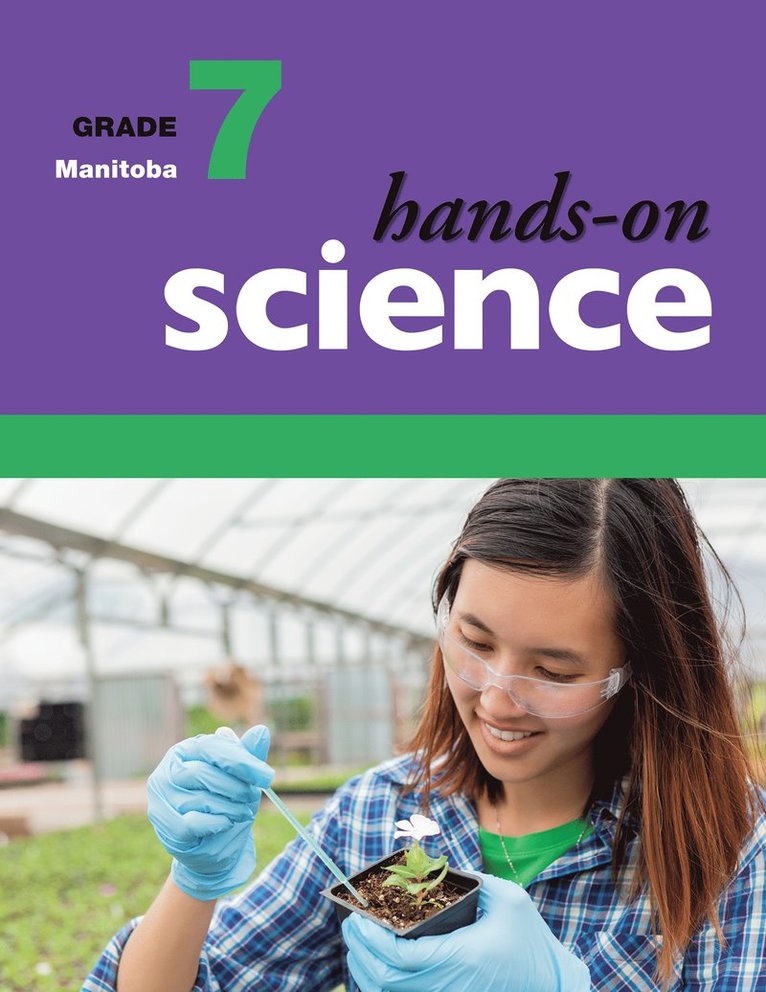
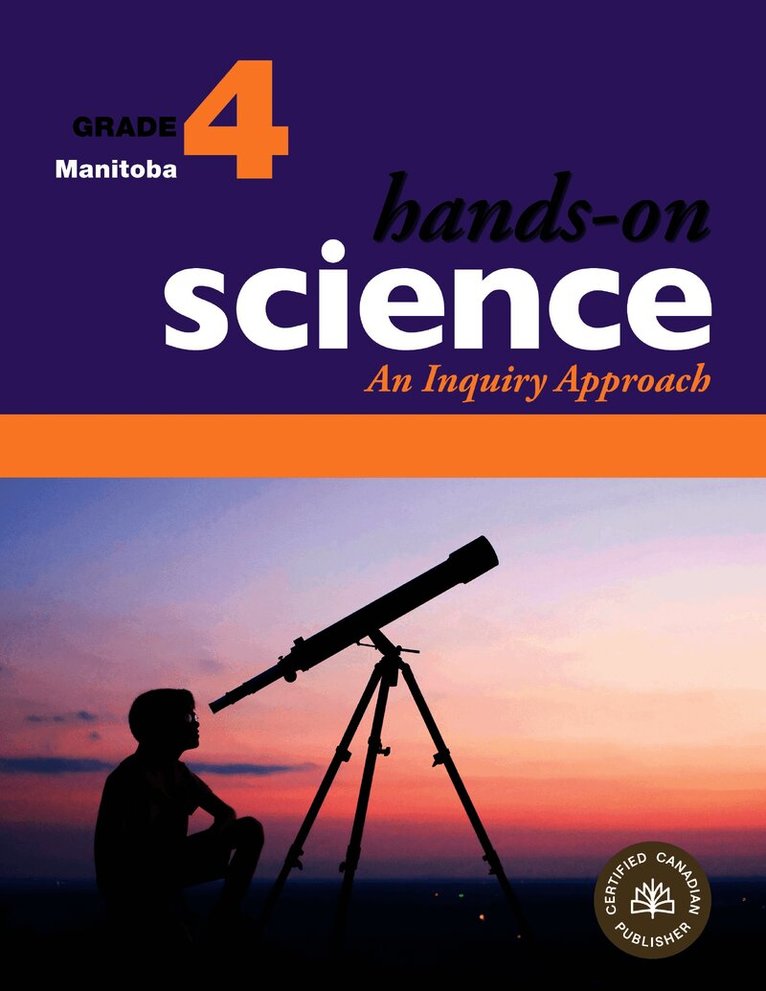
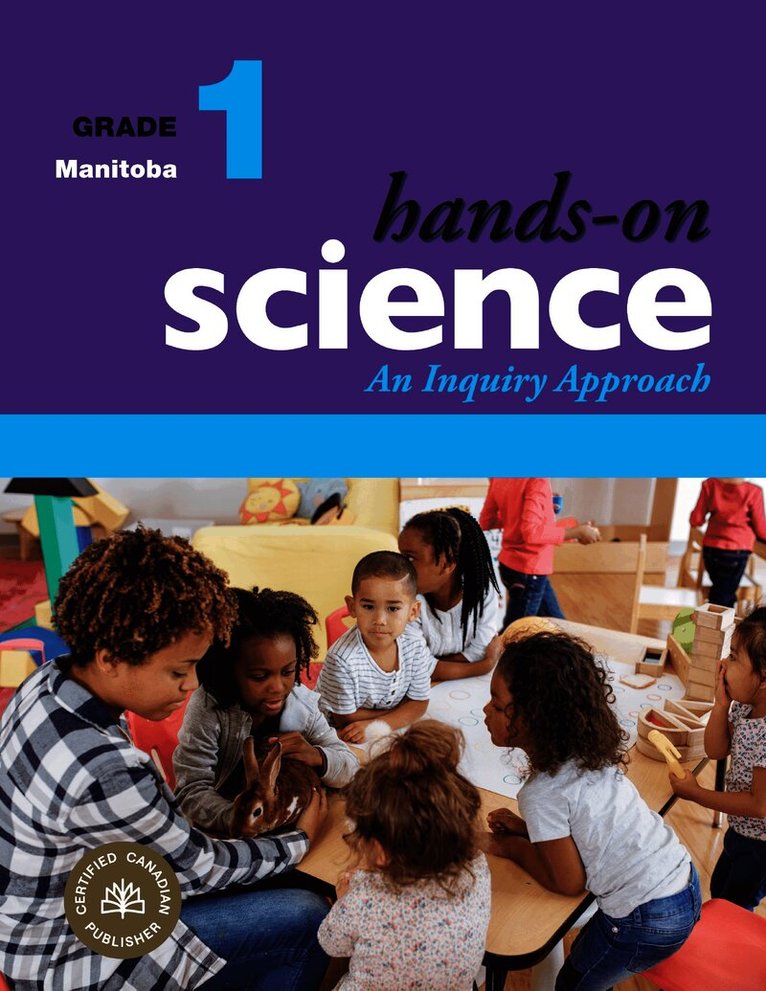
- Introduction to Hands-On Science for Manitoba, Grade 6 2Program Introduction 2The Foundations of Scientific Literacy 2Program Principles 2Program Implementation 3Program Resources 3Classroom Environment 6Timelines 6Classroom Management 6Classroom Safety 7Scientific Inquiry Skill: Guidelines for Teachers 7Observing 7Exploring 7Classifying 7Measuring 8Communicating, Analyzing, and Interpreting 8Predicting 11Inferring 11Inquiry Through Investigating and Experimenting 11Inquiry Through Research 11Online Considerations 12Addressing Students’ Literacy Needs 12Using the Design Press 12Developing Attitudes Related to Science, Technology, and Society 13Cultural Connections 13Indigenous Connections 13Technology 14Sustainability 14The Hands-On Science Assessment Plan 15Assessment for Learning 15Assessment as Learning 15Assessment of Learning 16Performance Assessment 16Portfolios 17An Important Note to Teachers 17Assessment Reproducibles 18Unit 1: Diversity of Living Things 29Introduction 30Curriculum Correlation Chart: Knowledge and Understanding Outcomes 33Curriculum Correlation Chart: Scientific Inquiry and Design Process Outcomes 34Resources for Students 37Websites and Online Videos 381 What Do We Know About the Diversity of Living Things? 402 How Can We Show Classification Systems in Different Ways? 483 How Is the Animal Kingdom Divided Up? 554 How Can We Compare and Contrast Animals? 695 What Can We Learn by Investigating an Arthropod Colony? 806 What Are Characteristics of Organisms in the Plant Kingdom? 917 How Do Living Things Adapt to Survive in Their Environment? 998 What Is a Fungus? 1099 What Can We Learn About Organisms Through a Pond Study? 11410 What Are Bacteria? 12811 What Can Fossils Tell Us About Life on Earth? 13312 Inquiry Project: How Can I Use the Design Process to Explore Diversity of Living Things? 150Unit 2: Flight 157Introduction 158Curriculum Correlation Chart: Knowledge and Understanding Outcomes 161Curriculum Correlation Chart: Scientific Inquiry and Design Process Outcomes 162Resources for Students 165Websites and Online Videos 1661 How Do Organisms and Other Objects Move Through Fluids? 1692 What Are the Properties of Fluids? 1803 What Are the Features of Lighter-Than-Air Flying Devices? 1924 What Is Bernoulli’s Principle? 2015 How Is Bernoulli’s Principle Used in the Design of Airplane Wings? 2086 What Are the Forces Affecting Flight? 2157 What Is Propulsion? 2258 How Are Unbalanced Forces Used to Steer Flying Devices? 2309 How Is Pneumatic Power Used in Flight? 23810 How Can We Design and Construct Model Aircraft to Meet Certain Criteria? 24411 How Do Aircraft and Spacecraft Compare? 25012 Inquiry Project: What Can We Learn About the Pioneers of Air and Space Travel? 253Unit 3: Electricity 259Introduction 260Curriculum Correlation Chart: Knowledge and Understanding Outcomes 263Curriculum Correlation Chart: Scientific Inquiry and Design Process Outcomes 264Resources for Students 267Websites and Online Videos 2681 What Do We know About Electricity? 2702 What Is Static Electricity? 2783 What Is Current Electricity? 2884 How Do We Get Electricity From Chemical Sources? 2945 How Do Electric Circuits Work? 3036 What Are Electrical Conductors and Insulators? 3107 How Do Electrical Switches Work? 3158 What Happens When We Use Multiple Batteries to Construct Parallel and Series Circuits? 3199 What Happens When We Use Multiple Light Bulbs to Construct Parallel and Series Circuits? 32410 How Can We Design and Construct an Electrical Device to Perform a Useful Function? 32911 How Can We Construct an Electromagnet? 33512 How Is Electricity Transformed into Motion in a Motor? 34013 How Is Motion Transformed into Electricity in a Generator? 34514 What Are Nonrenewable Sources of Energy? 35015 What Are Renewable Sources of Electrical Energy? 35516 How Do We Consume and Conserve Electrical Energy? 36217 Inquiry Project: What More Do I Want to Know About Electricity? 376Unit 4: The Solar System 381Introduction 382Curriculum Correlation Chart: Knowledge and Understanding Outcomes 385Curriculum Correlation Chart: Scientific Inquiry and Design Process Outcomes 387Resources for Students 390Websites and Online Videos 3921 What Do We Know About the Solar System? 3952 What Are the Features of Our Solar System? 4033 What Are the Characteristics of the Planets in Our Solar System? 4124 What Are the Characteristics of the Sun? 4215 Why Do We Experience a Day/Night Cycle? 4256 Why Do We Have a Year Cycle? 4317 How Can We Use the Sun to Tell Time? 4368 What Is the Surface of the Moon Like? 4409 What Are Gravity, Mass, and Weight? 44410 What Are the Phases of the Moon? 44911 What Is a Lunar Eclipse? 45612 What Can We Learn About Space Exploration? 46113 How Have Canadians Contributed to Space Science? 46614 How Has Space Exploration Contributed to Daily Life? 47115 What Are the Advantages and Disadvantages of Space Exploration? 47616 What Are Constellations? 48317 How Are Astronomy and Astrology Different? 49018 Inquiry Project: What More Do I Want to Know About the Solar System? 494References for Teachers 499About the Contributors 500Access Digital Resources 50