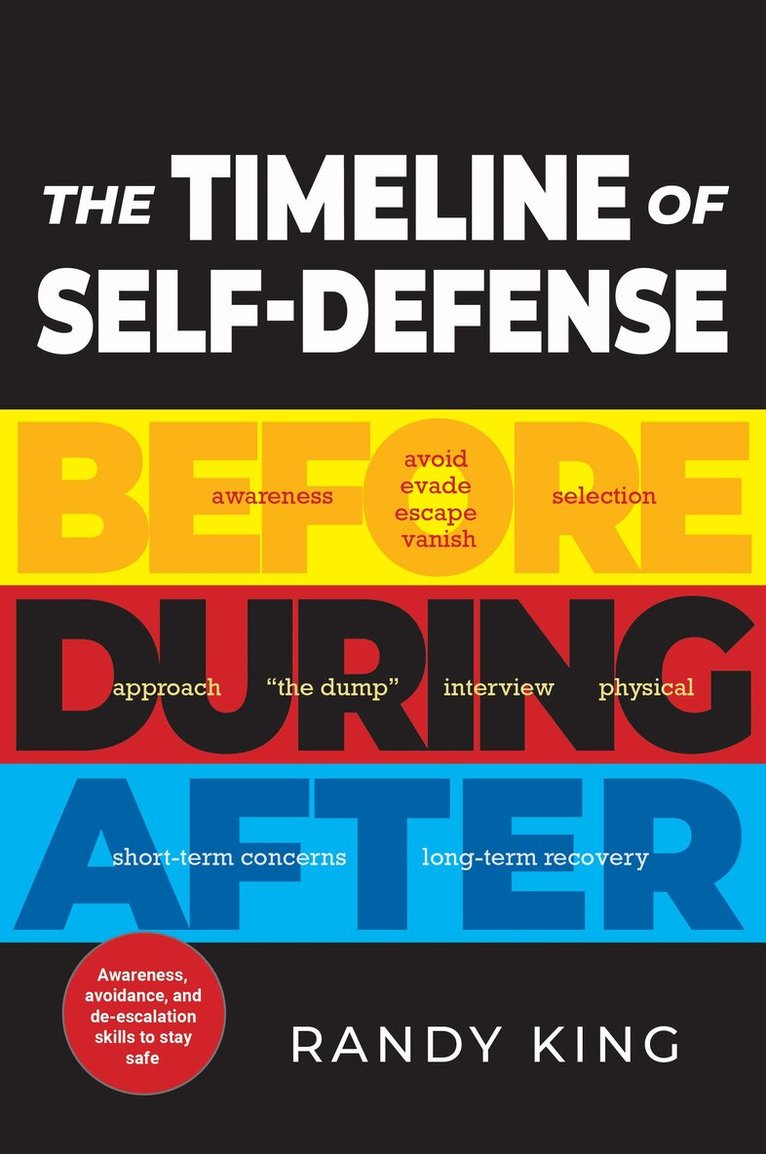
“I’ll let you in on a secret. A lot of top-end martial arts instructors have a ‘project student.’ Some kid who is basically hopeless. Unbelievably uncoordinated. Or maybe in a constant state of panic. Or maybe seemingly incapable of remembering almost anything. And the instructors, maybe for penance, put in endless effort. Never giving up.Randy does this, too. The unique thing, unlike all other instructors I’ve known, is that Randy’s project students get better. Not just at martial arts. They grow into amazing human beings.When evaluating an instructor, never bother looking at what he or she can do. Look for what the students can do. Randy’s students excel.Randy’s a good instructor. He’s also a good thinker. We’ve spent two months in a tiny car together, crossing the US and giving seminars. The ideas and talk never got stale, or boring. Or dumb, for that matter. (Stupid and silly sometimes but never dumb.) If I had an idea, he’d consider it, challenge it, research it, and almost always refine it into something better. Back and forth.Reading this book will be a lot like sitting down and having a conversation with one of the best thinkers in the self-defense world today.”—Rory Miller, author of Meditations on Violence, Facing Violence, Conflict Communication, Scaling Force, and others“If someone came to me and asked, ‘What self-defense book should I get, one that would really make me safer?’ I wouldn’t have to ask them what training they already have, what kinds of situations they find themselves in, or whom they need to protect themselves from. I would just tell them to grab The Timeline of Self-Defense: Before, During, After by Randy King.So, what makes this book any different from the countless other self-defense books out there?Organization—The layout and organization of this book, looking at violence and self- defense as a process that unfolds over time, allows the reader to make sense out of this seemingly random set of events.Comprehensive—This book covers violence, not just as physical acts, but as emotional and psychological acts as well. Cybercrime as a form of violence is there. Boundary breaching as a precursor to violence is there. How to recover after the violence has passed is there as well.Easy to digest—Most books get purchased and left on the shelf. Not this one. It’s fun to read. found myself sorry to reach the end; not because there was more to be said or something was missing, just because it is that well-written.So, why is this the one book you need, regardless of your skill level? Look at how it's put together, what’s in it, and how it tastes, and you’ll know why this is the book to have if self-defense is what you need.”—William Kennedy, Psy.D., clinical, forensic, and sports psychologist, hostage negotiation team member, 5th dan Chi-Mu Ryu Japanese Jujitsu, 2nd dan Judo, black-sash Hsing-I Chuan Kung-Fu, member of the Association of Threat Assessment Professionals (ATAP), member of the American Society of Industrial Security (ASIS), Situational Awareness Specialist (SAS)“If your personal protection plan focuses entirely on physical skills, you are at a great disadvantage. Fortunately, this book will help you incorporate avoidance and de-escalation strategies to prevent a physical altercation. Not all violence is avoidable, and physical skills are obviously important. However, actual violent encounters rarely occur the way they are presented in training. This book allows the reader to enhance their physical training with tools to manage adrenaline and respond effectively—this is where most available training ends. Randy, however, knows from personal hard-won experience that there are consequences that last long after the ‘fight’ is over. The Timeline of Self-Defense informs the reader of the short-term and long-term aftermath [of self-defense] including legal, emotional, and social ramifications and provides workable solutions to deal with these issues. This book helps fill the gaps present in most traditional training and will greatly enhance your personal protection plan. I would go as far as to say that if you are teaching anything labeled self-defense, this is mandatory reading.”—Kasey J. Keckeisen, Shihan 7th dan Katamedo Jujitsu, Executive Officer Ramsey County SWAT team“I highly recommend this book as it not only has broken out a complex topic into well-explained pieces, but it also gives you tools to apply this information. Additionally, Randy has one of the best breakdowns and approaches to situational awareness I have read. I highly recommend The Timeline of Self-Defense: Before, During, After.”—Richard (Rick) Bruce Wilson, 6th dan Uechi Ryu Karate-Jutsu, author of Now You See It, Now You Don't and Watch Out for the Pointy End“I’ve spoken with Randy King many times over the years, both on air and off. If you’ve listened to those episodes, you’ll know he has a knack for cutting through pretense and the testosterone-infused BS that sometimes pervades the ‘self-defense’ community. He doesn’t dress violence up. He doesn’t romanticize it. He truly treats violence as something traumatic, damaging and usually avoidable. That’s the tone of this book.There’s no mysticism, no cinematic fantasies, and no posturing. Just the realities of how violence develops, how people behave under pressure, and what it really takes to keep yourself or someone else safe.Chapters on selection dynamics, boundary-setting, and the way people get drawn into situations long before anything physical happens are especially useful for 99 percent of the population.He also doesn’t shy away from the aftermath. The shock, the confusion, the medical follow-up, the legal implications, the awkward conversations, and the way a single event can dominate the following years of someone’s life. All of that is handled plainly and earnestly. People who have never been exposed to real-world violence will come away with a clearer sense of just how strongly we must try to avoid it.If you’re a complete beginner, this book will give you a solid map. If you’re already in the field, you’ll find it’s a good corrective for the blind spots that creep in over time. Randy is one of the few voices in this space who consistently engages with the uncomfortable questions instead of trying to sell certainty.”—J. Saunders, host of the Managing Violence podcast and Secure Frequency podcast, author of Protecting the Faith among others“This book is the culmination of years of study, practice, failure, and retooling. I have watched and read Randy's work for decades and have seen the evolution of his ideas and methodology. He presents the material with a mix of stories and examples, with data and research that explains the complexity of what is going on. By opening the proverbial can of worms, he challenges the reader to question their assumptions. This is good. Complacency and tunnel-vision thinking has plagued the self-defense world. This dangerous trend has caused people to unwittingly assume that they ‘know’ what to do. Randy has expanded my conception of self-defense. The title of the book is very appropriate. The Timeline of Self-Defense is much more detailed than what has been presented in the past.As a martial artist who grew up in a traditional system, I have seen where we have excelled and where we have fallen short in terms of self-defense. Research and data have been there but bringing it all together and getting it organized has been a big challenge. Randy has approached it as an opportunity to bring clarity to the confusion. His writing is meant to be read by everyone. Regardless of your training or experience, this book is a great resource to have in your library. I intend to read and reread this book for years to come. The information presented is going to continue to evolve, and this book will be considered a benchmark. An essential read and resource for everyone who is in the self-defense world or who is interested in learning more.”—Balraj Dhaliwal, DC, 5th dan Tae Kwon Do“Too many self-defense books give instructions about how to be a badass, win bar fights, and impress people with your fighting prowess.This is not one of those books. Underscoring the truism that real warriors don’t look for fights, start fights, or brag about fights, The Timeline of Self Defense looks at the full context of self-protection and teaches us how to avoid combat rather than take our chances with the hands-on.Randy King has written this book based on decades of experience on the mat and in the rough and tumble and has done an excellent job of distilling his knowledge into something everybody can (and should) drink.”—Jason Brick, 6th dan Kenpo Karate, host of the Safest Family on the Block podcast“Reading The Timeline of Self-Defense felt less like studying a book and more like being guided, step by step, by someone who genuinely wants you to be safer, stronger, and empowered to take ownership of your own safety.From the very beginning, Randy sets the tone: self-defense is not simple, and it never was. He shows the full picture—the messy, unpredictable, human picture.What moved me most was how he lets the reader in through personal stories, hard-earned lessons, and the kind of honesty that can only come from surviving real violence. He brings the timeline of self-defense to life. His storytelling bridges the gap between theory and lived experience—turning concepts into something you can feel, remember, and may even see in a glimpse of recognition.Reflecting over The Timeline for Self-Defense, I found myself thinking that my world won’t change, but it will expand.—Terje Theiss, 3rd dan Jujitsu, 3rd dan Aikido, 3rd dan Kombatan Arnis, Co-creator of Street Sence Reality-Based Self-Defense Concept, author