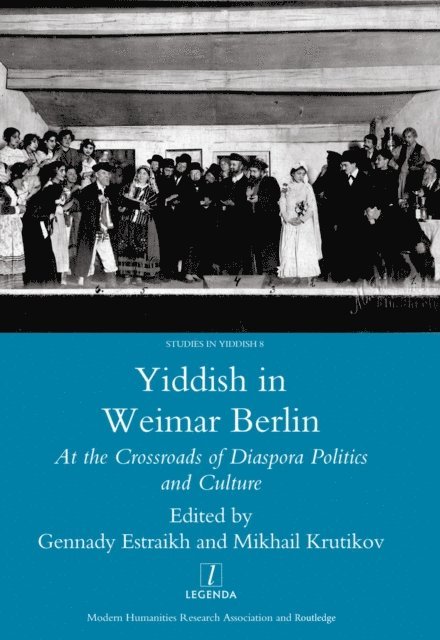
This volume includes contributions by an international team of leading scholars dealing with various aspects of history, arts and literature, which tell the dramatic story of Yiddish cultural life in Weimar Berlin as a case study in modern European culture.
In the 1920s, Yiddish was more than just a lingua franca for East European Jewish emigres; it was also a language of high culture, as demonstrated by a brilliant new book, Yiddish in Weimar Berlin: At the Crossroads of Diaspora Politics and Culture. -- The Arty Semite The Arty Semite To be commended for keeping alive the names, literary output, and civilization of a Yiddish world that is lost forever. -- Association of Jewish Libraries Reviews Association of Jewish Libraries Reviews There are many interesting articles in this volume. It is clear that in this brief period of flourishing Yiddish cultural activity there is much to disentangle. Berlin is a cultural and political hub in the Weimar period. An influx of multilingual Jews... enter a German Jewish world within a German world. Each of these 'migrants' arrives with existing cultural attachments into a war-time/post-war landscape which is signalling all kinds of modernisms. Some Yiddish writers in Berlin acknowledge the city in their literary work, others do not or only minimally. Berlin often emerges later once writers have moved elsewhere and begin to 'recreate their past'. -- Slavonic and East European Review Slavonic and East European Review
Innehållsförteckning
Introduction: Yiddish on the Spree 1. Deciphering the Hieroglyphics of the Metropolis: Literary Topographies of Berlin in Hebrew and Yiddish Modernism 2. A Yiddish Poet Engages with German Society: A. N. Stencl's Weimar Period 3. Like fires in overgrown forests': Moyshe Kulbak's Contemporary Berlin Poetics 4. Belarus in Berlin, Berlin in Belarus: Moyshe Kulbak's Raysn and Meshiekh ben-Efrayim between Nostalgia and Apocalypse 5. The air outside is bloody': Leyb Kvitko and his Pogrom Cycle 1919 6. A Warm Morning Gown and a Shawl from Berlin: Liebe Zaltsman's Yiddish Letters to Helene Koigen 7. The Berlin Bureau of the New York Forverts 8. Max Weinreich in Weimar Germany 9. Reports from the 'Republic Lear': David Eynhorn in Weimar Berlin 1920–24 10. Jewish Universalism, the Yiddish Encyclopedia, and the Nazi Rise to Power 11. Yiddish, the Storyteller, and German-Jewish Modernism: A New Look at Alfred Döblin in the 1920s 12. Between Literature and History: Israel Joshua Singer's Berlin Novel the Family Carnovsky as a Cul-de-Sac of the German-Jewish 'Symbiosis' 13. Unkind Mirrors: Berlin in Three Yiddish Novels of the 1930s