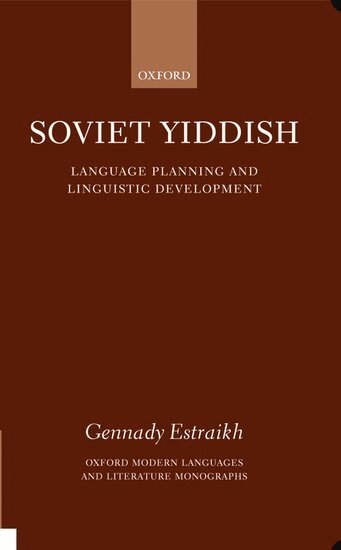
Inbunden, Engelska, 1999
Soviet Yiddish
Language-Planning and Linguistic Development
Del i serien Oxford Modern Languages and Literature Monographs
2924 kr
Beställningsvara. Skickas inom 10-15 vardagar. Fri frakt över 249 kr.
Beskrivning
This is the first comprehensive study of Yiddish in the former Soviet Union. A chronicle of orthographic and other reformsfrom the state of the language in pre-Revolutionary Russia, through active language-planning in the 1920s and 1930s, repression, and subsequent developments up to the 1980sis recreated from contemporary publications and archival materials. Later chapters draw on the author's own experience as a Yiddish writer and lexicographer in Moscow. At a time when the Bolshevik party's Jewish sections held an influential position, Yiddish attained a functional diversity without precedent in its history; but underlying contradictions between ideas expressed in the slogans `Proletarians of all countries, unite!' and `The right of nations to self-determination' led to extremes in language-planning. A golden mean was achieved after the 1934 Yiddish language conference in Kiev. Using contemporary literary works as a source of linguistic and sociolinguistic information, Gennady Estraikh charts the development of the resultant variety of the language, `Soviet Yiddish'; the effects of severe repression in the late 1930s and 1940s; and the subsequent decline in usage. Comparisons are drawn between Soviet Yiddish language-planning and concurrent reforms in Russian, Ukrainian, Belorussian, and German; and the features and types of Soviet Yiddish word-formation are analysed, notably univerbation, or compressing a phrase into one word.
Produktinformation
- Utgivningsdatum: 1999-02-04
- Mått: 144 x 224 x 18 mm
- Vikt: 384 g
- Format: Inbunden
- Språk: Engelska
- Serie: Oxford Modern Languages and Literature Monographs
- Antal sidor: 227
- Förlag: OUP OXFORD
- ISBN: 9780198184799
Utforska kategorier
Recensioner i media
Yiddish continues to interest both linguists and those among Russian Jews who prefer to stay in the country without being completely assimilated. Whether they will create another spoken variety of Yiddish or the Yiddish of their ancestors will be studied as a dead language, one thing is clear enough: no student of Soviet/Russian Yiddish will be able to do without Estraikh's book
Betyg & recensioner
0 recensioner
Inga recensioner tillgängliga.