Häftad, Engelska, 2022
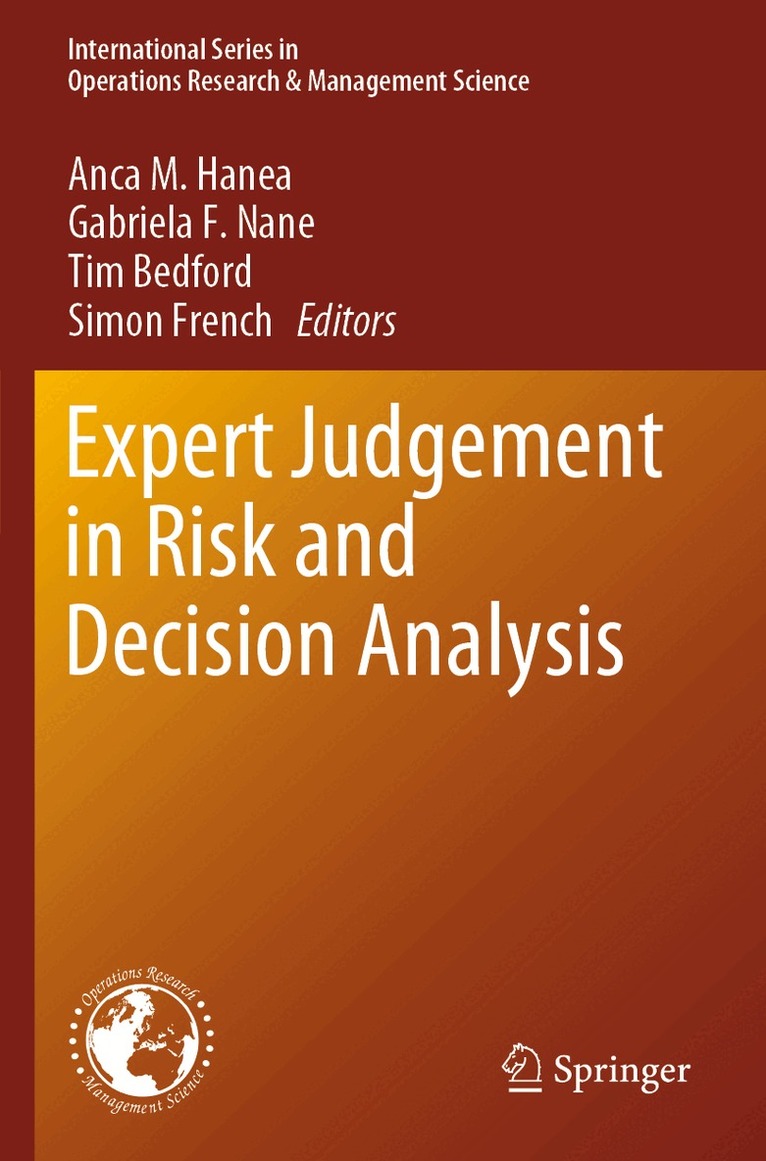
Expert Judgement in Risk and Decision Analysis
Av Anca M. Hanea, Gabriela F. Nane, Tim Bedford, Simon French
1687 kr
Beställningsvara. Skickas inom 10-15 vardagar. Fri frakt över 249 kr.
Beskrivning
This book pulls together many perspectives on the theory, methods and practice of drawing judgments from panels of experts in assessing risks and making decisions in complex circumstances. The book is divided into four parts: Structured Expert Judgment (SEJ) current research fronts; the contributions of Roger Cooke and the Classical Model he developed; process, procedures and education; and applications.After an Introduction by the Editors, the first part presents chapters on expert elicitation of parameters of multinomial models; the advantages of using performance weighting by advancing the “random expert” hypothesis; expert elicitation for specific graphical models; modelling dependencies between experts’ assessments within a Bayesian framework; preventive maintenance optimization in a Bayesian framework; eliciting life time distributions to parametrize a Dirichlet process; and on an adversarial risk analysis approach for structured expert judgment studies.The second part includes Roger Cooke’s oration from 1995 on taking up his chair at Delft University of Technology; one of the editors reflections on the early decade of the Classical Model development and use; a current overview of the theory of the Classical Model, providing a deep and comprehensive perspective on its foundations and its application; and an interview with Roger Cooke.The third part starts with an interview with Professor Dame Anne Glover, who served as the Chief Scientific Advisor to the President of the European Commission. It then presents chapters on the characteristics of good elicitations by reviewing those advocated and applied; the design and development of a training course for SEJ; and on specific experiences with SEJ protocols with the intention of presenting the challenges and insights collected during these journeys.Finally, the fourth (and largest) part begins with some reflections from Willy Aspinall on his many experiences in applying the Classical Model in several application domains; it continues with related reflections on imperfect elicitations; and then it presents chapters with applications on medicines policy and management, supply chain cyber risk management, geo-political risks, terrorism and the risks facing businesses looking to internationalise.
Produktinformation
- Utgivningsdatum: 2022-02-20
- Mått: 155 x 235 x 29 mm
- Vikt: 797 g
- Format: Häftad
- Språk: Engelska
- Serie: International Series in Operations Research & Management Science
- Antal sidor: 503
- Förlag: Springer Nature Switzerland AG
- ISBN: 9783030464769
Utforska kategorier
Betyg & recensioner
0 recensioner
Inga recensioner tillgängliga.