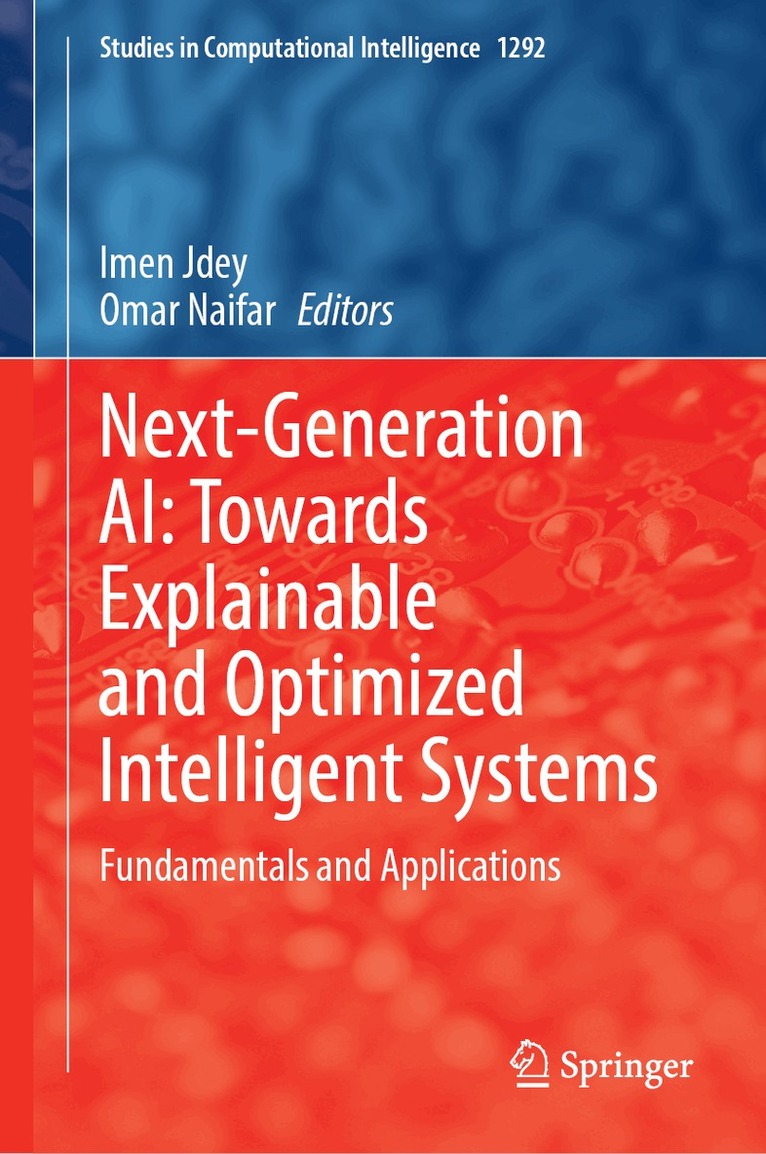
Inbunden, Engelska, 2026
Next-Generation AI: Towards Explainable and Optimized Intelligent Systems
Av Imen Jdey, Omar Naifar
2482 kr
Ej publicerad ännu
Beskrivning
This book addresses all three challenges in an integrated and principled way—offering researchers, engineers, and practitioners a coherent, application-driven resource that bridges theory and deployment. As AI systems move from research benchmarks into clinical workflows, industrial deployments, and everyday decision support, three imperatives have become central to responsible AI development: making systems genuinely explainable, privacy-compliant, and computationally efficient enough for real-world use.This book brings together fifteen original contributions from research teams spanning universities, engineering schools, and industrial R&D centres. Its defining feature is the explicit connection it draws between formal explainability theory and practical AI systems: rather than treating interpretability as a post-hoc concern, this book argues—and demonstrates—that genuine transparency must be built into system architecture from the outset, with neuro-symbolic integration positioned as its deepest available foundation.Organised into four thematically coherent parts, this book covers explainability from symbolic foundations through to applied clinical and agricultural systems; privacy-preserving learning via federated architectures, blockchain-secured aggregation, and differential privacy; model optimisation and efficient deployment through quantisation, hyperparameter search, and knowledge distillation; and generative AI with vision-language models, large language model-driven annotation, and multimodal plant disease detection.Application domains include dermatology, breast cancer diagnosis, dental imaging, diabetes prediction, smart agriculture, and natural language processing for medical text.The intended readership includes graduate students and researchers in artificial intelligence, machine learning, and biomedical engineering, as well as applied scientists and engineers seeking rigorous, deployable solutions to explainability, privacy, and efficiency challenges.This book is equally valuable as a reference for practitioners navigating regulatory requirements such as the EU AI Act and GDPR, where the distinction between apparent and verifiable transparency has direct legal and ethical significance.
Produktinformation
- Utgivningsdatum: 2026-11-24
- Mått: 155 x 235 x undefined mm
- Format: Inbunden
- Språk: Engelska
- Antal sidor: 316
- Förlag: Springer Nature Switzerland AG
- Serie: Studies in Computational Intelligence
- ISBN: 9783032283337
Utforska kategorier
Betyg & recensioner
0 recensioner
Inga recensioner tillgängliga.