Inbunden, Engelska, 2026
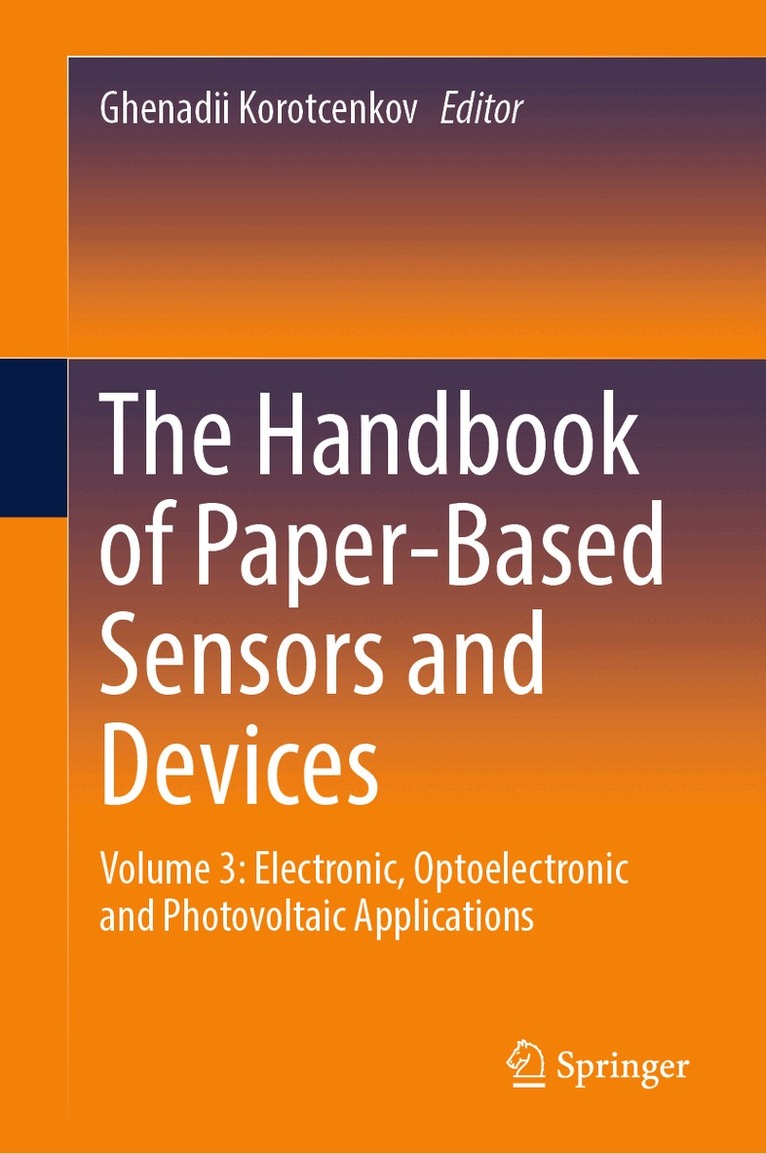
Handbook of Paper-Based Sensors and Devices
3032 kr
Ej publicerad ännu
Beskrivning
This collection on Electronic, Optoelectronic and Photovoltaic Applications is the third of a four-volume handbook that provides comprehensive and detailed consideration of all aspects of paper-based devices from the design and principles of their operation to the features of their production and application in electronics, optoelectronics and photovoltaics. The chapters of this volume demonstrate that using the specific properties of paper- and cellulose, it is possible to develop both passive elements of electronic and optoelectronic circuits and active devices such as field-effect transistors, photodetectors, light-emitting diodes, solar cells, memory devices, RFID tags, touchpads and keyboards. It is also shown that the chiral structure of cellulose exhibit unique optical properties, making them promising candidates for applications as photonic materials with specific optical functions, such as photonic inks, structural coloration, and light manipulation. The book presents also the latest achievements, highlights new perspectives and describes approaches based on the use of cellulose and paper in the development of green technologies and green electronics. Finally, the book highlights a number of challenges associated with developing paper-based sensors and devices. World renowned experts with extensive expertise in the development of paper-based optoelectronic, electronic and photovoltaic devices comprise the contributors to this collection. The Handbook of Paper-Based Sensors and Devices is an authoritative reference for materials scientists, biologists, physicians, and biochemical engineers as well as for chemical, biomedical, environmental, electronic engineers, working in R&D industry and academia. It further stands as a valuable teaching tool for university faculty and students working in biomaterials, electronics, optoelectronics, energy technologies, environment protection and remediation.
Produktinformation
- Utgivningsdatum: 2026-10-28
- Mått: 155 x 235 x undefined mm
- Format: Inbunden
- Språk: Engelska
- Antal sidor: 458
- Förlag: Springer Nature Switzerland AG
- ISBN: 9783032291660
Utforska kategorier
Betyg & recensioner
0 recensioner
Inga recensioner tillgängliga.