Beställningsvara. Skickas inom 10-15 vardagar. Fri frakt över 249 kr.
Beskrivning
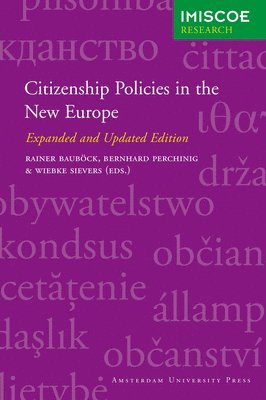
Citizenship Policies in the New Europe describes the citizenship laws in each of the twelve new countries as well as in the accession states Croatia and Turkey and analyses their historical background. Citizenship Policies in the New Europe complements two volumes on Acquisition and Loss of Nationality in the fifteen old Member States published in the same series in 2006.
Rainer Bauböck is Professor of Social and Political Theory at the European University Institute, Florence. Previous publications: Transnational Citizenship (1994), From Aliens to citizens (1994), The Challenge of Diversity (1996), Blurred Boundaries (1998), Migration and Citizenship (2006). Bernhard Perchinig is senior researcher at the Institute for European Integration Research at the Austrian Academy of Sciences. Wiebke Sievers is researcher at the Institute for Urban and Regional Research of the Austrian Academy of Sciences.
Recensioner i media
“Until now, the fast-growing literature on citizenship in Europe had largely neglected the recent accession countries. By extending the common framework of the NATAC study to the ‘new Europe’, this volume provides the first systematic comparison of these important cases, thus providing scholars and policymakers with a more complete and accurate picture of citizenship policies throughout the European Union.”-- Marc Morjé Howard, Georgetown University, Washington, D.C. “This book keeps up the high standard of its preceding volumes – sticking to the same structure, which allows direct comparisons to be made, and presenting richly illustrated histories of the development of citizenship in each case. I know of no other comparable collection that combines this breadth of coverage with the characteristic depth of analysis.”-- Mike Collyer, Sussex University, Brighton This book provides a detailed and unique analysis of citizenship policies in the countries of the most recent wave of EU enlargement, plus Turkey. The contributors provide deep insights into the complex histories of nationality in these countries, and the challenges they now face in managing national and ethnic identity issues, at a time when EU membership has also required a new cross-border coordination of policies. Martin Rhodes, Professor and Co-Director, Joseph Korbel School of International Relations, University of Denver, Colorado
Innehållsförteckning
Preface Introduction: Altneuländer or the vicissitudes of citizenship in the new EU states 1 New states and old concerns, or why there is not much plural citizenship in the Altneuländer 2 Old categories and new principles, or how ethnicity has trumped other grounds of citizenship 3 Old wrongs and new rights, or how to use citizenship to correct history 4 Conclusion: The historical past, the ethnic present and the immigrant future Annex: Constitutional preambles (extracts) PART I RESTORED STATES 1 Estonian citizenship: Between ethnic preferences and democratic obligations 2 Checks and balances in Latvian nationality policies: National agendas and international frameworks 3 Lithuanian nationality: Trump card to independence and its current challenges PART II STATES WITH HISTORIES OF SHIFTING BORDERS 4 Same letter, new spirit: Nationality regulations and their implementation in Poland 5 Kin-state responsibility and ethnic citizenship: The Hungarian case 6 Politics of citizenship in post-communist Romania: Legal traditions, restitution of nationality and multiple memberships 6 CITIZENSHIP POLICIES IN THE NEW EUROPE 7 The politics of Bulgarian citizenship: National identity, democracy and other uses PART III POST-PARTITION STATES 8 Czech citizenship legislation between past and future 9 The Slovak question and the Slovak answer: Citizenship during the quest for national self-determination and after 10 From civic to ethnic community? The evolution of Slovenian citizenship 11 Croatian citizenship: From ethnic engineering to inclusiveness PART IV MEDITERRANEAN POST-IMPERIAL STATES 12 Malta’s citizenship law: Evolution and current regime 13 Nationality and citizenship in Cyprus since 1945: Communal citizenship, gendered nationality and the adventures of a post-colonial subject in a divided country 14 Changing conceptions of citizenship in Turkey 8 CITIZENSHIP POLICIES IN THE NEW EUROPE ‘A call to kinship’? Citizenship and migration in the new Member States and the accession countries of the EU 1 Excluding long-term residents and their descendants: Initial determination of citizenship in Estonia, Latvia, Slovenia and Croatia 2 Reaching out to emigrants and expatriates: Restitution laws, dual nationality and status laws 3 Excluding recent immigrants: Naturalisation requirements 4 Conclusions, List of contributors.