Angela Woods - Böcker
Visar alla böcker från författaren Angela Woods. Handla med fri frakt och snabb leverans.
10 produkter
10 produkter
943 kr
Skickas inom 5-8 vardagar
Voice-hearing experiences associated with psychosis are highly varied, frequently distressing, poorly understood, and deeply stigmatised, even within mental health settings. Voices in Psychosis responds to the urgent need for new ways of listening to and making sense of these experiences. It brings multiple disciplinary, clinical, and experiential perspectives to bear on an original and extraordinarily rich body of testimony: transcripts of forty in-depth phenomenological interviews conducted with people who hear voices and who have accessed Early Intervention in Psychosis services.The book addresses the social, clinical, and research contexts in which the interviews took place, thoroughly investigating the embodied, multisensory, affective, linguistic, spatial, and relational qualities of voice-hearing experiences. The nature, politics, and consequences of these analytic endeavours is a focus of critical reflection throughout. Each chapter gives a multifaceted insight into the experiences of voice-hearers in the North East of England and to their wider resonance in contexts ranging from medieval mysticism to Amazonian shamanism, from the nineteenth-century novel to the twenty-first century survivor movement.By deepening and extending our understanding of hearing voices in psychosis in a striking way, the book will be an invaluable resource not only for academics in the field, but for mental health practitioners and members of the voice-hearing community.An open access title available under the terms of a CC BY-NC-ND 4.0 International licence.
1 224 kr
Skickas inom 7-10 vardagar
Schizophrenia has been one of psychiatry's most contested diagnostic categories. It has also served as a metaphor for cultural theorists to interpret modern and postmodern understandings of the self. These radical, compelling, and puzzling appropriations of clinical accounts of schizophrenia have been dismissed by many as illegitimate, insensitive and inappropriate. Until now, no attempt has been made to analyse them systematically, nor has their significance for our broader understanding of this most 'ununderstandable' of experiences been addressed. The Sublime Object of Psychiatry is the first book to study representations of schizophrenia across a wide range of disciplines and discourses: biological and phenomenological psychiatry, psychoanalysis, critical psychology, antipsychiatry, and postmodern philosophy. In part one, Woods offers a fresh analysis of the foundational clinical accounts of schizophrenia, concentrating on the work of Emil Kraepelin, Eugen Bleuler, Karl Jaspers, Sigmund Freud and Jacques Lacan. In the second part of the book, she examines how these accounts were critiqued, adapted, and mobilised in the 'cultural theory' of R D Laing, Thomas Szasz, Gilles Deleuze, Félix Guattari, Louis Sass, Fredric Jameson and Jean Baudrillard. Using the aesthetic concept of the sublime as an organising framework, Woods explains how a clinical diagnostic category came to be transformed into a potent metaphor in cultural theory, and how, in that transformation, schizophrenia came to be associated with the everyday experience of modern and postmodern life. Susan Sontag once wrote: 'Any important disease whose causality is murky, and for which treatment is ineffectual, tends to be awash in significance'. The Sublime Object of Psychiatry does not provide an answer to the question 'What is schizophrenia?', but instead brings clinical and cultural theory into dialogue in order to explain how schizophrenia became 'awash in significance'.
254 kr
Skickas inom 10-15 vardagar
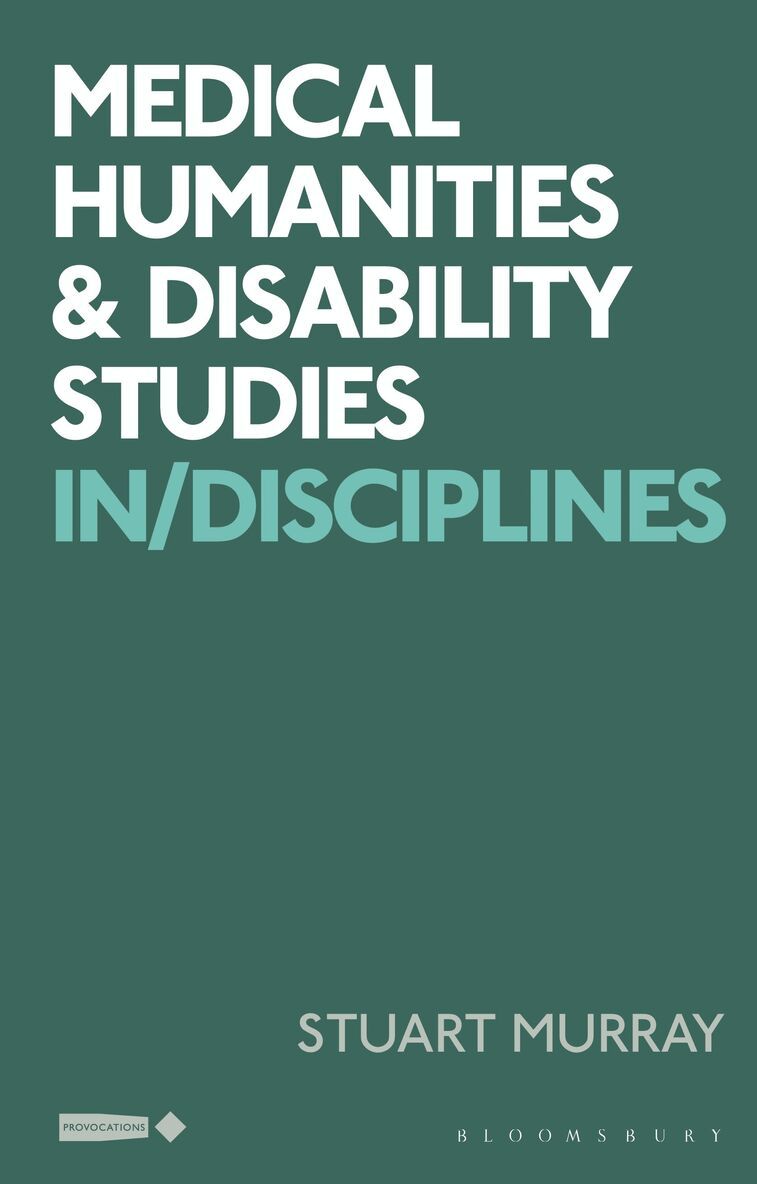
Medical humanities and disability studies are disciplines at the cutting edge of innovative critical work in the study of health and disability, but to date there has been no book-length examination of the relationship between the two. Although each has emerged from different heritages, they share many features, from discussing the complexities of embodiment, identifying processes of exclusion and championing user participation, to a commitment to new forms of critical writing.In/Disciplines explores the connections between the two disciplines in detail. It presents a series of provocations about how they interact, the forms their practice take, and their strengths and weaknesses as working methods. With a focus on life stories that give accounts of health and disability experiences, it mixes creative and critical writing in an accessible manner aimed at a wide audience in both Medical Humanities and Disability Studies, and across new humanities more widely. The book asserts that both disciplines need to evaluate and challenge core assumptions if they are to remain critically relevant in the evolving study of social and cultural understanding of health and disability.
210 kr
Skickas inom 7-10 vardagar
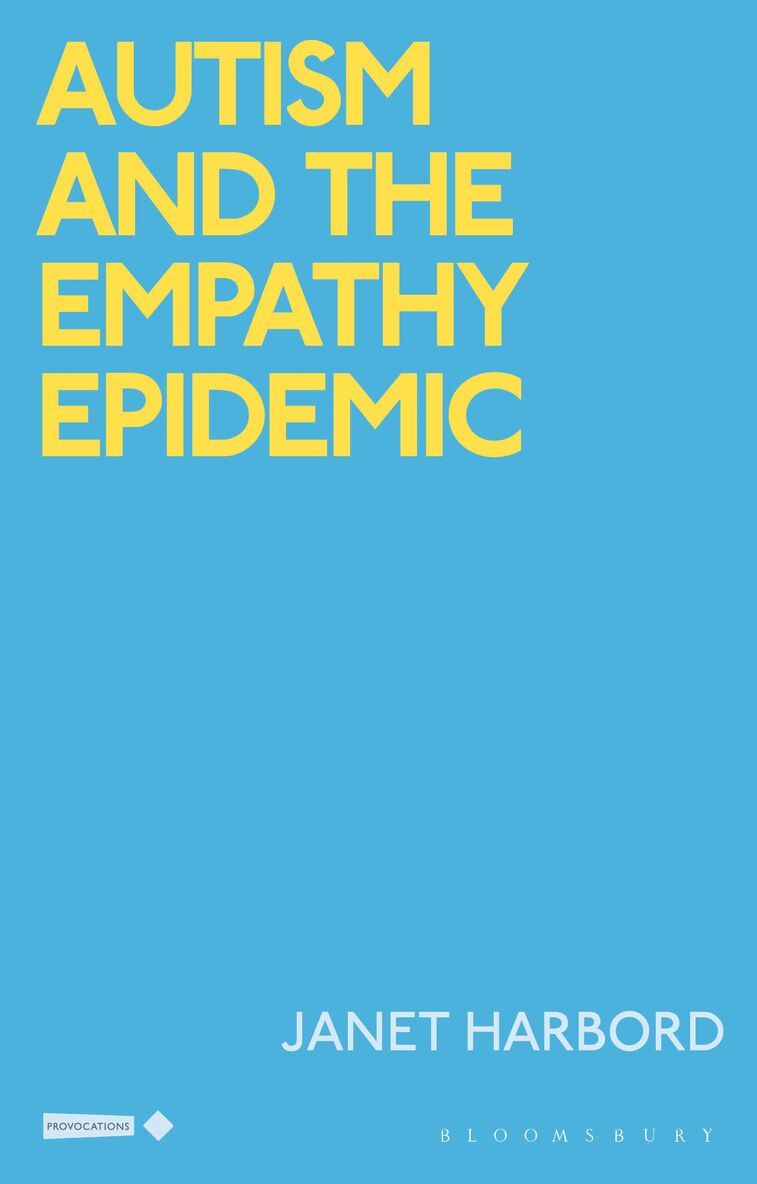
Threading an enquiry through debates in neurodiversity scholarship and disability studies as well as film theory, this open access book challenges the widespread idea that autism is an epidemic characterised predominantly by a deficit of empathy, arguing that the reverse is true: we are living through an empathy epidemic in which autism is the outcast. In 1908, the British psychologist, Edward Titchener, translated the German term Einfühlung into the English language as ‘empathy’, around the same time that Eugen Bleuler coined the term ‘autism’ for a group of symptoms subset to an emerging classification of schizophrenia. Empathy became a useful tool to describe relations between people in a clinical context, but in the process of its incorporation into psychology, it shed its rich sensory meaning from Einfühlung as ‘feeling-into’ weather systems, architectural forms, and artworks. A remarkable reversal takes place in the first part of the twentieth century whereby empathy becomes an intra-human ethical act, and autism emerges as its inverse. Digging up and examining the buried relation between autism with an earlier form of ‘empathy’, this book argues that autism, like cinema, models an ethical apprehension of the more-than-human world.The eBook editions of this book are available open access under a CC BY-NC-ND 4.0 licence on bloomsburycollections.com. Open access was funded by The Wellcome Trust.
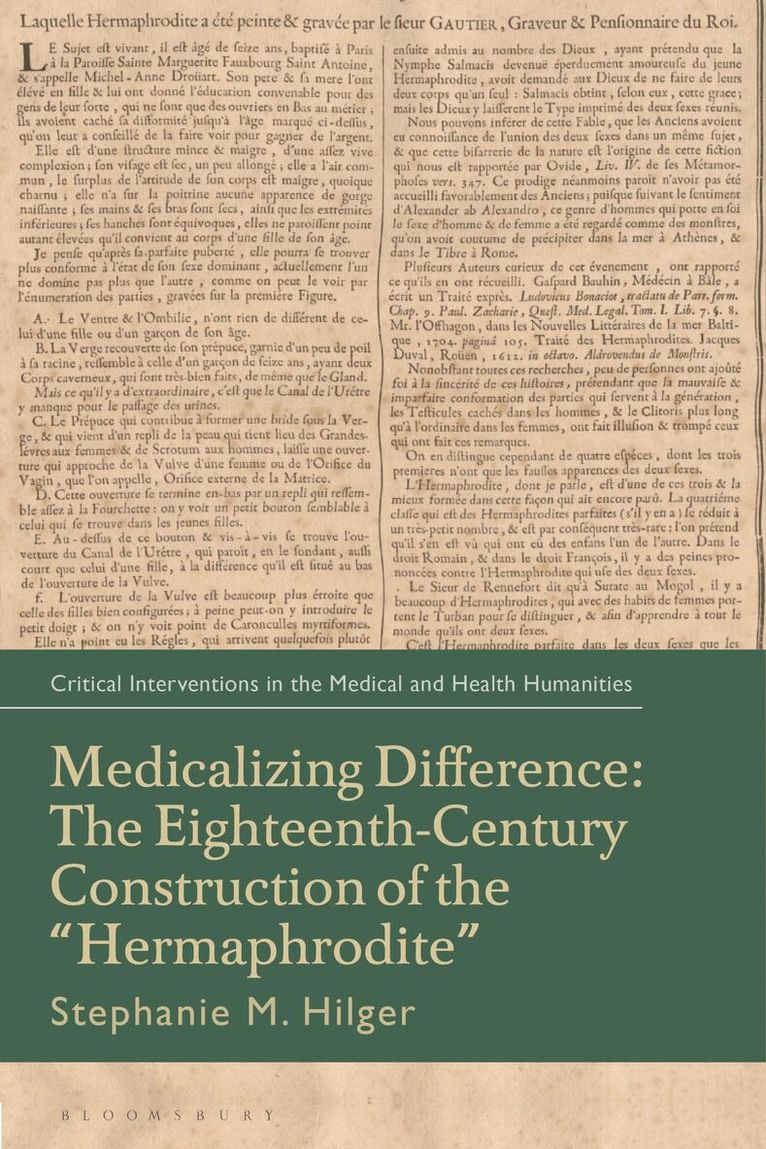
Medicalizing Difference
The Eighteenth-Century Construction of the "Hermaphrodite"
Häftad, Engelska, 2026
557 kr
Kommande
Exploring 18th-century medicine’s construction of individuals with non-standard sexual anatomy as “hermaphrodites”, this book focuses on the genre of the case history from three different languages and national contexts—British, French, and German. Medicalizing Difference examines case studies written about Anne Grandjean, Michel Anne Drouart, Maria Dorothea Derrier, and an unnamed “Angolan hermaphrodite.” Multiple case studies were published about each of these individuals and are discussed throughout the book's four chapters, each of which focuses on one momentous epistemological shift in the eighteenth-century: an increasing focus on empiricism and the related professionalization of medicine, the expanding market for popular scientific literature, changing notions about generation and reproduction, and the exploration of foreign territories.This book reads these case histories against the grain and historicizes 18th-century medicine’s construction of the category of the “hermaphrodite”, demonstrating that, rather than describing a fact, these histories created their subject of study
220 kr
Kommande
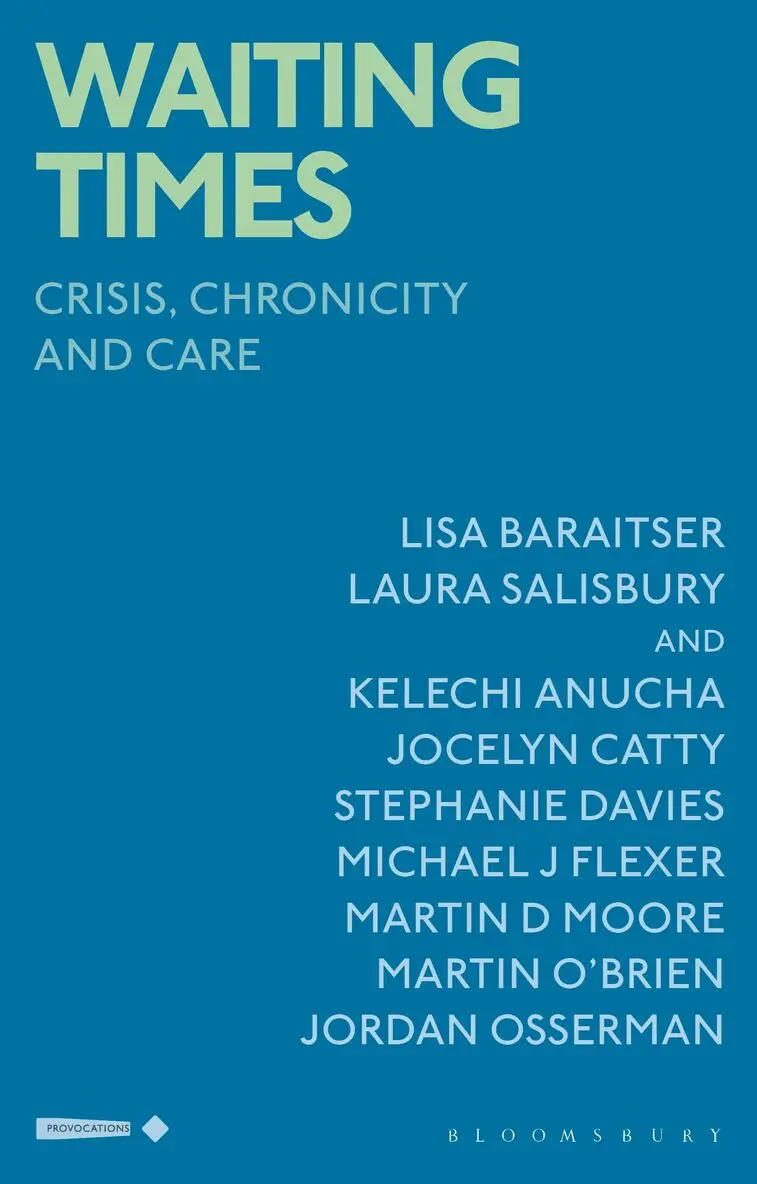
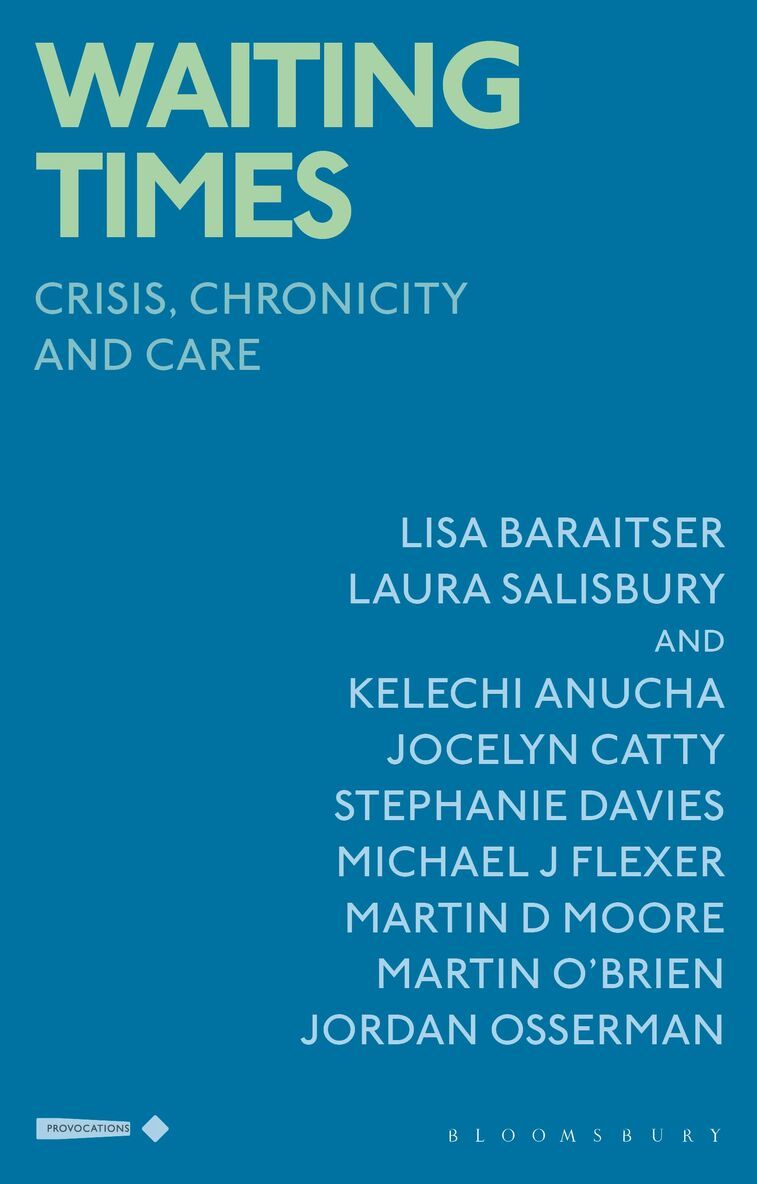
In a world characterised by ‘poly crisis’, two major crises stand out: a crisis of time and a crisis of care. This open access book investigates what it means to wait in and for healthcare in an era when care is politicised and rationed and time is lived at increasingly different and complex tempos. Waiting times within the UK National Health Service (NHS) have been at historic levels through and since the Covid-19 pandemic. Although this sense of a crisis of waiting is culturally and historically specific, it casts important light on the ‘crisis’ of welfare structures across the Global North. Such a crisis in waiting times brings both a call for judgment and a call to action.This book argues that all healthcare entails waiting and other forms of elongated time, such as pausing to observe, staying alongside patients at end of life, or stopping treatment as an ethical intervention. Instead of trying to 'solve' the crisis of the NHS by moving people more quickly through the system, reallocating time to address ‘shortfalls’ to reduce waits to access care, or even abandoning the social commitment to a universal service, the authors argue that it is vital to pay attention, first, to how time and care continue to be made in the current system. It is only by reckoning with the essential ‘untimeliness’ of care that we might then be able to conceptualise interventions in the NHS that are ‘timely’ and that sustain its social mission.The ebook editions of this book are available open access under a CC BY-NC-ND 4.0 licence on bloomsburycollections.com. Open access was funded by The Wellcome Trust.
720 kr
Kommande
In a world characterised by ‘poly crisis’, two major crises stand out: a crisis of time and a crisis of care. This open access book investigates what it means to wait in and for healthcare in an era when care is politicised and rationed and time is lived at increasingly different and complex tempos. Waiting times within the UK National Health Service (NHS) have been at historic levels through and since the Covid-19 pandemic. Although this sense of a crisis of waiting is culturally and historically specific, it casts important light on the ‘crisis’ of welfare structures across the Global North. Such a crisis in waiting times brings both a call for judgment and a call to action.This book argues that all healthcare entails waiting and other forms of elongated time, such as pausing to observe, staying alongside patients at end of life, or stopping treatment as an ethical intervention. Instead of trying to 'solve' the crisis of the NHS by moving people more quickly through the system, reallocating time to address ‘shortfalls’ to reduce waits to access care, or even abandoning the social commitment to a universal service, the authors argue that it is vital to pay attention, first, to how time and care continue to be made in the current system. It is only by reckoning with the essential ‘untimeliness’ of care that we might then be able to conceptualise interventions in the NHS that are ‘timely’ and that sustain its social mission.The ebook editions of this book are available open access under a CC BY-NC-ND 4.0 licence on bloomsburycollections.com. Open access was funded by The Wellcome Trust.
1 617 kr
Kommande
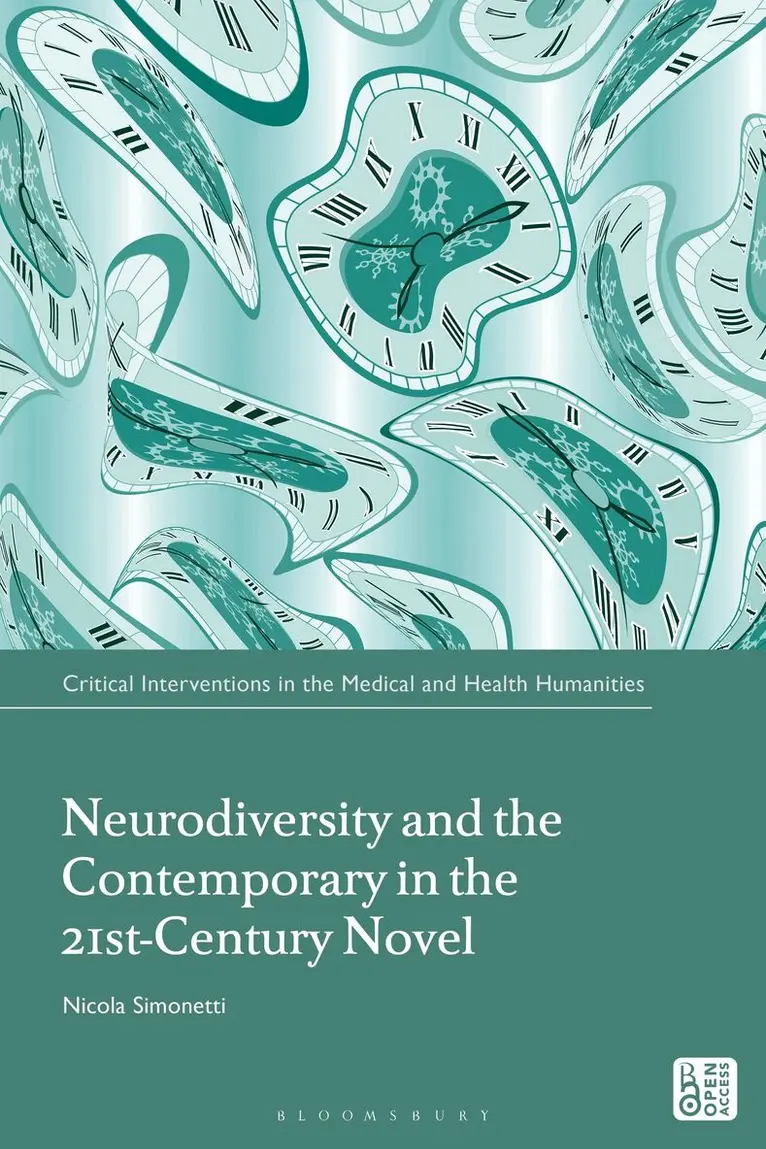
Offering a provocative analysis of neurodivergent and twenty-first-century perspectives on time and some of its cultural expressions, this open access book is the first comparative study of the intersections between neurodiversity and the evolving field of Contemporary Studies.Blending literary close reading and sociological discourse analysis, the book turns to fiction for the strategic insights it can offer into cultural imaginaries of neurodiversity and time. With a focus on twenty-first-century novels from authors such as Jonathan Safran Foer, Lisa Genova, John Wray, and Julie Dachez, it interrogates the entanglements between categories of crip time and the contemporary, examines the processes of exclusion governing neurodivergence construction, and advocates for a new vocabulary demonstrating the role of contemporary neuroinclusive perspectives in twenty-first-century epistemological processes.The ebook editions of this book are available open access under a CC BY 4.0 licence on bloomsburycollections.com. Open access was funded by the Wellcome Trust.
623 kr
Skickas
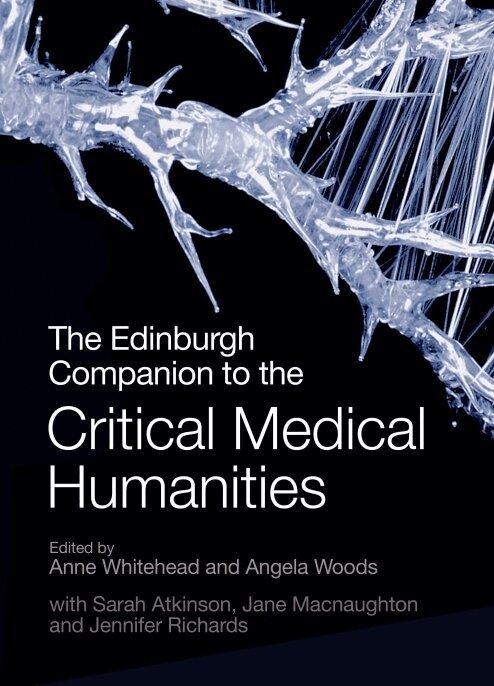
In this landmark Companion, expert contributors from around the world map out the field of the critical medical humanities. This is the first volume to introduce comprehensively the ways in which interdisciplinary thinking across the humanities and social sciences might contribute to, critique and develop medical understanding of the human individually and collectively. The thirty-six newly commissioned chapters range widely within and across disciplinary fields, always alert to the intersections between medicine, as broadly defined, and critical thinking. Each chapter offers suggestions for further reading on the issues raised, and each section concludes with an Afterword, written by a leading critic, outlining future possibilities for cutting-edge work in this area. Topics covered in this volume include: the affective body, biomedicine, blindness, breath, disability, early modern medical practice, fatness, the genome, language, madness, narrative, race, systems biology, performance, the postcolonial, public health, touch, twins, voice and wonder. Together the chapters generate a body of new knowledge and make a decisive intervention into how health, medicine and clinical care might address questions of individual, subjective and embodied experience.
4 884 kr
Skickas inom 3-6 vardagar
Original critical engagements at the intersection of the biomedical sciences, arts, humanities and social sciencesIn this landmark Companion, expert contributors from around the world map out the field of the critical medical humanities. This is the first volume to comprehensively introduce the ways in which interdisciplinary thinking across the humanities and social sciences might contribute to, critique and develop medical understanding of the human individually and collectively. The thirty-six newly commissioned chapters range widely within and across disciplinary fields, always alert to the intersections between medicine, as broadly defined, and critical thinking. Each chapter offers suggestions for further reading on the issues raised, and each section concludes with an Afterword, written by a leading critic, outlining future possibilities for cutting-edge work in this area.Key FeaturesOffers an introduction to the second wave of the field of the medical humanitiesPositions the humanities not as additive to medicine but as making a decisive intervention into how health, medicine and clinical care might think about individual, subjective and embodied experienceExemplifies the commitment of the critical medical humanities to genuinely interdisciplinary thinking by stimulating multi-disciplinary dialogue around key areas of debate within the fieldPresents thirty-six original chapters from leading and emergent scholars in the field, who are defining its new critical edge