Arvind Panagariya – författare
Visar alla böcker från författaren Arvind Panagariya. Handla med fri frakt och snabb leverans.
19 produkter
19 produkter
Inbunden, Engelska, 2015
1 112 kr
Skickas inom 5-8 vardagar
Growth miracles typically have been studied at the country level. The Making of Miracles in Indian States breaks from that tradition and studies three growth miracles in India at the level of the state: Andhra Pradesh, Bihar, and Gujarat. These are three of the largest and most diverse states in India. Andhra Pradesh is situated in the south of India, Bihar in the east, and Gujarat in the west. Bihar is the poorest among all states in India, Gujarat the third richest among the largest eighteen states, and Andhra Pradesh in the middle. Andhra Pradesh and Gujarat have long coastal lines while Bihar is landlocked. Yet, all of these states have grown at rates exceeding 8% for an entire decade in the 21st century.Despite many differences in the initial conditions, several common threads tie the high-growth experiences of the three states. First, accelerated growth has permitted acceleration in the growth of development expenditures in all three states, which has helped improve connectivity to markets. Alongside this growth, poverty has seen accelerated decline. Second, the composition of growth matters. Growth in high-value commodities such as fruits and vegetables, commercial crops, dairy, and animal husbandry in Andhra Pradesh and Gujarat has led to accelerated reduction in rural poverty. However, the failure of labor-intensive industry has stunted the migration of workers out of agriculture into industry. Third, the quality of leadership that brings improved governance with it is central to improved outcomes in the states. Visionary leaders---Chandrababu Naidu in Andhra Pradesh, Nitish Kumar in Bihar, and Narendra Modi in Gujarat---played critical roles in the making of all three miracles. Fourth, the three studies also bring out the importance of pro-market reforms and the adoption of technology in development. Finally, the studies show that good economics is also good politics: voters reward the chief ministers who bring about significant improvement to the people's lives.
Inbunden, Engelska, 2019
592 kr
Skickas inom 5-8 vardagar
Arguments for protection and against free trade have seen a revival in developed countries such as the United States and Great Britain as well as developing countries such as India. Given the clear benefits trade openness has brought everywhere, this is a surprising development. The benefits of free trade are especially great for emerging market economies. FreeTrade and Prosperityoffers the first full-scale defense of pro-free-trade policies with developing countries at its center. Arvind Panagariya, a professor at Columbia University and former top economic advisor to the government of India, supplies a historically informed analysis of many longstanding but flawed arguments for protection. He starts with an insightful overview of the positive case for free trade, and then closely examines the various contentions of protectionists. One protectionist argument is that "infant" industries need time to grow and become competitive, and thus should be sheltered. Other arguments are that emerging markets are especially prone to coordination failures, they are in need of diversification of their production structures, and they suffer from market imperfections. The panoply of protectionist arguments, including those for import substitution industrialization, fails when subject to close logical and empirical scrutiny. Free trade and outward-oriented policies are preconditions to both sustained rapid growth and poverty alleviation in developing countries. Panagariya provides compelling evidence demonstrating the failures of protectionism and the promise of free trade using detailed case studies of successful countries such as Singapore, Taiwan, South Korea, China and India. Low or declining barriers to free trade and high or rising shares of trade in total income have been key elements in the sustained rapid growth and poverty alleviation in these countries and many others. Free trade is like oxygen: the benefits are ubiquitous and not noticed until they are no longer there. This important book is an essential reminder of the costs of protectionism.
Inbunden, Engelska, 2020
424 kr
Skickas inom 5-8 vardagar
With a GDP that just reached $2.6 trillion, India is poised to become the world's third largest economy in less than a decade. In doing so, it will have moved one step closer to reclaiming its pre-industrial glory when it accounted for one-sixth of the global output and ranked second in economic size. This rapid movement in the absolute size of the economy will be insufficient, however, to bring prosperity to India's vast population. Today, 44% of the country's workforce remains in agriculture and another 42% in small enterprises with fewer than twenty workers. Labor productivity of both sets of workers remains low and they live overwhelmingly on subsistence-level incomes. In New India: Reclaiming the Lost Glory, Arvind Panagariya outlines a concise strategy to transform India from a primarily rural and agricultural economy to an urban and industrial economy with well-paid jobs for those with limited skills. Panagariya argues that the creation of good jobs requires the emergence of medium and large enterprises in industry and services, especially labor-intensive sectors such as apparel, footwear, and other light manufactures. He explains that India needs policies conducive to the growth of firms from small to medium, medium to large, and large to larger still. Such policies include greater outward orientation; more flexible land, labor, and capital markets; concerted effort to improve the quality of higher education; faster urbanization; and improved governance at all levels.Written by a preeminent authority on the Indian economy, New India: Reclaiming the Lost Glory provides a data-driven and persuasive roadmap for India to eliminate abject poverty, accelerate economic growth, and return to its historically prominent position in the global economy.
Inbunden, Engelska, 2024
422 kr
Kommande
India's economic model underwent transformational change following independence in 1947. The country's first Prime Minister, Jawaharlal Nehru, embarked upon two foundational projects to build modern India: a political project aimed at establishing democracy with universal suffrage, and an economic one aimed at ending poverty. Three-quarters of a century later, his political project is a resounding success, but the opposite is true of the economic one.The Nehru-Era Economic History and Thought & Their Lasting Impact examines the evolution of Nehru's economic philosophy with socialism, self-sufficiency, and heavy-industry development at its core. Through extensive archival research, Arvind Panagariya reconstructs and reinterprets this history, paying particular attention to the administrative processes deployed to implement policies, contemporary economic thought, and important historical events not adequately covered in the existing literature. He assesses the evolution of Nehru's own political beliefs and the construction of the Nehru development model, the resulting regime and exclusionary nature of economic growth, and the lasting intellectual legacy of the Nehru-era socialism on politicians, civil servants, policy analysts, and businesspeople in the six decades since Nehru's death.This book is the fascinating tale of a model with the near-unanimous approval of experts from all around the world at its inception and the impact of its failure.
Inbunden, Engelska, 2014
1 059 kr
Skickas inom 5-8 vardagar
Most discussions of India's substantive economic growth since the 1990s tend to focus on national level statistics or on particular sectors such as the financial and call service sectors or on the pharmaceutical industry. But with a population of 1.2 billion, India demands to be treated like a collection of individual "countries, " rather than a unified nation. Ten of its states have populations equaling or exceeding that of the United Kingdom. If the state of Uttar Pradesh were a country, it would be the fourth largest, behind China, India, and the United States. These facts pointedly tell us that if we are to understand the ongoing experiment in economic reforms and poverty alleviation, we must study India at the level of the state.In this spirit, State Level Reforms and Growth and Development in Indian States provides the first-ever comprehensive analysis of growth at the highly diverse state level. The authors argue that when the national government loosened its stronghold on industry and services, state governments were able to shape the fortunes of their citizens through state-level policy reforms. Because of this, every Indian state experienced accelerated growth, unlike China during the first two decades of its development when the eastern half flourished as the western half lagged. Every Indian state has grown faster in the last decade than any other decade in the post-independence era. In fact, some of the poorest states, notably Bihar and Orissa, have been growing the fastest.Professors Panagariya and Chakraborty and Dr. Rao refute the common assumptions that growth has not occurred or that poverty has not been reduced in all Indian states. The recent reforms have also led to improved access in every state to basic amenities such as permanent houses, electricity, water, and sanitation. These accomplishments notwithstanding, regional inequality on a per capita basis has grown as well. Reforms in state-controlled sectors such as agriculture, industry, healthcare, and education have not advanced as far as some analysts previously predicted. The authors outline the reforms in these areas and draw on the experience of states that have successfully carried out some of them. The authors pay special attention to reforms in the areas of education and health while recognizing that the Indian constitution vests in the states much of this legislative and other authority and while considering the real absolute rise in income, literacy, and health status across all the states.
Inbunden, Engelska, 2012
838 kr
Skickas inom 5-8 vardagar
When India embraced systematic economic reforms in 1991 and began opening its economy to both domestic and foreign competition, critics argued that they had contributed little to the acceleration of economic growth. Their argument had rested on the claim that growth in the 1990s was no faster than in the 1980s. This claim was quickly refuted on the grounds that when properly evaluated, growth had indeed accelerated in the 1990s and, more importantly, while reforms had been made systematic in 1991, they had actually begun much earlier in the late 1970s. Subsequently, the reforms of the late 1990s and early 2000s have led to a jump in the growth rate from six percent in the 1990s to eight to nine percent beginning in 2003. The reforms have also led to a major structural change in the economy: the trade to GDP ratio tripled since 1991, there has been a gigantic expansion of foreign investment in India, and sectors such as telecommunications, airlines, and automobiles have expanded at rates much higher than those observed any time in the past. This dramatic turn-around has led the critics to shift ground. They now argue that opening the economy to trade has hurt the poor; that rapid growth is leaving the socially disadvantaged groups behind; and that the reforms have led to increased inequality. They also argue that people themselves do not feel that their fortunes are improving.The five original essays in this volume, topped by a substantial introductory essay summarizing their findings, take these challenges head on. They use large-scale sample surveys and other data to systematically address each of these arguments. They show that trade openness has indeed helped reduce poverty not just in general but also among the socially disadvantaged groups. The contributors to the volume find no evidence whatsoever in favor of a negative impact of trade openness on poverty on any groups. The essays also show that inequality shows no clear trend and is unrelated to trade openness. Peoples responses have also now turned grossly in favor of reforms. Thus, when asked how they feel about the change in their fortunes in the recent past, an overwhelmingly large proportion of individuals from every conceivable group report improvements. Moreover, systematic analysis of the 2009 parliamentary elections show that people now reward the Chief Ministers in states in which they deliver superior growth outcomes and punish those that do not.This book is the first volume in the series Studies in Indian Economic Policies edited by Jagdish Bhagwati and Arvind Panagariya and published by OUP. It contains the first set of five original papers produced under the auspices of the Columbia Program on Indian Economic Policies housed in the School of International and Public Affairs (SIPA) and the Institute for Social and Economic Research and Policy (ISERP).
Inbunden, Engelska, 2014
838 kr
Skickas inom 5-8 vardagar
Reforms and Economic Transformation in India is the second volume in the series Studies in Indian Economic Policies. The first volume, India's Reforms: How They Produced Inclusive Growth (OUP, 2012), systematically demonstrated that reforms-led growth in India led to reduced poverty among all social groups. They also led to shifts in attitudes whereby citizens overwhelmingly acknowledge the benefits that accelerated growth has brought them and as voters, they now reward the governments that deliver superior economic outcomes and punish those that fail to do so. This latest volume takes as its starting point the fact that while reforms have undoubtedly delivered in terms of poverty reduction and associated social objectives, the impact has not been as substantial as seen in other reform-oriented economies such as South Korea and Taiwan in the 1960s and 1970s, and more recently, in China. The overarching hypothesis of the volume is that the smaller reduction in poverty has been the result of slower transformation of the economy from a primarily agrarian to a modern, industrial one. Even as the GDP share of agriculture has seen rapid decline, its employment share has declined very gradually. More than half of the workforce in India still remains in agriculture. In addition, non-farm workers are overwhelmingly in the informal sector. Against this background, the nine original essays by eminent economists pursue three broad themes using firm level data in both industry and services. The papers in part I ask why the transformation in India has been slow in terms of the movement of workers out of agriculture, into industry and services, and from informal to formal employment. They address what India needs to do to speed up this transformation. They specifically show that severe labor-market distortions and policy bias against large firms has been a key factor behind the slow transformation. The papers in part II analyze the transformation that reforms have brought about within and across enterprises. For example, they investigate the impact of privatization on enterprise profitability. Part III addresses the manner in which the reforms have helped promote social transformation. Here the papers analyze the impact the reforms have had on the fortunes of the socially disadvantaged groups in terms of wage and education outcomes and as entrepreneurs.
Häftad, Engelska, 1998
849 kr
Skickas inom 5-8 vardagar
Inbunden, Engelska, 2007
2 289 kr
Skickas inom 10-15 vardagar
An outstanding work, written to celebrate the seventieth birthday of Jagdish Bhagwati; the foremost defender of free trade and its role in developing economies in the world today, this rigorously academic and critical volume represents an important contribution to the understanding of many aspects of globalization. The editors, affiliated with four of the leading economics departments in the USA bring together a stellar line of contributors from across the world to discuss the themes and arguments raised by Bhagwati’s latest work.A renowned professor of economics and regarded as one of the foremost international trade economist of modern times, Jagdish Bhagwati has written or edited over forty books including In Defence of Globalization and Free Trade Today as well as being the founding editor of Economics and Politics and The Journal of International Economics. A tribute to the great intellectual accomplishments and the inspiration that Jagdish Bhagwati provided to the field during his prolific and influential career, this book is a must read for all students and academics studying or working in international trade and development economics.
Inbunden, Engelska, 2004
1 837 kr
Skickas inom 5-8 vardagar
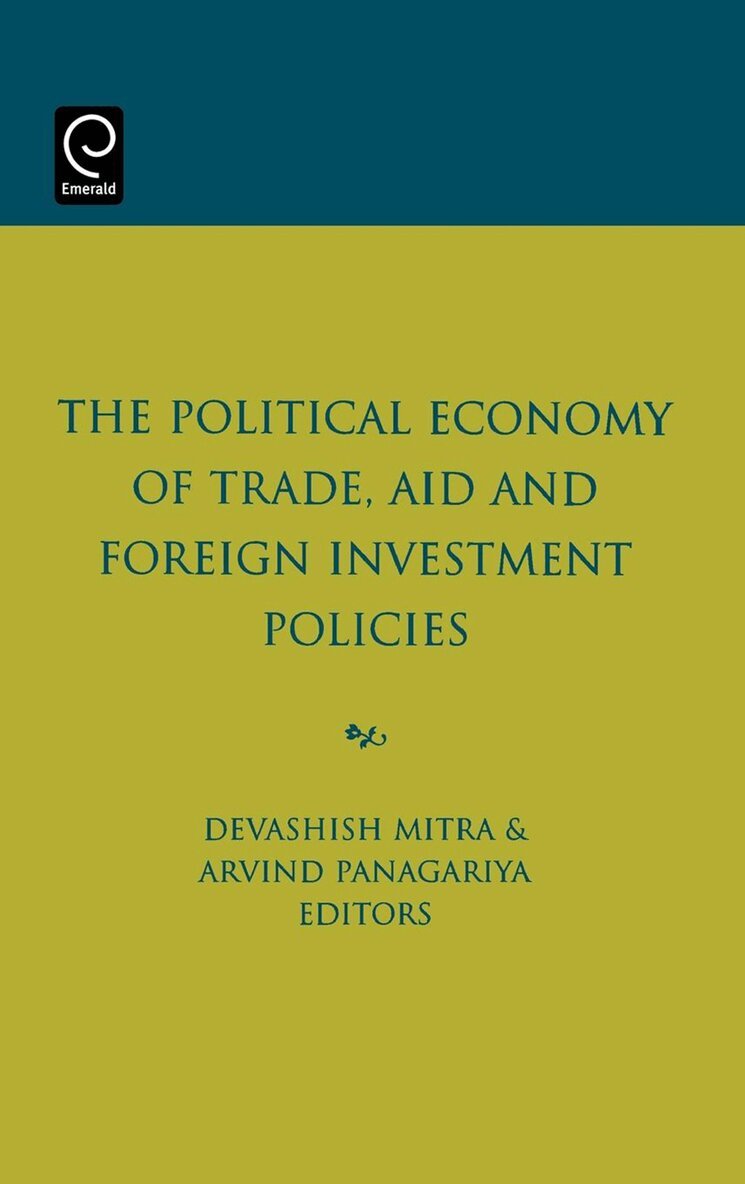
While considerable progress has been made in analyzing the formulation of international economic policies, the existing literature remains deficient in several respects. First, the existing models take a relatively simplistic view of the political-economy environment. For example, in contrast to the observed reality, a large majority of the models view the government as a monolithic entity. Second, there is only limited recognition of the political-economy interactions between interest groups across national borders. Third, dynamic factors governing trade policy formulation have been essentially absent in the literature. Fourth, the empirical work in this area, both cross-industry within national boundaries and cross-national, is very much in infancy and in need of further development. Fifth, other aspects of international economic policy such as foreign aid and foreign direct investment have been scarcely addressed in the existing literature. In this volume, edited by Devashish Mitra and Arvind Panagariya, a group of distinguished scholars in international trade, especially from the younger generation, analyzes several of these important but neglected aspects of the political economy of international economic policy. The volume contains 12 essays topped by an introduction by the editors. The contributors to this volume are Alok Bohara, Carl Davidson, David Feldman, Kishore Gawande, Amy Glass, Omer Gokcekus, Keith Hall, William Kaempfer, Justin Knowles, Pravin Krishna, Phil Levy, Chris Magee, Steve Matusz, Wolfgang Mayer, John McLaren, Devashish Mitra, Alex Mourmouras, Doug Nelson, Arvind Panagariya, Martin Richardson, Martin Ross, Kamal Saggi and Ed Tower. The volume makes major advances in the area of political economy of trade, aid and investment policy, and therefore will be of considerable interest to academic researchers and students of international economics. Because of its obvious focus on the process of policy formulation, economists as think tanks, international institutions such as the World Bank, International Monetary Fund and World Trade Organization, and trade-policy analysts in developed and developing countries will also read it.
Häftad, Engelska, 1996
569 kr
Skickas inom 7-10 vardagar
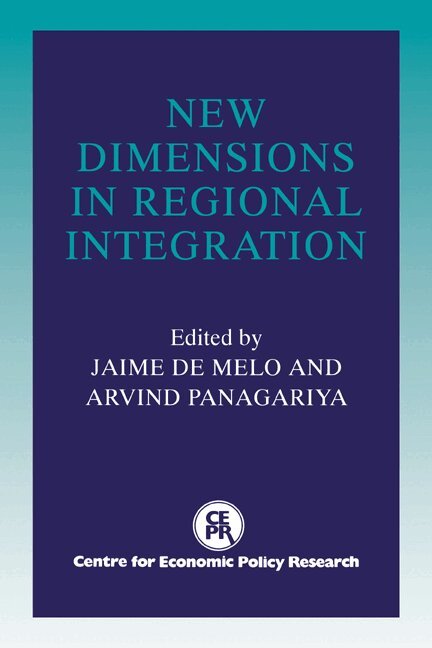
Interest in regional integration has recently revived in both developed and developing countries. The US has responded to the lack of progress in the Uruguay Round of the GATT by pursuing bilateral trade negotiations, while developing countries have been prompted to re-evaluate the potential benefits of regional integration. The tendency for the world trading system to divide into three blocs - the European Community, the Americas and East Asia - is providing their members with guaranteed access to large markets; however, poor non-member countries will suffer from the loss of access and the risk of trade wars is increased. In this book leading international experts assess the renewed attractiveness of regional integration to individual countries, the types of integration that are suitable to various circumstances, the conditions necessary to their success, and the relationship of regionalism to multilateral free trade.
Häftad, Engelska, 2004
443 kr
Skickas inom 10-15 vardagar
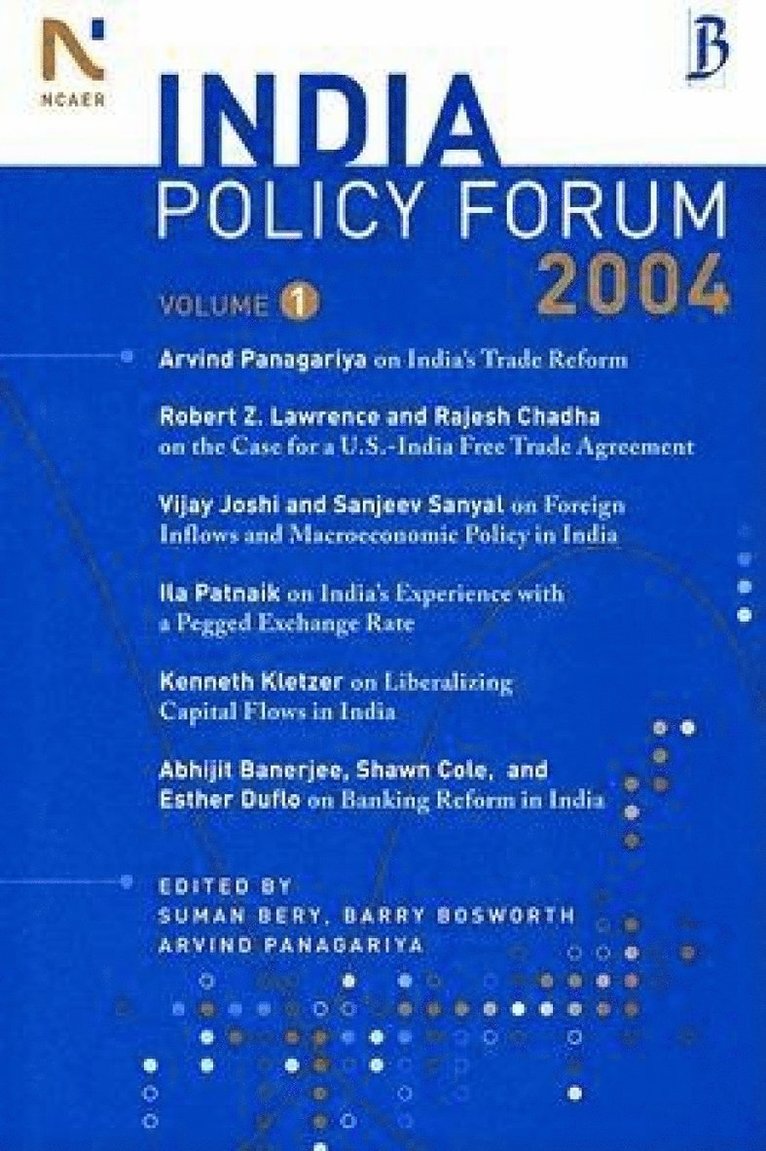
The India Policy Forum (IPF) is a new annual publication dedicated to research on the contemporary Indian economy. It provides a forum for addressing the scope, speed, and desirability of economic reforms within India and their fundamental impacts on the country's social and economic welfare. The IPF aims to nurture a global network of scholars interested in India's economic transformation. A joint publication of the National Council of Applied Economic Research in India and the Brookings Institution in the United States, the IPF provides a bridge between researchers in India and abroad. This inaugural issue contains highlights from a conference held in New Delhi in March 2004. Topics include: India's Trade Reform: Progress, Impact, and Future Strategy Should a U.S.-India Free Trade Agreement Be Part of India's Trade Strategy? Foreign Inflows and Macroeconomic Policy in India India's Experience with the Implementation of a Pegged Exchange Rate The Challenges for Capital Account Convertibility in India Banking Reform in India
Häftad, Engelska, 1996
182 kr
Skickas inom 5-8 vardagar
This volume explores the claims of proponents of free-trade areas and analyzes two principal initiatives associated with recent US trade policy: NAFTA and APEC. The authors conclude that the US should reject preferential trading in favour of the more beneficial goal of non-preferential trading.
Häftad, Engelska, 2018
762 kr
Skickas inom 10-15 vardagar
An outstanding work, written to celebrate the seventieth birthday of Jagdish Bhagwati; the foremost defender of free trade and its role in developing economies in the world today, this rigorously academic and critical volume represents an important contribution to the understanding of many aspects of globalization. The editors, affiliated with four of the leading economics departments in the USA bring together a stellar line of contributors from across the world to discuss the themes and arguments raised by Bhagwati’s latest work.A renowned professor of economics and regarded as one of the foremost international trade economist of modern times, Jagdish Bhagwati has written or edited over forty books including In Defence of Globalization and Free Trade Today as well as being the founding editor of Economics and Politics and The Journal of International Economics. A tribute to the great intellectual accomplishments and the inspiration that Jagdish Bhagwati provided to the field during his prolific and influential career, this book is a must read for all students and academics studying or working in international trade and development economics.
Häftad, Engelska, 2014
200 kr
Skickas inom 5-8 vardagar
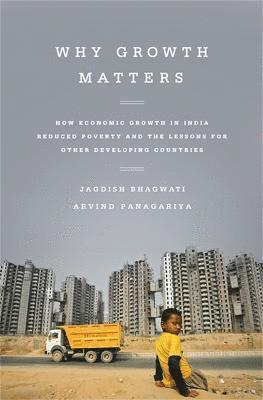
In its history since Independence, India has seen widely different economic experiments: from Jawharlal Nehru's pragmatism to the rigid state socialism of Indira Gandhi to the brisk liberalization of the 1990s. So which strategy best addresses India's, and by extension the world's, greatest moral challenge: lifting a great number of extremely poor people out of poverty?Bhagwati and Panagariya argue forcefully that only one strategy will help the poor to any significant effect: economic growth, led by markets overseen and encouraged by liberal state policies. Their radical message has huge consequences for economists, development NGOs and anti-poverty campaigners worldwide. There are vital lessons here not only for Southeast Asia, but for Africa, Eastern Europe, and anyone who cares that the effort to eradicate poverty is more than just good intentions. If you want it to work, you need growth. With all that implies.
Häftad, Engelska, 2024
204 kr
Skickas
Inbunden, Engelska, 2016
776 kr
Tillfälligt slut
Inbunden, Engelska, 1999
922 kr
Tillfälligt slut
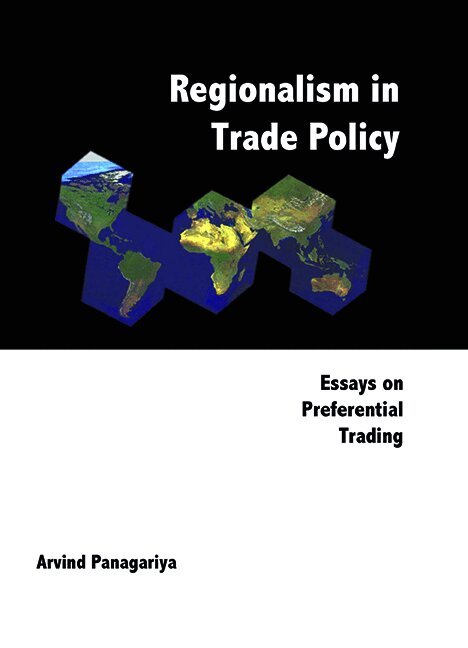
The signing of the North American Free Trade Agreement (NAFTA) and recent expansions of the European Union have led to renewed efforts to create preferential trade areas (PTAs) around the world including Asia, Africa and Latin America. Because PTAs liberalize trade with union members but not the rest of the world, they are not necessarily a healthy development. By dividing the world into trade blocs, they also threaten to undermine the multilateral trading system.This collection of recently published essays by a leading critic of regionalism offers an assessment of the economic impact of PTAs on member countries and the world. The first set of essays present a theoretical analysis of the issues using simple economic models, and study the relationship between regionalism and multilateralism. Subsequent essays evaluate the role of PTAs in Asia, North America and Latin America. The general theme of the book is that, on balance, trade liberalization through PTAs is a mistake. Trade diversion, and the creation of complicated and discriminatory tariff regimes with increased tariffs for non-member countries — the consequences of PTAs — are likely to undermine the multilateral trading system.The book will be useful to academics as well as policy makers and policy analysts. Many of the essays have been featured in newspapers and journals such as the Financial Times, Economist, Journal of Commerce and International Herald Tribune. Some of these essays are already on many reading lists in the United States.
Häftad, Engelska, 1999
576 kr
Tillfälligt slut
The signing of the North American Free Trade Agreement (NAFTA) and recent expansions of the European Union have led to renewed efforts to create preferential trade areas (PTAs) around the world including Asia, Africa and Latin America. Because PTAs liberalize trade with union members but not the rest of the world, they are not necessarily a healthy development. By dividing the world into trade blocs, they also threaten to undermine the multilateral trading system.This collection of recently published essays by a leading critic of regionalism offers an assessment of the economic impact of PTAs on member countries and the world. The first set of essays present a theoretical analysis of the issues using simple economic models, and study the relationship between regionalism and multilateralism. Subsequent essays evaluate the role of PTAs in Asia, North America and Latin America. The general theme of the book is that, on balance, trade liberalization through PTAs is a mistake. Trade diversion, and the creation of complicated and discriminatory tariff regimes with increased tariffs for non-member countries — the consequences of PTAs — are likely to undermine the multilateral trading system.The book will be useful to academics as well as policy makers and policy analysts. Many of the essays have been featured in newspapers and journals such as the Financial Times, Economist, Journal of Commerce and International Herald Tribune. Some of these essays are already on many reading lists in the United States.